
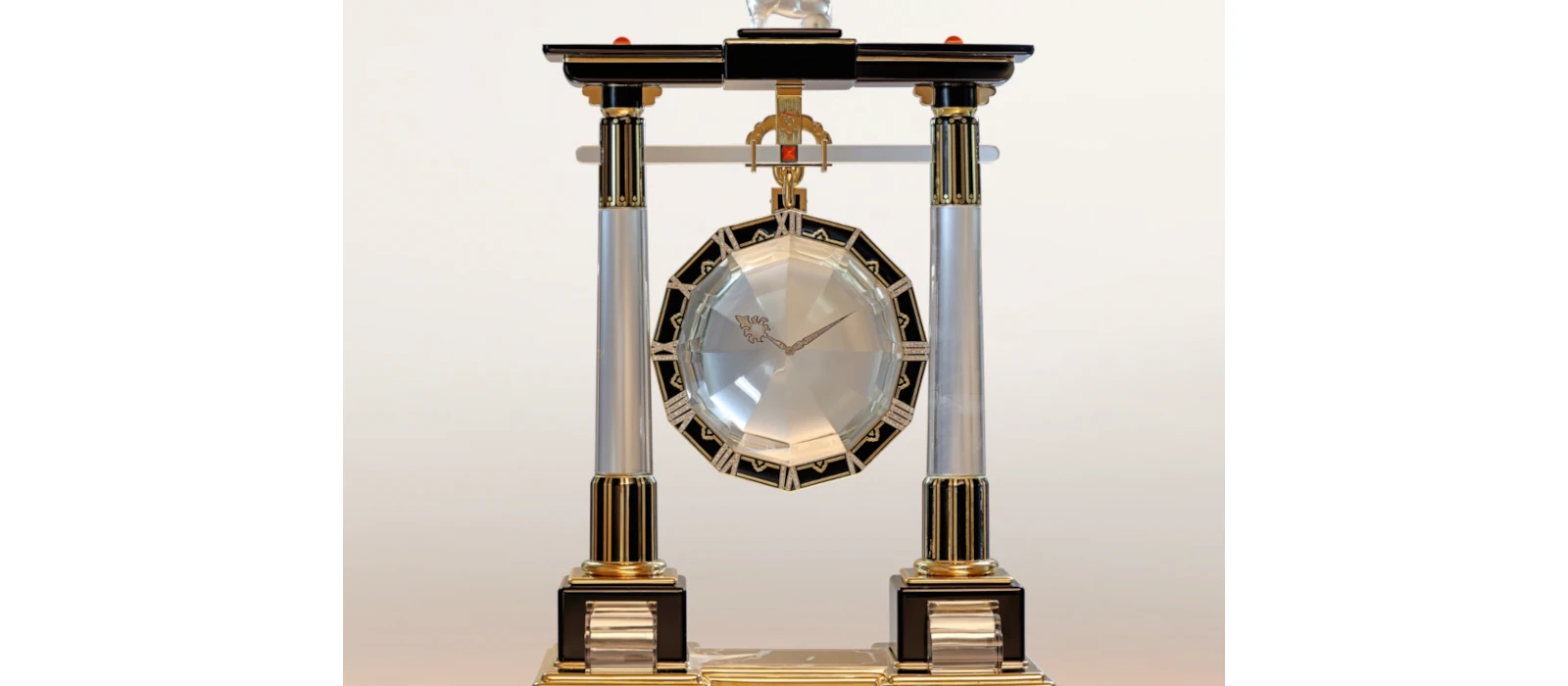
A masterpiece of early 20th-century horology is set to resurface after decades in private hands. Sotheby’s has announced that an early 1923 Cartier Portico Mystery Clock will be offered at its Important Watches Live Sale in Geneva on November 9, 2025. Estimated between 3 million and 5 million CHF, the timepiece was exhibited during the recently held Geneva Watch Days.
“This is a landmark moment in the world of horology and in collectors’ circles given how extraordinarily rare Cartier Portico Mystery Clocks are at auction. To present this 1923 model, one of the earliest in the six-strong series ever created, for the first time in nearly fifty years is not only a privilege but also an event of remarkable importance, especially to international collectors,” said Sam Hines, Sotheby’s Global Chairman, Watches.

This Portico Mystery Clock is one of only six known examples produced between 1923 and 1925. It has remained with the same family since 1978. A 1924 Portico Mystery Clock was auctioned by Phillips in May 2025 for CHF3,932,000.
Cartier introduced its first mystery clock in 1912 with the Model A, designed by horologist Maurice Couët. The hands appeared to float on a transparent dial, concealing the mechanism within the base. The idea itself dated back nearly a century earlier, when French illusionist-turned-watchmaker Jean-Eugène Robert-Houdin created clocks that disguised their inner workings in ways that mirrored his stage acts, an approach so influential that Harry Houdini later adopted Robert-Houdin’s name as a tribute.
Couët advanced the illusion for Cartier by using rock crystal instead of glass and later evolved the design for the Portico model. For this version, he hid the entire movement inside the dial, while designer Charles Jacqueau framed it with temple-inspired columns and Asian architectural motifs, blending technical ingenuity with stylistic innovation.
Among Cartier’s mystery clocks, the Portico holds a special significance. Its design drew on Art Deco influences and combined materials such as rock crystal, jade, onyx, mother-of-pearl, and precious stones. Beyond their rarity, the six clocks symbolize a period when Cartier redefined timepieces as objects of wonder and artistic expression.
This November, the 1923 Portico Mystery Clock will test its strength at Sotheby’s Geneva sale. As one of the earliest examples ever made, it represents a moment when horology crossed into decorative art, and it will now face the market for the first time in more than a quarter of a century.