

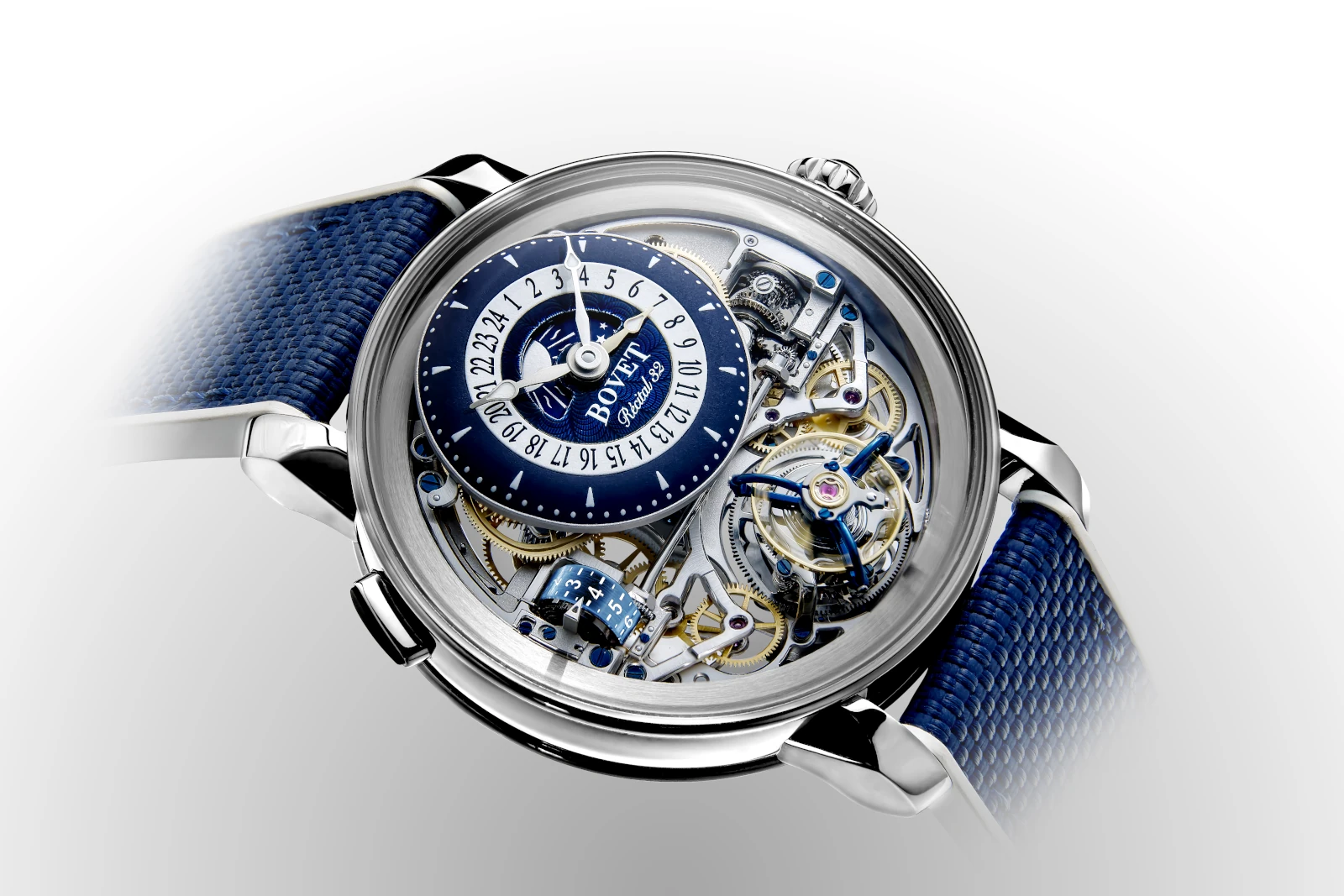
BOVET, the Swiss manufacture based in Tramelan, has unveiled two new references in its Récital collection, the Récital 31 and the Récital 32, both carrying significant technical additions to a catalog that already holds more than 70 industry awards since 2006.
Two watches, two very different problems solved. One takes on the perpetual calendar, a complication that has frustrated collectors for as long as it has impressed them. The other finally gives BOVET’s catalog something it has never had, a true GMT, and does it with a flying tourbillon inside a case smaller than anything the brand has attempted for this kind of movement.
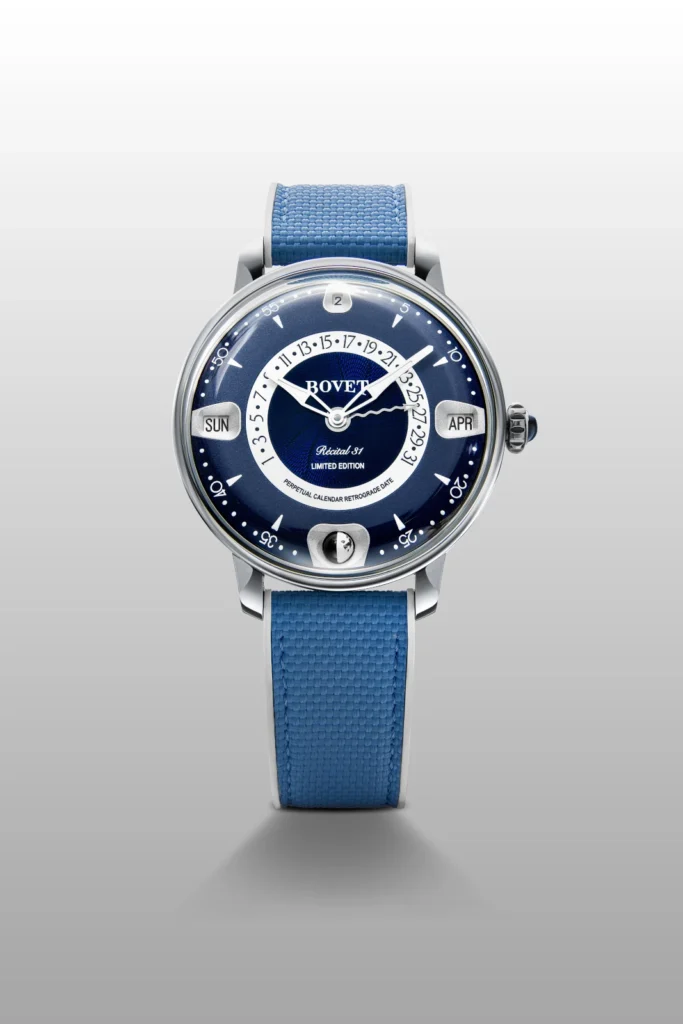
Starting with the Récital 31, BOVET has developed a 469-component in-house movement that combines a perpetual calendar, a retrograde date, and a spherical moon phase inside a 44mm Dimier case with a box sapphire crystal. The perpetual calendar is one of watchmaking’s most complex functions, capable of tracking the varying lengths of months and accounting for leap years across decades without manual correction. Getting all three indications into a single movement presented real challenges for BOVET’s technical office, particularly around space and available power.
A detail that stands out on the Récital 31 is the corrector pushers for the perpetual calendar and the moon phase, which are labeled and engraved directly on the case. Collectors have long dealt with unmarked correctors that require a manual to use correctly, and adjusting the wrong one is a common and occasionally costly mistake. BOVET has removed that problem entirely.
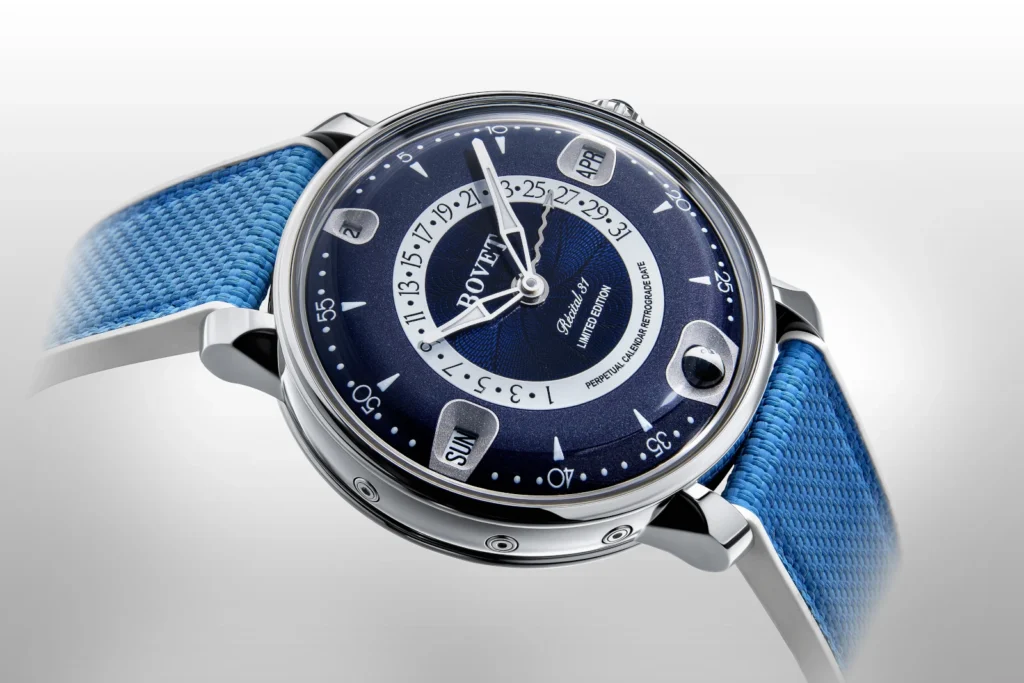
“I have always been fascinated by perpetual calendars; it is one of the most beautiful complications in watchmaking history. I wanted to develop a 100% in-house movement with a spherical moon phase and a clear, intuitive display for all the indications, so that this complication could become truly practical for everyday use. We continue to defend art, beautiful guilloché, and hand-engraving. The Récital 31 is a substantial timepiece, designed with both poetry and precision in mind,” said Pascal Raffy, owner of the brand.
BOVET has paired spherical moon phases with perpetual calendars before, but only within larger Grand Complications. A spherical moon phase also appeared alongside an annual calendar in the Récital 20 Astérium, which won the Calendar and Astronomy Award at the GPHG. The Récital 31 marks the first time this moon phase has been paired with a perpetual calendar on its own. Raffy has also noted that the design direction of the Récital 31 continues the evolution initiated by the Récital 30, a reference in whose design his children, Audrey, Alexandra, and Amadéo, played a big role.
Every component in the movement is hand-finished. A new engraving motif called étoiles carrées, which translates to square stars, was created specifically for the Récital 31 and the Récital 32. Engraving the movement alone takes more than 15 hours, carried out entirely at BOVET’s in-house atelier in Tramelan. More than 95% of all components across BOVET’s watches are produced at this facility, a standard Raffy has been building toward since he acquired the manufacture in 2006. There are no assembly lines anywhere in the manufacture or castle.
In the BOVET Récital 32, the watchmaker continues its long-standing tradition of producing watches designed to work with different time zones. As evidenced by their prior releases including the Récital 28 Prowess One which offered a solution for daylight savings time and Récital 27 that offered solutions for three time zones, BOVET has established itself as a company that creates innovative watches in this category. Still it wasn’t until now that a simple GMT watch would be included within the BOVET catalogue
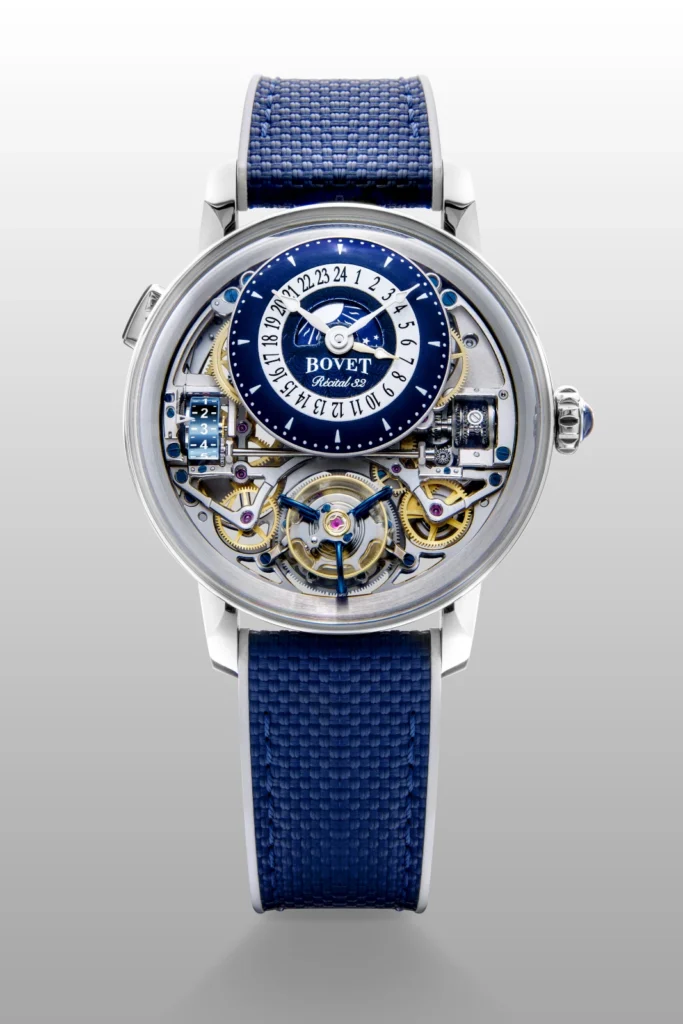
Raffy’s condition for the Récital 32 was size. BOVET’s tourbillon watches have traditionally required larger cases to accommodate the movement. The Récital 28 runs at 46.3mm and carries 744 components. The Virtuoso VIII uses a 44mm case with 356 components. For the Récital 32, BOVET’s engineers placed a 375-component manufacture movement, a flying tourbillon, a GMT complication, and ten days of power reserve inside a 42mm case. To make this work, the patented flying tourbillon was elevated above the main plate, and a box sapphire crystal was used, which allows the tourbillon to be seen from the front and the side.
On the dial, local time is displayed at 12 o’clock with a blue guilloché day and night indicator around it. A 24-hour track runs the circumference of the dial for the independent GMT hand. A dedicated pusher at 10 o’clock moves the GMT hand forward one hour at a time. Ten days of power reserve comes from a single barrel, made possible by BOVET’s patented spherical winding system, which doubles the output of each crown rotation and is shown on a roller display.
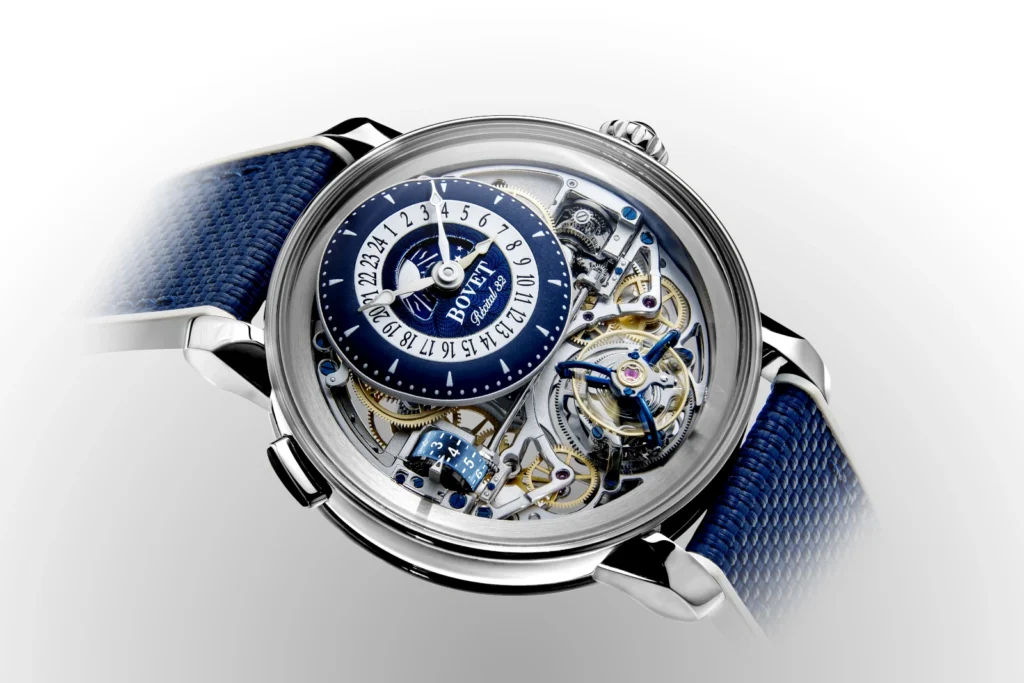
Two patents cover the watch, one for the flying tourbillon and one for the spherical winding system, both the result of two years of internal research and development. Setting the watch involves winding it fully, pulling the sapphire-cabochon crown to adjust local hours with the day and night indicator as a guide, and advancing the GMT hand through the dedicated pusher.
Every component in the Récital 32 is hand-finished, and the movement plates are completely hand-engraved with the étoiles carrées motif, a process that takes at least 15 hours. Eight layers of lacquer cover the offset domed guilloché dial.
Both the Récital 31 and the Récital 32 are available in grade 5 titanium or 18K red gold, across three color combinations each, with rubber straps matched to the dial color. Each variation is limited to 60 numbered pieces. BOVET has won more than 70 awards since 2006, including six GPHG prizes in the last eight years, among them the highest GPHG honor for the Récital 22 Grand Récital, and the Calendar and Astronomy Award at the GPHG for the Récital 20 Astérium.