


Sotheby’s New York will auction the personal collection of Maurice Tempelsman on June 24, 2026, in a sale titled A Marvelous Journey, spanning fine art, gold boxes, antiquities, and personal objects accumulated across eight decades by a man whose life moved between wartime refugee camps, postcolonial Africa, the diamond trade, and the most documented drawing rooms of 20th-century America.
Tempelsman was born in Antwerp in 1929 into a Jewish trading family. Antwerp was then, as now, the global center of the diamond trade, and the rhythms of international commerce shaped him early. He was 11 years old when the Germans invaded Belgium in 1940. His family fled through France, Spain, and Portugal before boarding the steamship Serpa Pinto in Lisbon, spent seven months at Camp Gibraltar in Jamaica, and were finally admitted to the United States.
By 16, he was already working in the diamond business with his father in New York. He eventually became chief executive of Lazare Kaplan International, the largest diamond company in the United States, a position that gave him access to political and economic power across multiple continents.
His professional network was genuinely unusual for a private collector. He traveled extensively across Africa, Russia, Latin America, and Europe, forging relationships with heads of state and liberation leaders across the postcolonial world. He helped organize Nelson Mandela’s first visit to the United States following his release from prison. He chaired the Africa-America Institute and the Corporate Council on Africa, sat on the International Advisory Council of the Harvard AIDS Institute, and was a director of the National Democratic Institute for International Affairs. He also served on the boards of the Woods Hole Oceanographic Institution, the Academy of American Poets, and the Institute of Fine Arts. Tempelsman was not a collector who drifted into institutional life. His life revolved across science, politics, literature, and art simultaneously.
He was also, for more than a decade, the last companion of Jacqueline Kennedy Onassis, a relationship that began as a friendship in the late 1950s when she was still the wife of Senator John F. Kennedy, and deepened into a close partnership after the death of her second husband, Aristotle Onassis, in 1975. They shared a Fifth Avenue apartment, holidays in Martha’s Vineyard, and a mutual love of art, literature, music, and the French language. He was at her side when she died in May 1994. At her funeral, he read C.P. Cavafy’s poem Ithaka, one of her favorites, and added his own line: “And now the journey is over, too short, alas, too short.”
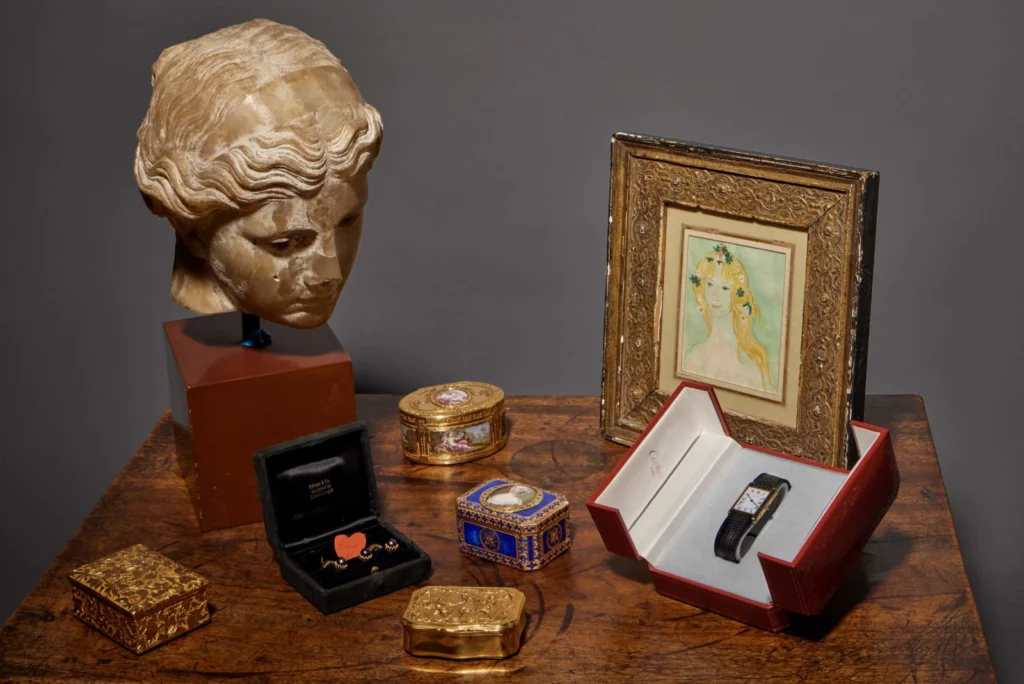
Objects connected directly to that relationship are now entering the market for the first time. A gold Cartier Tank wristwatch, estimated at $10,000 to $15,000, was given by Mrs. Onassis to Tempelsman on his birthday. Its caseback is engraved in her hand: For Maurice Love J 8/26/1985. It is offered in its original Cartier presentation box and has never previously been sold.
Cartier Tank watches have consistently held strong at auction over the past decade, with examples tied to significant ownership histories achieving well above their pre-sale estimates.
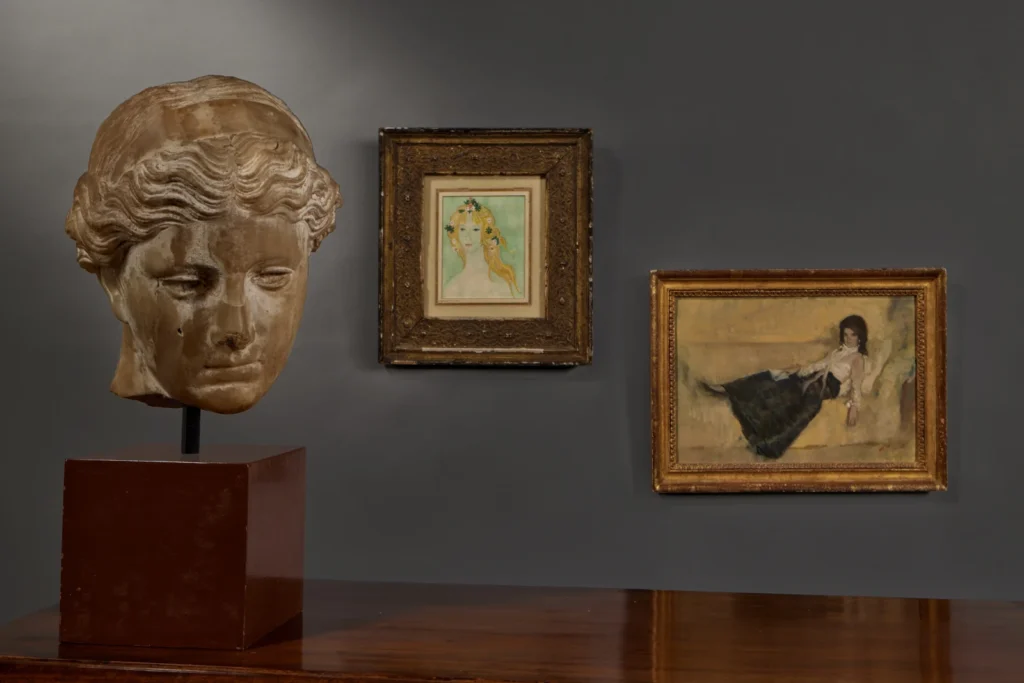
More historically loaded is a Greek alabaster head of a woman, estimated at $7,000 to $10,000. It is documented on the mantelpiece of the Yellow Oval Room of the White House in an August 1963 photograph. Mrs. Kennedy sent a memo to White House Chief Usher J.B. West specifically requesting a spotlight be installed above the mantel to illuminate it, noting that “the Pres. would like it.” It later appeared in a 1973 Vogue feature on her Park Avenue apartment. In her will, she left it to Tempelsman by name: “I give and bequeath to my friend Maurice Tempelsman, if he survives me, my Greek Alabaster head of a woman if owned by me at the time of my death.” Its estimate reflects the object on its own archaeological terms. Its final price will reflect its full history.
Sotheby’s has handled several high-profile Kennedy-adjacent sales over the years, most notably the 1996 estate auction of Jacqueline Kennedy Onassis herself, which generated $34.5 million against a pre-sale estimate of $4.6 million, a result driven almost entirely by personal association rather than art-market fundamentals. That precedent is directly relevant to how buyers are likely to approach the Tempelsman lots.
The top lot is a gold-mounted hardstone box made around 1770 by Christian Gottlieb Stiehl, court lapidary in Dresden, estimated at $600,000 to $800,000. Stiehl produced only ten such boxes across his entire career, and four are now held permanently in museum collections at the Louvre, the Palazzo Pitti, the Naturhistorisches Museum in Vienna, and the Thyssen-Bornemisza Collection.
This example last appeared at public auction in Paris in 1906; was documented once more in 1935 through a single black-and-white photograph; and then disappeared from public view entirely. Tempelsman acquired it in the 1960s. Its surfaces are inlaid in Zellenmosaik, a technique in which polished hardstone specimens, agates, carnelians, sardonyx, white opal, and petrified wood from the Ore Mountains of Saxony, are fitted within gold borders less than a millimeter wide. Held to the light, the effect reads like stained glass.
A secret compartment in the base, activated by pressing one of the opal inlays, conceals a handwritten bilingual booklet in French and German cataloging every stone on the box and its exact place of origin. It is an object that sits precisely at the intersection of scientific inquiry and luxury craft that defined Enlightenment-era Dresden.
Alexandra Starp, Sotheby’s Head of Vertu and Gold Boxes, said, “I have seen a great many gold boxes in my career, but when I first encountered this one, I could hardly believe my eyes. I had known it only from a black-and-white image in the reference literature, a single illustration from nearly a century ago, with no record of its colors, the delicacy of the carefully chosen hardstones or just how magnificent it is in person. To have a Stiehl Steinkabinett of this quality and condition reappear in public after nearly a century is a true discovery. It is not only an object of breathtaking beauty, but a masterpiece rooted in history and science that transcends the boundaries of any single collecting category.”

Robert Frederick Blum’s Entrance to the Grand Canal, Venice, 1881-85, estimated at $300,000 to $500,000, has been off the market since January 1917, when it sold at The Walpole Galleries. Blum visited Venice six times during the 1880s and regarded the city as among the defining subjects of his career. His two highest auction results have both come from Venetian works, and this painting reflects the direct influence of James Abbott McNeill Whistler on his approach. It has been in the Tempelsman collection for more than two decades.
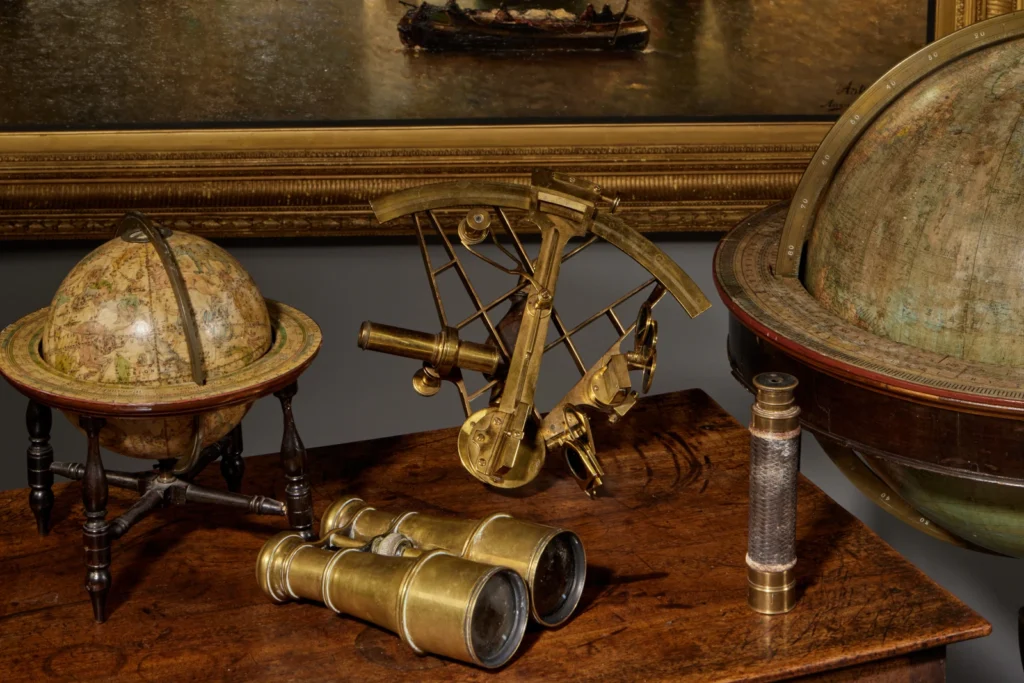
Tempelsman grew up in Antwerp’s port environment and later served on the board of the Woods Hole Oceanographic Institution. A large-scale marine painting by Montague Dawson, Ship in a Storm, estimated at $80,000 to $120,000, has been in the collection since 1960. Dawson remains the most commercially consistent marine painter of the 20th century, and large dramatic works of this scale represent the strongest segment of his market.
A Roman-period Egyptian gold snake armlet, estimated at $20,000 to $30,000, is fashioned as a coiled serpent designed to be worn high on the upper arm. It dates to circa 1st century B.C. to 1st century A.D., a period when Egyptian, Hellenistic, and Roman visual traditions were actively merging in the Nile Delta. Comparable pieces are held by the Metropolitan Museum of Art, the Louvre, and the J. Paul Getty Museum.
Dennis Harrington, Sotheby’s Head of European Furniture, said, “Maurice Tempelsman was a collector of extraordinary breadth and genuine intellectual seriousness. What strikes you, looking at this collection as a whole, is how naturally it coheres, not around a single period or category, but around a sensibility. Every object in this collection reflects a man who looked carefully, collected with real conviction, and lived with beautiful things in a way that enriched everyone around him. It is a privilege to bring his collection to market, and to share the story of his remarkable life with collectors around the world.”
Tempelsman died on August 23, 2025, three days before his 96th birthday. A Marvelous Journey preview runs from June 17 to 23 at Sotheby’s New York, with the live auction on June 24 at 10am.