
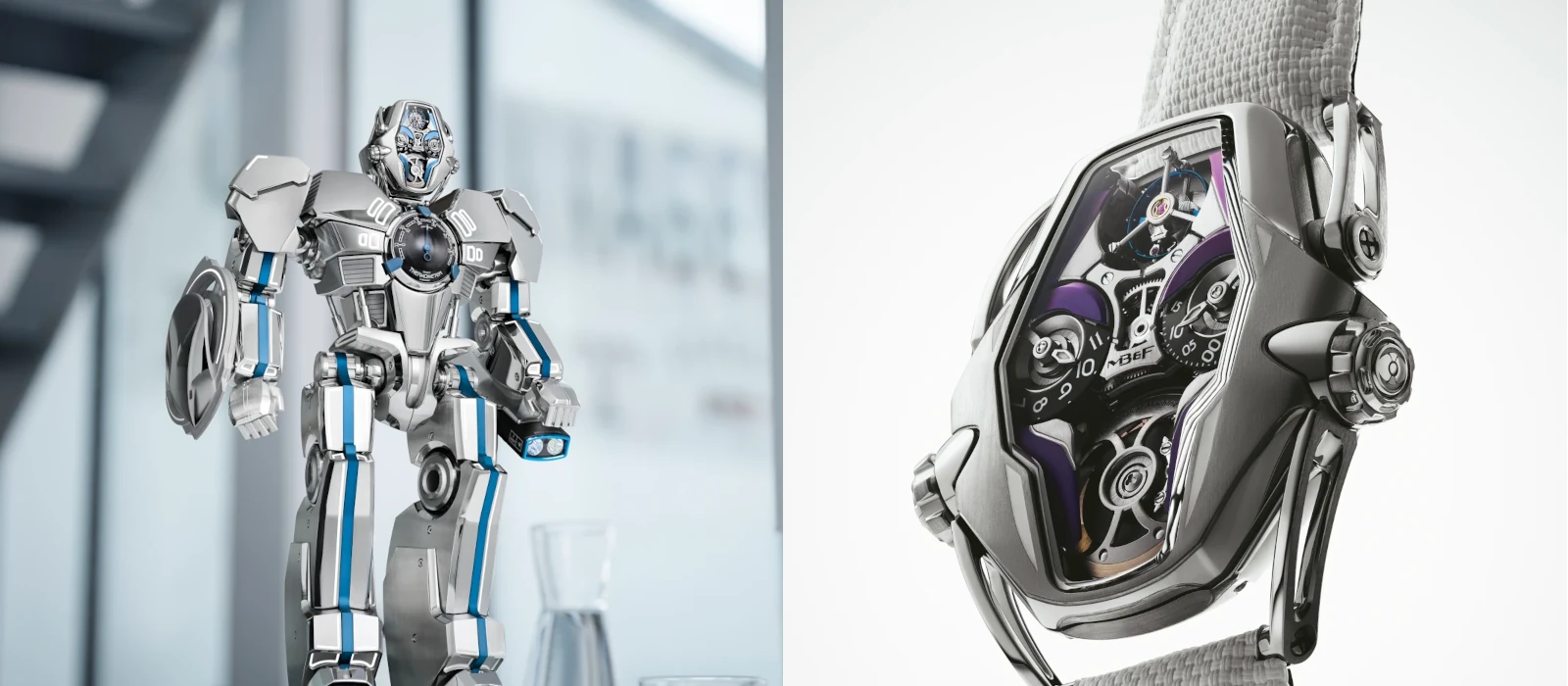
Geneva-based independent watchmaker MB&F has launched HM12 The Guardian, a mechanical duo combining a wristwatch and a 38cm-tall robot into a single unit containing nearly 1,500 components.
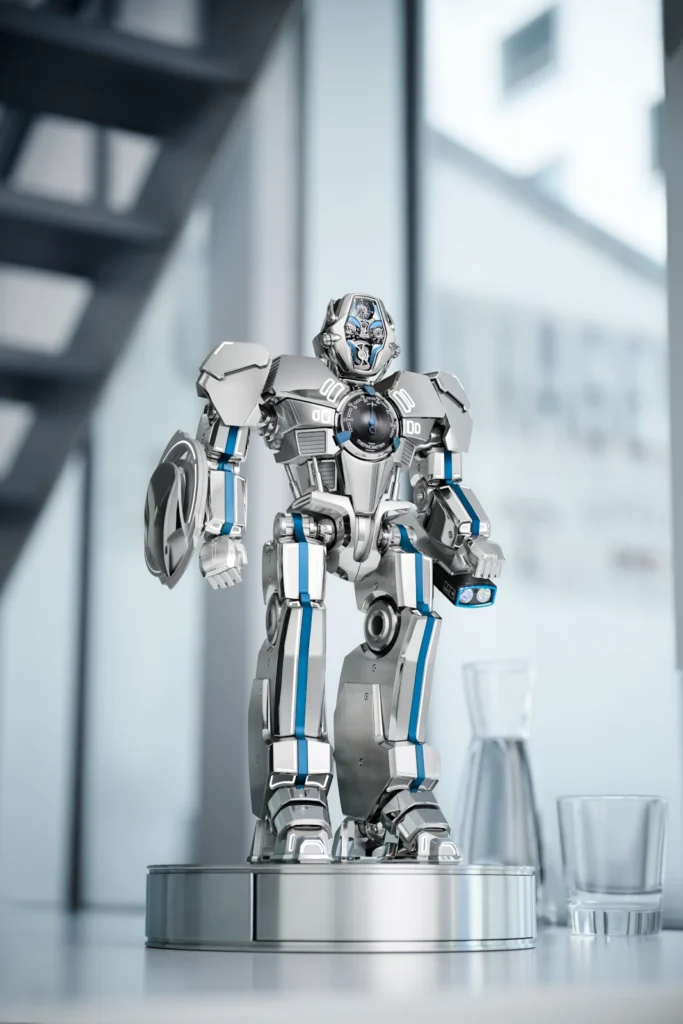
HM12 The Guardian began as a project to mark MB&F’s 20th anniversary. Development ran longer than expected as its overall scope grew into a statement about the start of their third decade of business. The purpose of the project was changed from an anniversary to a new product deposition.
The concept splits across two objects. HM12 is a wristwatch that serves as the head of a robot. The Guardian is the body built around it. Together, via a clip-on mounting system, they form a single mechanical unit. The strap detaches via a quick-release system, and the watch mounts directly onto the robot’s head. The strap is stored in a hidden drawer built into the robot’s base.
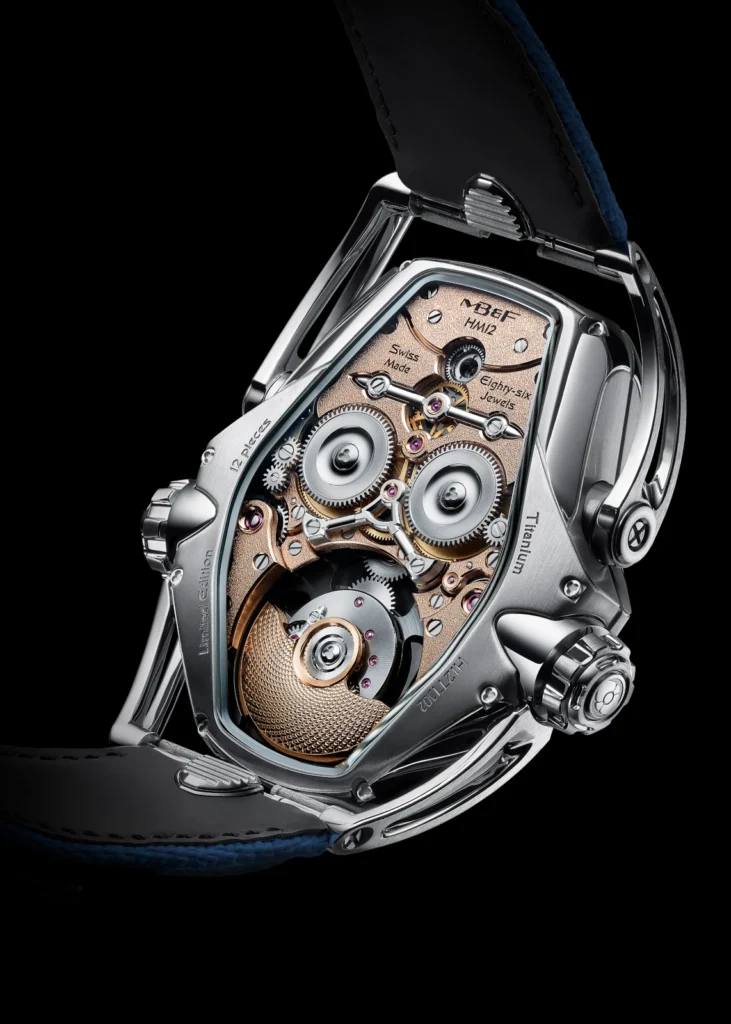
HM12’s calibre was developed entirely in-house by MB&F and runs to 646 components, most of them hand-finished, with 86 jewels and an 84-hour power reserve. It carries a flying tourbillon, jumping hours on the left, and trailing minutes on the right, both read on rotating discs. A double-sided micro-rotor shaped like the MB&F battle-axe handles winding. Much of the case is sapphire crystal, which allows light to reach the tourbillon from several directions, visible both from the front and through the sides of the case.
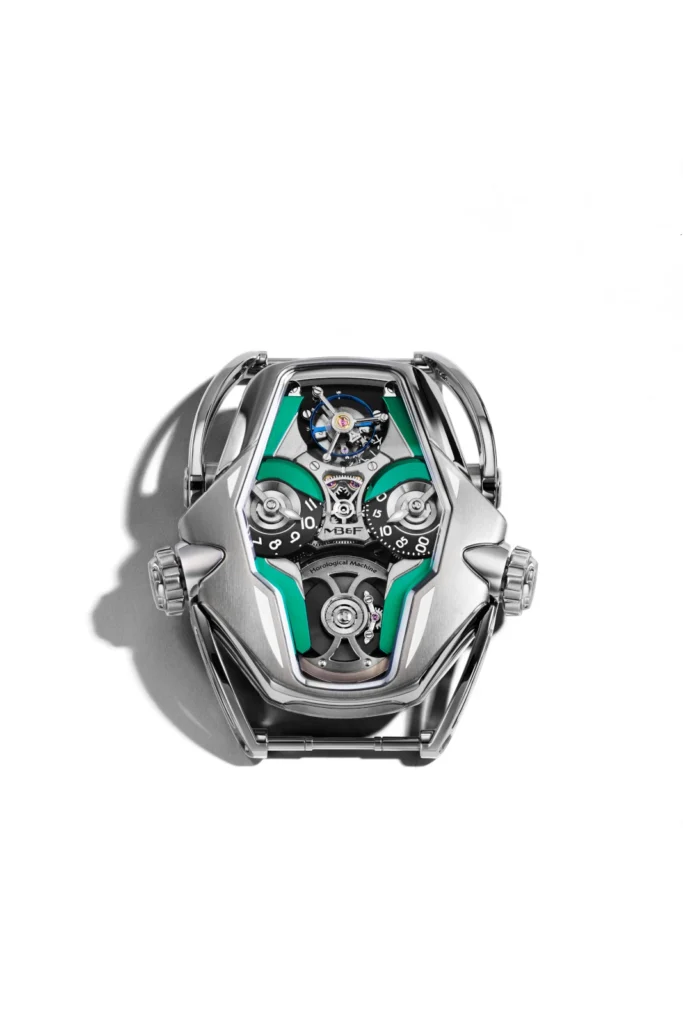
HM12 is designed to read as a face. The time display occupies where the eyes would be. The micro-rotor sits where the mouth would be. The tourbillon is positioned at the top, exposed, functioning as the brain of the robot.
The back of the watch follows a different approach. Curved bridges, hand-finished surfaces, a grained mainplate, and a guilloché dome on the rear rotor. The guillochage on that dome was executed with the involvement of independent watchmaker Kari Voutilainen and his team, a technically demanding exercise because the surface is curved and spherical rather than flat. Voutilainen’s workshop in Môtiers is widely associated with some of the most exacting hand-finishing in independent watchmaking.
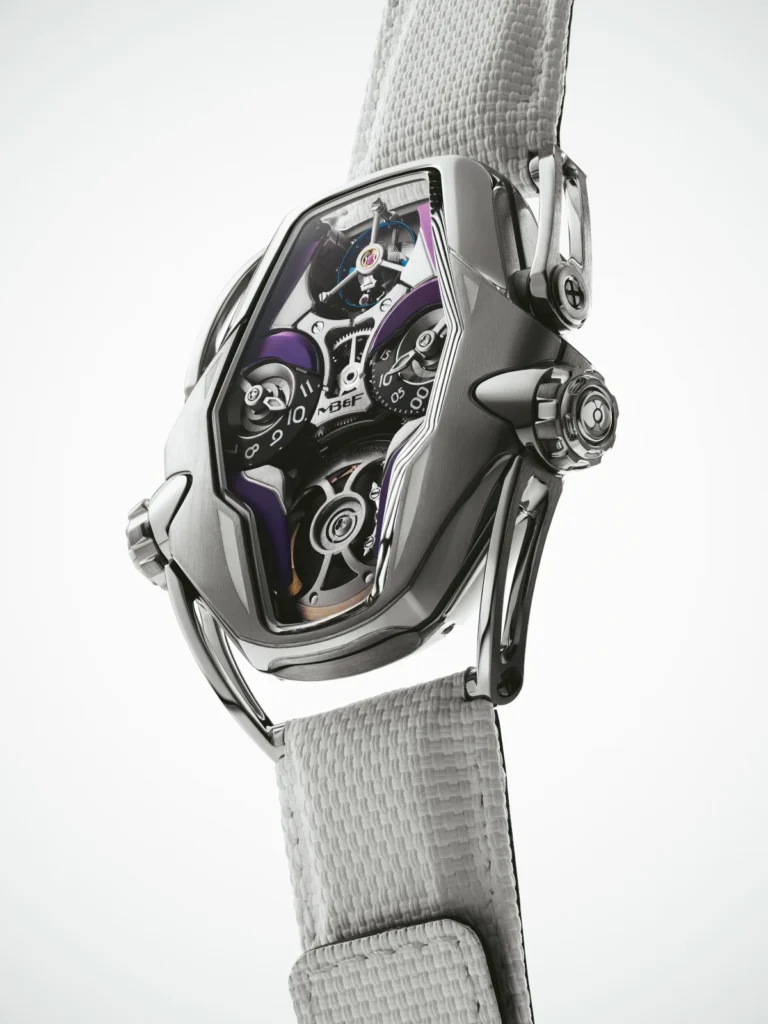
HM12’s face shield system is one of its most complex features. A set of mechanical shields, operated by the left crown, slides across the dial. The wearer can stop at any point in the travel, from fully open to fully closed, controlling how much of the watch’s face is visible. The crown declutches automatically once the shields reach their end position. Over 200 components are dedicated to this function alone, and the system runs independently from the timekeeping movement.
Two engineers worked in parallel throughout development, one on the movement and one on the shields, coordinating to avoid conflicts in space, mechanics, and function.
HM12 is the first Horological Machine conceived entirely by the creative partnership of MB&F founder Maximilian Büsser and designer Maximilian Maertens. For 20 years, MB&F’s Horological Machine line was designed in collaboration with designer Eric Giroud, who continues to be involved in various projects at MB&F.
Maertens had previously contributed to the brand’s clock and music box collaborations with L’Epée 1839 and Reuge. HM12 is his first full lead on a wristwatch. Büsser put forward the initial concept, “what if a robot’s head were a watch?”, and Maertens took the project from there, spending four years working through drawings, 3D models, printed prototypes, and structural adjustments.
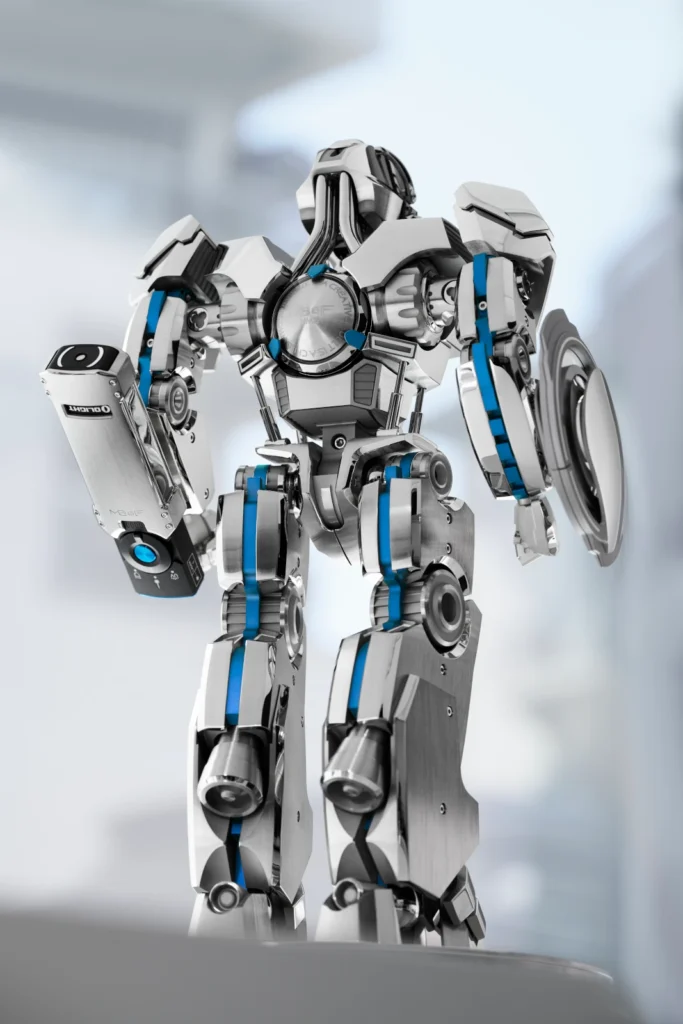
L’Epée 1839, MB&F’s long-standing partner in mechanical objects, built The Guardian. It contains 755 components. L’Epée has collaborated with MB&F since 2011, producing mechanical clocks and figures including Melchior, the robot-clock released in 2015 that first brought robot imagery into MB&F’s co-creation work.
One arm of The Guardian holds a shield with a loupe calibrated to inspect the movement. The other arm carries a detachable torch with UV capability, designed to activate the Super-LumiNova on both the watch and the robot. A mechanical thermometer occupies the robot’s chest.
Büsser has pointed consistently to the science fiction imagery of the 1970s and 1980s, a period when machines in popular culture were imagined as characters, explorers, and guardians rather than tools. Maertens brings a different generation of references, such as Transformers, animated series, and films like I, Robot, where robots are adaptive and take on more complex roles. HM12 was shaped by both sets of references simultaneously.
HM12 The Guardian is produced in three colours, blue, purple, and green, with 12 pieces produced per colour. There are only 36 pieces in total, with no further production planned, priced at US$ 384,000.