
Jewels that once adorned the Russian Imperial court, pieces directly tied to Catherine the Great and Emperor Nicholas II, are coming to public view for the first time in nearly 100 years. Sotheby’s New York will offer them at auction on June 17, in a sale titled Artistic Luxury: Fabergé, Gold Boxes, Silver & Ceramics, the house’s first auction in this category, running alongside its broader Luxury Week programming.
Russian Imperial decorative arts have held strong at auction over the past decade, with Fabergé pieces in particular drawing serious collector interest globally. This sale brings something rarer than the usual single-lot offering. It presents a documented, historically traceable group of pieces spanning two Imperial reigns, with paperwork and photography going back to the early Soviet period.
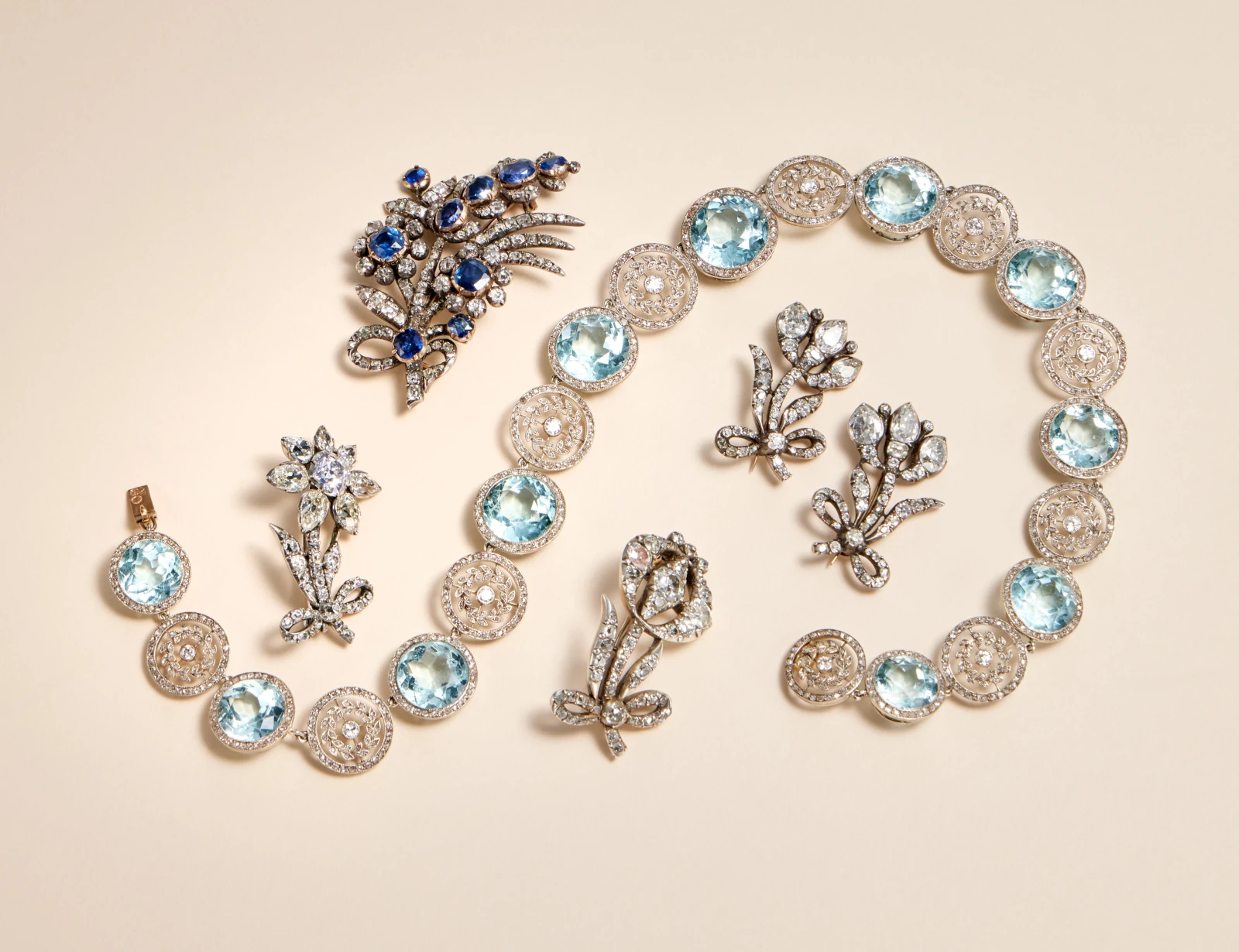
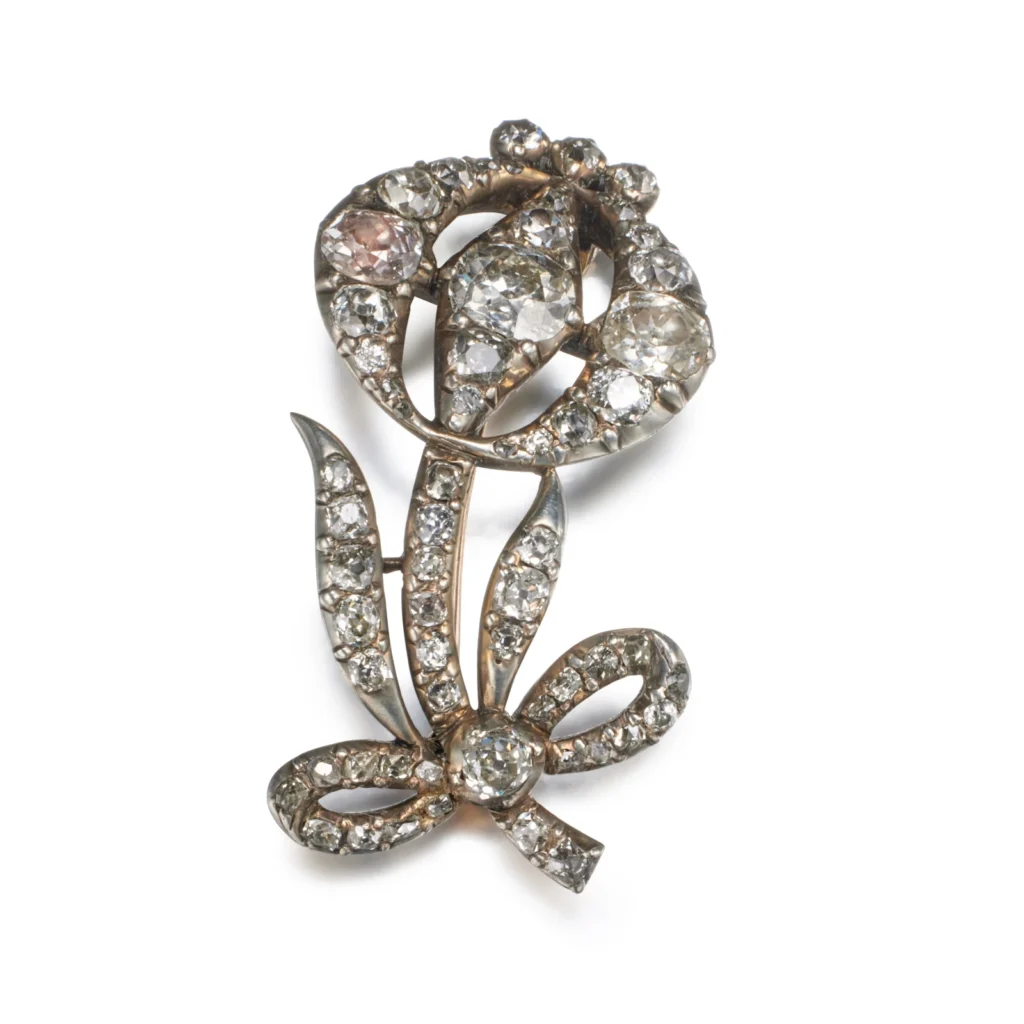
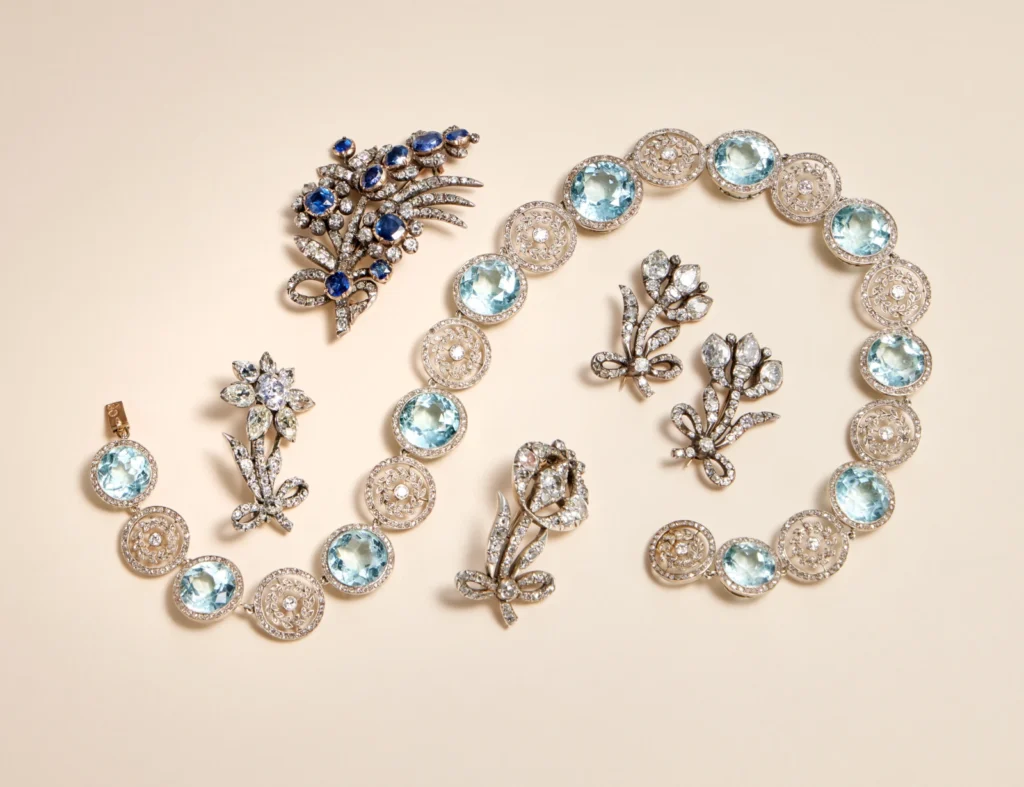
Catherine the Great’s relationship with diamonds was not purely personal. During her reign from 1762 to 1796, she used jewelry as a tool of statecraft, building a court designed to rival Versailles and expanding the Imperial jewelry collection by approximately 40%. Four diamond-set flower dress trimmings from that era are among the highlights of this sale. Three are attributed to Louis David Duval of Geneva, one of Catherine’s principal jewelry suppliers, dating to around 1780, formed as ribbon-tied flowers set with old-cut diamonds mounted in silver. These were worn directly onto the fabric of the imperial gown, creating what contemporaries described as mesmerizing points of glitter across her attire. Estimates sit at $60,000 to $80,000 for a pair, $40,000 to $60,000, and $30,000 to $50,000 respectively.
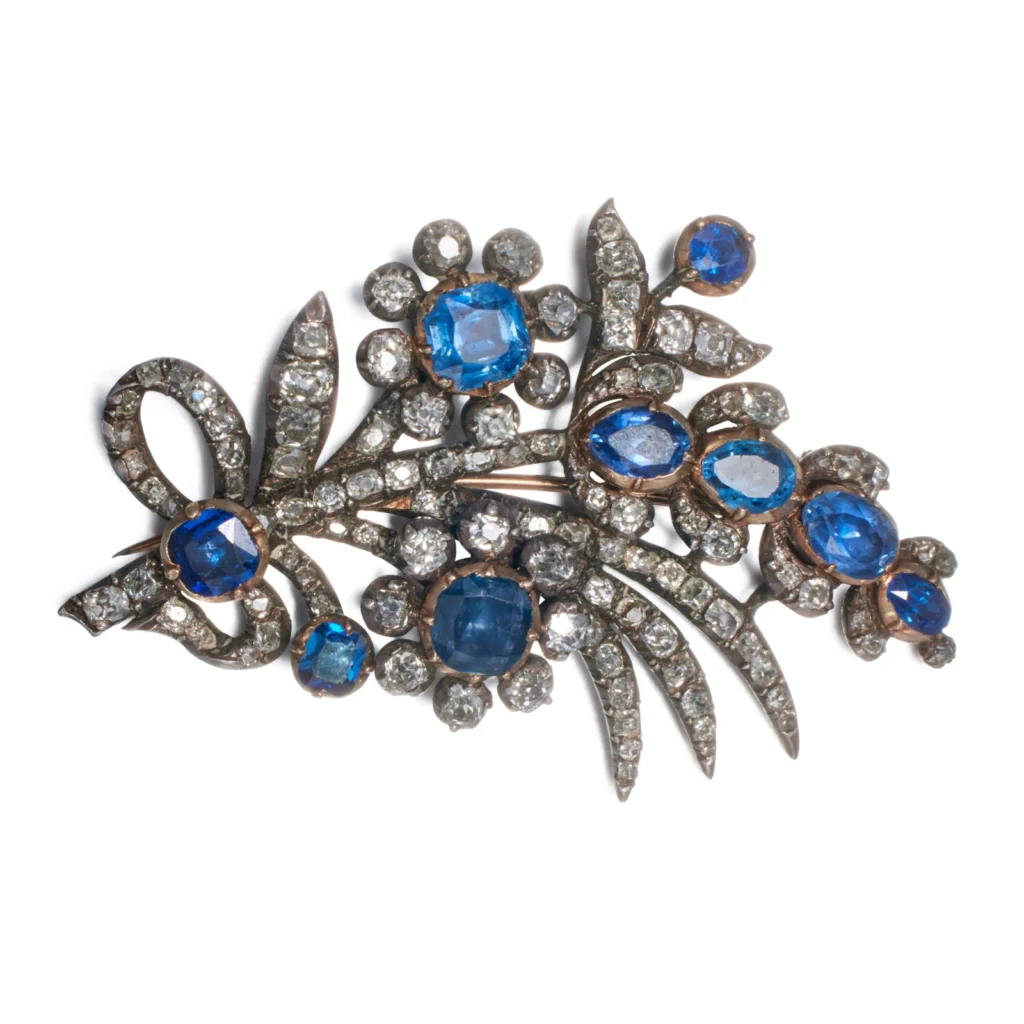
A fourth and older piece dates to Catherine’s predecessor, Empress Elizabeth Petrovna, who reigned from 1741 to 1762. Composed of diamonds and Ceylon sapphires mounted in gold foil, it depicts sprays of wheat and cornflowers and is notably larger in scale than the Catherine trimmings. Estimated at $40,000 to $60,000, it represents an era known for producing pieces of beauty from relatively modest materials.
These trimmings were stored in Catherine’s ‘Brilliant Room’, the former Imperial bedchamber in the Winter Palace converted specifically to house her diamond collection. Both Empress Maria Feodorovna and Empress Alexandra Feodorovna are documented wearing these same pieces in surviving photographs, placing them at the center of Imperial life across multiple generations.
After 1917, the Bolsheviks seized the Crown Jewels from the Winter Palace and transferred them to the Moscow Armoury Hall. In 1922, facing a shattered economy, the Soviet government commissioned a full inventory of what it held. Professor A. E. Fersman, a mineralogist and member of the Soviet Academy of Sciences, led a team that spent nearly four months cataloguing and photographing the collection. Their work produced Russia’s Treasure of Diamonds and Precious Stones, published between 1925 and 1926, the definitive illustrated record of the Imperial jewels. All four trimmings in this sale are documented in that catalogue.
In 1927, a portion of the collection was sold at Christie’s London to raise reconstruction funds for the Soviet state. These pieces surfaced shortly after at S.J. Phillips in London, where the present owner’s family acquired them. They have remained in private hands ever since.
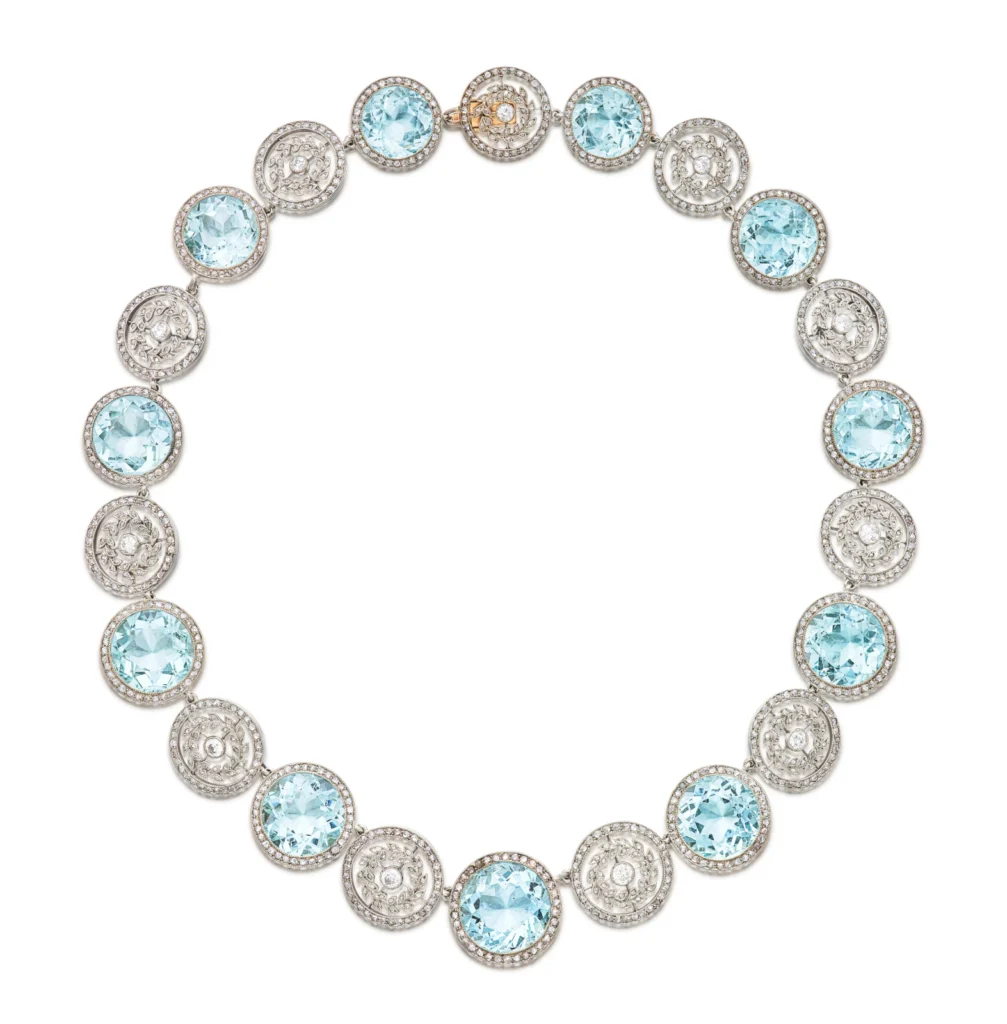
A Fabergé diamond and aquamarine necklace, estimated at $400,000 to $600,000, is the highest-valued lot in the sale. In May 1911, the Imperial Cabinet presented it to Empress Alexandra Feodorovna as a suggested gift during the state visit of German Crown Prince Friedrich and Crown Princess Cecilie to St Petersburg. Crown Princess Cecilie was a second cousin of Emperor Nicholas II. During the visit, the German royals attended official state functions, celebrated the Emperor’s 43rd birthday, and shortly afterward represented Germany at the coronation of King George V in London. Cecilie was offered the necklace during this occasion at a cost of 2,650 roubles.
Albert Holmström, who had succeeded his father August as Fabergé’s head jeweler, crafted the piece. Holmström was responsible for some of the firm’s most significant commissions, including the gold-mounted kokoshnik tiara composed of diamonds sold at Sotheby’s Geneva in May 2019. His design approach prioritized precision over spectacle. Siberian aquamarines are set within rose-cut diamond surrounds and diamond-set laurels, a recurring Fabergé motif, with deep galleries engineered beneath each stone to lift the aquamarines from the neck and allow them to catch and reflect light. Two design books from Fabergé’s St Petersburg workshops have survived, both belonging to Holmström, documenting every jewel made between March 1909 and March 1915. Each entry carries watercolor diagrams alongside handwritten notes recording materials, stone quantities and exact weights. For this necklace, the specification calls for 11 round-cut aquamarines, 11 brilliants and 958 rose-cut diamonds.
Fabergé necklaces at this quality level are scarce. Post-revolution confiscations resulted in much of the firm’s jewelry being broken up for parts. This necklace survived intact and retains its original fitted Fabergé case, over 16 inches in length, considered one of the largest known examples by the firm.
A gold, silver-gilt and guilloché enamel Fabergé desk clock from around 1898, belonging to Empress Marie Feodorovna, mother of Emperor Nicholas II, carries an estimate of $70,000 to $90,000. A group of gold boxes from the collection of Ailsa Mellon Bruce, gifted to the Virginia Museum of Fine Arts, brings American collecting history into a sale otherwise anchored in Russian Imperial material.
Helen Culver Smith, Global Head of Fabergé and Russian Works of Art at Sotheby’s, said, “These jewels carry with them a fascinating window into the luxury and opulence of the Russian Imperial court. It is difficult to overstate their rarity and historical importance, and I am truly thrilled to be presenting them side by side for the first time. Our hope with the inaugural Artistic Luxury sale is to showcase the beautiful marriage between luxury and artistry, whether in gold, silver, or ceramic, and there is no better moment to bring these to market than during Luxury Week, which already unites our clients with the finest examples in watches, jewelry, handbags and beyond.”
A public exhibition opens at Sotheby’s New York on June 11 and runs through June 16. Bidding on June 17 will be the first time these pieces have been publicly available for acquisition in close to a century, following a trail that runs from the Winter Palace to a Soviet catalogue, through Christie’s London, and into nearly 100 years of private ownership.