
In the hills of Kurseong, tucked between forest and sky, lies Makaibari Tea Estate, the world’s first biodynamic tea garden, established in 1859 and today run by the Luxmi Tea Group. Spanning 248 hectares of cultivated tea fields and 240 hectares of preserved forest, Makaibari produces some of the rarest teas in the world, including the Silver Tips Imperial, plucked only under full moonlight. This isn’t just a place where tea is grown; it’s a place where tea is lived. When I visited Makaibari, I didn’t only drink tea. I walked through its mythology, its rhythm, and its people. And what I found was something far more lasting than flavour.

As we left the plains and began the slow drive up to Darjeeling, the usual clutter—messages, meetings, the pace of the city—began to recede. The air shifted. The sounds changed. I first mistook the chorus of grasshoppers and rustling leaves for silence, until I realised it was the landscape tuning itself in.
At the gate of Makaibari Tea Estate, we were greeted with a glass of cold Second Flush tea, which is harvested in summer and rich with warm, muscatel notes. Just a few sips, and it was clear: every part of Makaibari’s process is intentional. From the soil to the sip, nothing here is rushed or scaled beyond recognition.
The Makaibari Bungalow, built in the late 1800s, now functions as a heritage homestay. With its wooden floors, antique furniture, and verandahs that open out to the Eastern Himalayas, it holds onto its colonial past with quiet dignity. It also holds onto a spiritual rhythm, one that’s tied to the moon, the soil, and time itself.

The fields, the people, the pluck
The next morning began in the fields. Makaibari is known not just for its tea, but for how it’s grown. It follows biodynamic principles, which are a form of organic farming that treats the estate as a self-sustaining organism, in harmony with cosmic cycles. This approach, certified by Demeter International, relies on moon phases, natural composting, and planting rhythms aligned with the stars. “I know this land and our people so well that I don’t need words. The moon, the stars, and the soil guide us, and we work with their rhythms,” says Sanjay Das, Estate Manager, Makaibari, while walking us through the tea fields. And indeed, it’s true — anyone who visits can see it in the harmony between the fields, the workers, and the sky above.
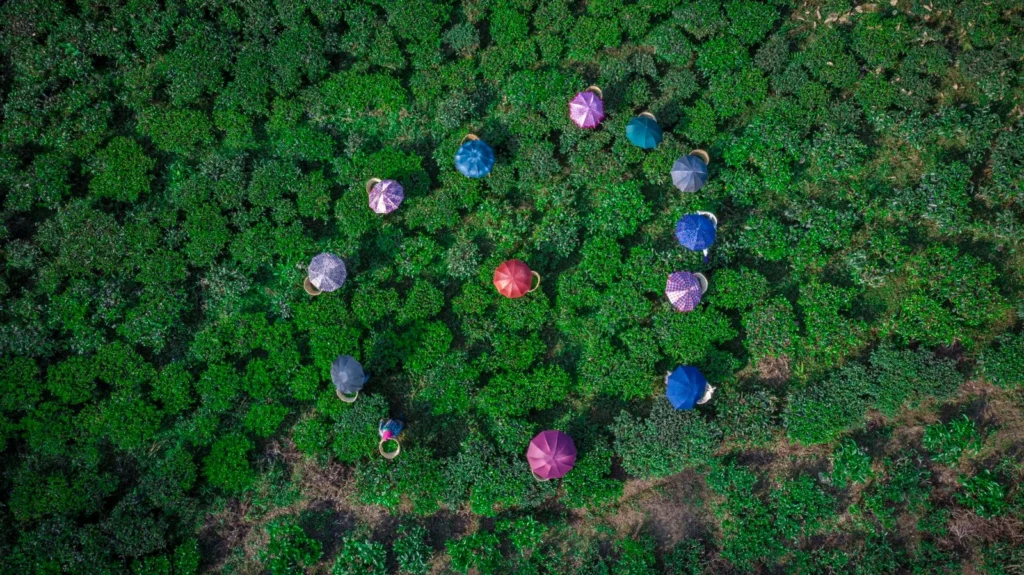
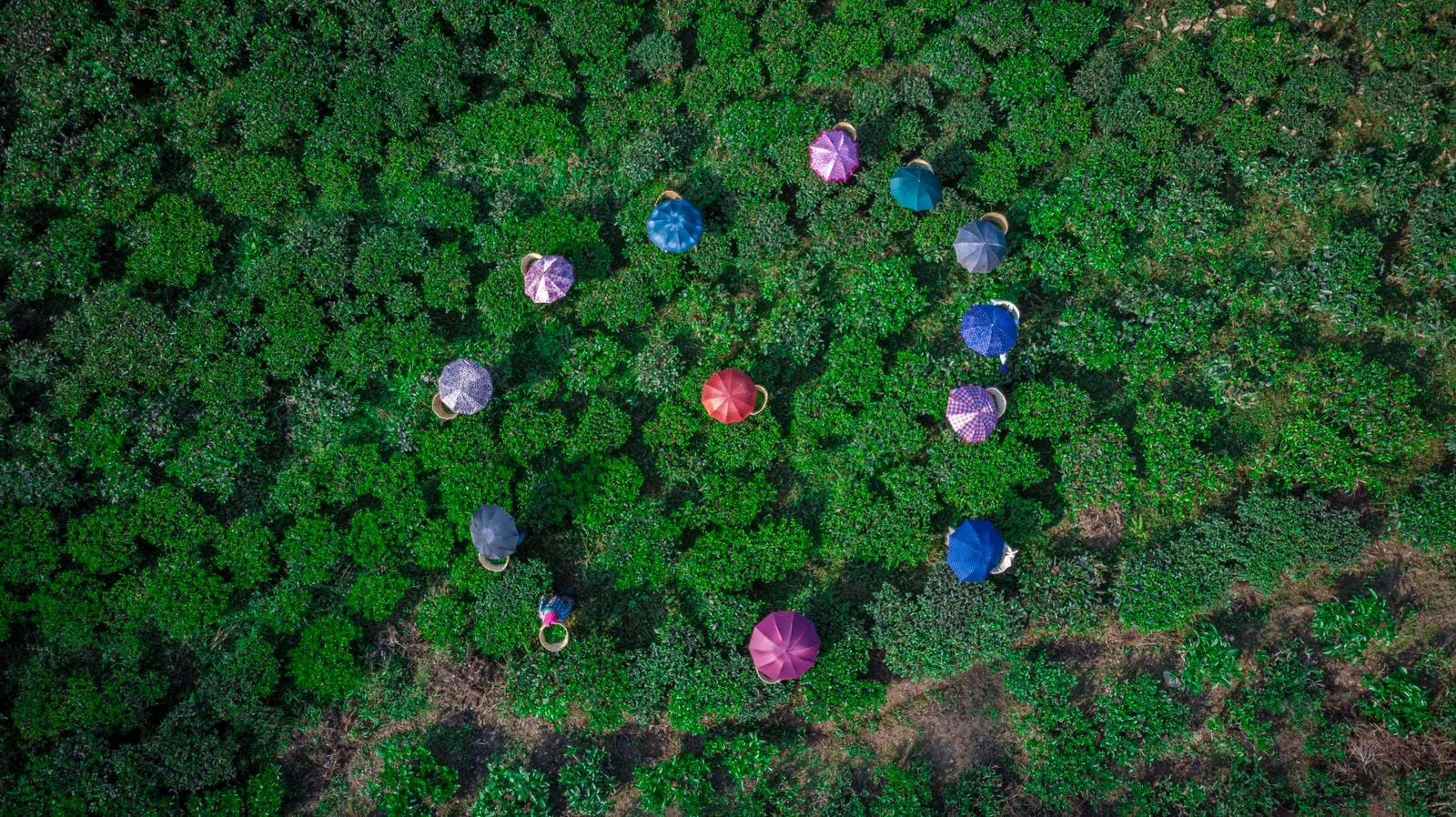
With baskets on our backs, we joined the pluckers in their daily ritual. They showed us how to identify the top two leaves and a bud, the standard for quality tea. For Silver Tips, only unopened buds are picked, often at dawn or under the moonlight. It’s delicate work, done entirely by hand. And in that early light, it felt like meditation.
I spotted something small and green clinging to my shoulder—what one of the women called a “tea deva.” Camouflaged like a tea leaf, this insect is considered a good omen, and in that moment, I believed her. The tea plant isn’t treated as a crop here; it’s treated as a being. The land is alive. The forest speaks. You just have to slow down enough to listen.
The taste of moonlight
Back at the bungalow, we gathered for an immersive tea tasting, where each brew had presence, and each sip was layered with story. As our cups were poured, we were also taken through the story of Makaibari and the wider history of tea in India by Parveez Hussain, Makaibari’s tea sommelier. We learned how tea, though native to Assam, was cultivated commercially only in the 19th century when the British, desperate to break China’s monopoly on the trade, began planting it across the northeast and the Darjeeling hills. Makaibari, founded in 1859, became one of the earliest estates to emerge from this colonial enterprise, yet it took a different path, remaining under Indian ownership and eventually evolving into the world’s first biodynamic tea garden.

With that lineage in mind, our tasting took on new meaning. We began with the First Flush, a light, grassy tea picked in spring, bright and floral, like the season itself. Then came the Second Flush, harvested in the summer, deeper, amber-hued, with the classic muscatel notes Darjeeling is known for.
The Silver Tips Imperial, Makaibari’s most coveted tea, followed: plucked only on full moon nights during the “five-moon cycle,” when the air is said to be richer in oxygen and the energy of the cosmos is in alignment. “Silver Tips Imperial is plucked only on full moon nights, by hand, during the rare five-moon cycle,” says Mr. Hussain. “That care shows in the cup, you know, soft, luminous, and unlike anything else.” This tea is harvested with reverence, entirely by hand, and its flavour reflects that care, subtle, luminous, with an almost mist-like softness. From 200 kilograms of fresh leaves, just 50 kilograms of Silver Tips emerge, making it as rare as it is refined.
The Silver Tips Imperial, Makaibari’s most coveted tea, followed: plucked only on full moon nights during the “five-moon cycle,” when the air is said to be richer in oxygen and the energy of the cosmos is in alignment.

The final offering was a chilled white tea infused with lavender and honey, a contemporary note to end on, floral and calming. As we sipped, we sat with the weight of centuries, the patience of pluckers, and the quiet alchemy that turns leaf to legacy. The Silver Tips have even reached Buckingham Palace, gifted to Queen Elizabeth II by Prime Minister Narendra Modi. A tea for royalty, yes, but here it felt intimate, sacred, almost personal.
Inside the factory
On our last day, we visited the factory. Time runs differently there. Machines over a hundred years old, like a rolling machine built by the Britannia Company, still operate quietly and precisely. The process is analogue—no rush, no shortcuts.

The journey of a tea leaf unfolds in seven stages:
- Plucking – The most delicate task, entirely by hand.
- Withering – Leaves are laid out on bamboo trays to reduce moisture.
- Rolling – Either by hand or gently with machines, to break cell walls and release oils.
- Oxidation – Where black and oolong teas develop their colour and aroma.
- Drying – At 150°C, locking in flavour and preserving shelf life.
- Sorting & Grading – Based on shape, size, and integrity of the leaf.
- Packaging – Often in eco-conscious or artisanal formats for global distribution.
Watching the process unfold, I noticed something striking: no one here seems detached from their work. Every leaf is observed, touched, and discussed. It’s as if the tea isn’t made so much as it’s raised, like a living thing.
A life built around tea
Over my last cup of tea at Makaibari, I asked Mr. Das, the estate manager, about their routine — or rather, how they consume tea throughout the day. At Makaibari, tea shapes the rhythm of every hour: a robust Second Flush in the morning, green tea after lunch, a delicate First Flush in the afternoon, and by evening, chamomile or mint to prepare for sleep. The day, like the estate itself, moves in gentle cycles, marked by cups, walks, conversations, and glimpses of the ever-changing sky.
This estate offers a deep, sensory education in care. In letting things take their time. In valuing not just the outcome, but the process.

There’s no pretence here. No over-designed ritual. Just rhythm.
The Makaibari philosophy is rooted in something rare: patience. Whether it’s the way the forest is preserved, the way the estate observes lunar cycles, or the way the workers speak about the tea, there’s a clarity of purpose. This isn’t a place trying to reinvent itself. It knows what it is. And it offers that to anyone willing to slow down and receive it.
As I left Makaibari, a part of me stayed behind, walking barefoot in the dew, crouched over a bush selecting leaves, waiting for the full moon. This estate offers a deep, sensory education in care. In letting things take their time. In valuing not just the outcome, but the process.
Makaibari isn’t just where tea is made. It’s where it becomes—through touch, timing, tradition, and trust. And in a world addicted to speed, that alone is worth remembering.