
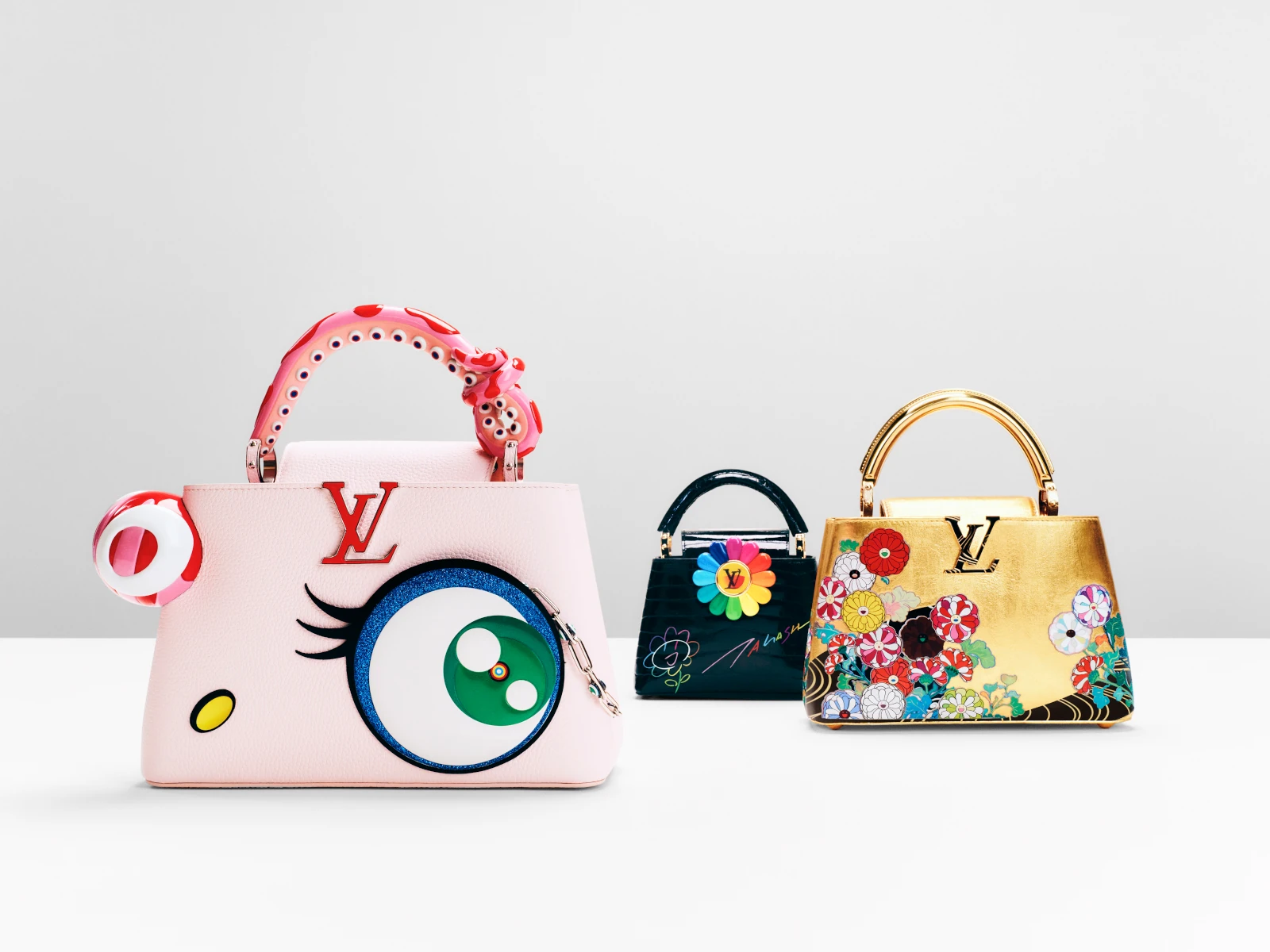
Almost two decades have passed since Takashi Murakami first transformed Louis Vuitton’s monogram canvas into a riot of 33 colors, and since then, the Japanese artist has been a regular fixture at the brand. But this latest collaboration might just be the most ambitious yet. As Art Basel Paris opens its doors this year, visitors to the Grand Palais will encounter an eight-meter-tall octopus sculpture whose glowing tentacles sprawl across the majestic Balcon d’Honneur, cradling 11 new interpretations of the iconic Capucines bag that push the boundaries of what luxury accessories can be.
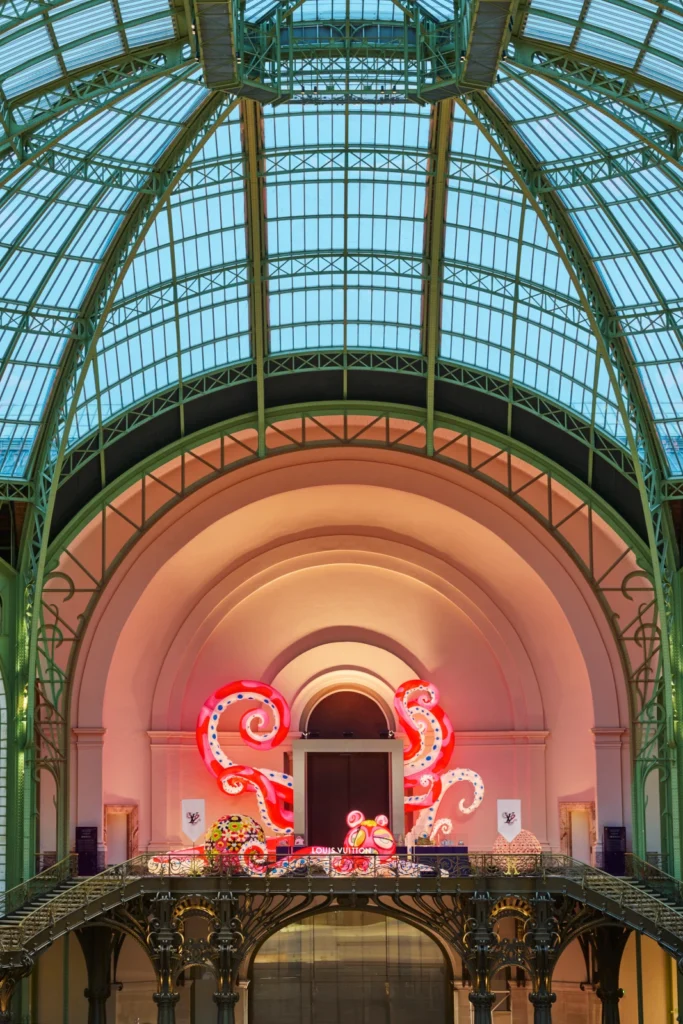
This installation marks the seventh edition of Louis Vuitton’s Artycapucines collection and serves as a reunion between the house and Murakami, whose first partnership in 2003 fundamentally changed how fashion brands approached artist collaborations.
Custom carpeting extends the tentacle motifs across the floor, while the octopus’s luminescent head showcases the Superflat Jellyfish Eyes pattern, a motif that entered Murakami’s visual vocabulary in 2001 and draws from childhood fears of being watched, while transforming that anxiety into something whimsical.
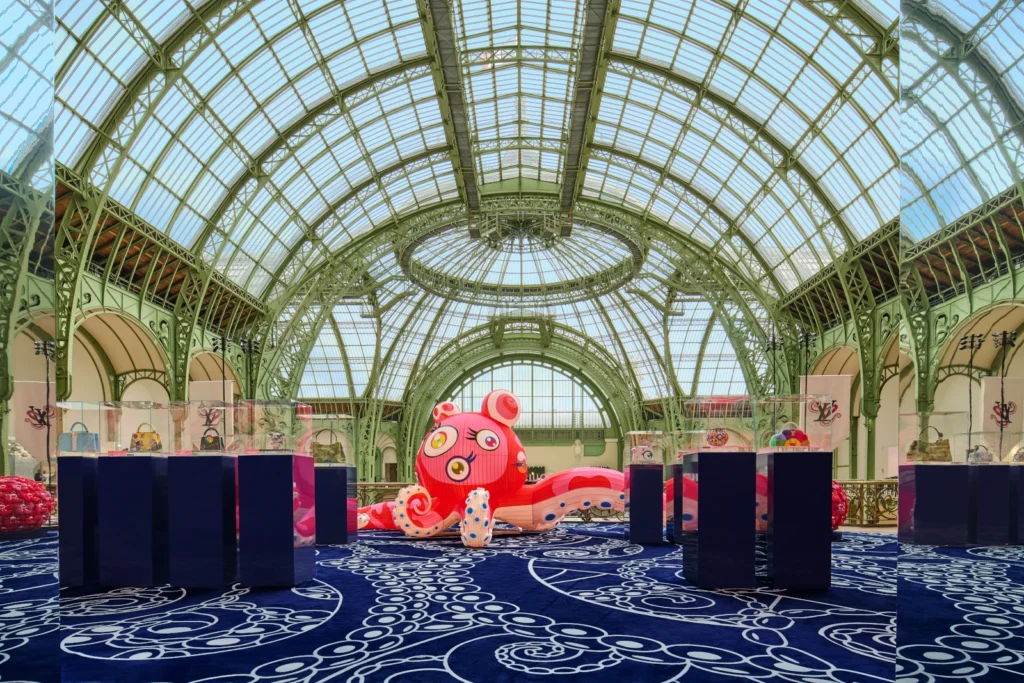
Murakami’s fascination with the Kraken motif dates back to his 2017 work “The Octopus Eats Its Own Leg,” which explores myths of disappearance and engulfment. Yet he consistently transforms these universal fears into playful, almost joyful forms, a tension between darkness and delight that runs through the entire collection.
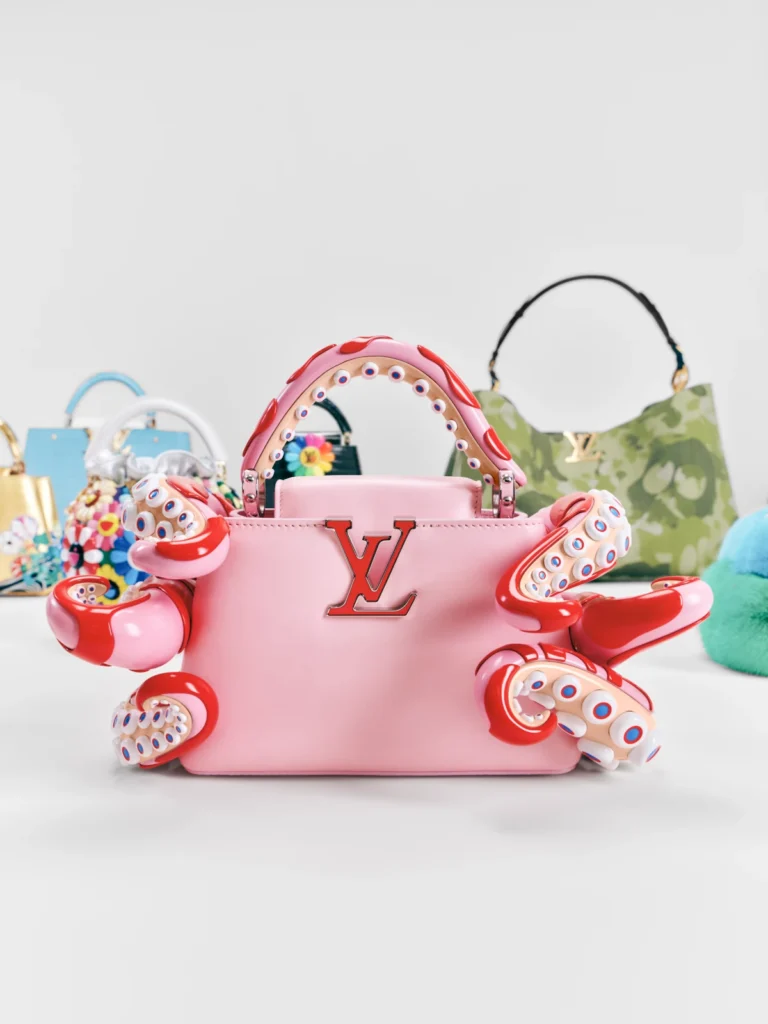
Among the standout pieces, the Capucines Mini Tentacle draws inspiration from Murakami’s 2017 sculptural work “DOBtobus.” Its seven sculptural tentacles consist of more than 450 individual elements and require 75 days of construction. Each tentacle’s core is crafted from colored resin using precision molding, while individual blue-and-white suckers are painted and polished by hand before application.
For those drawn to psychedelic aesthetics, the Capucines Mini Mushroom features more than 100 vibrant mushroom characters created using 3D resin printing. After being hand-polished, each piece is delicately embroidered onto silver mirrored canvas, a process taking almost 10 hours per bag. It references Murakami’s 1999 artwork “DOB in The Strange Forest” and transforms his Superflat aesthetic into something tactile and sculptural.
Louis Vuitton’s artisans crafted the Panda Clutch as a sculptural masterpiece from silver-toned brass, directly referencing Murakami’s iconic Panda character from his 2003 “Superflat Monogram” universe. Each clutch features 6,250 hand-set crystals creating a shimmering multicolored effect, with a removable precious metal chain serving as a shoulder strap.

Perhaps the most technically ambitious piece is the Capucines EW Dragon, inspired by Murakami’s 18-meter-long painting “Dragon in Clouds Indigo Blue” from 2011. For the first time in the bag’s history, Louis Vuitton designed an extra-wide East-West silhouette specifically to accommodate a small-scale replica of the entire artwork across its exterior. Intricate cloud-and-dragon imagery is reproduced using high-definition inkjet print on porcelain-like leather, while the sculptural handle and LV signature evoke dragon scales through silver-toned brass finished with hand-applied enamel details requiring four hours of precision work.
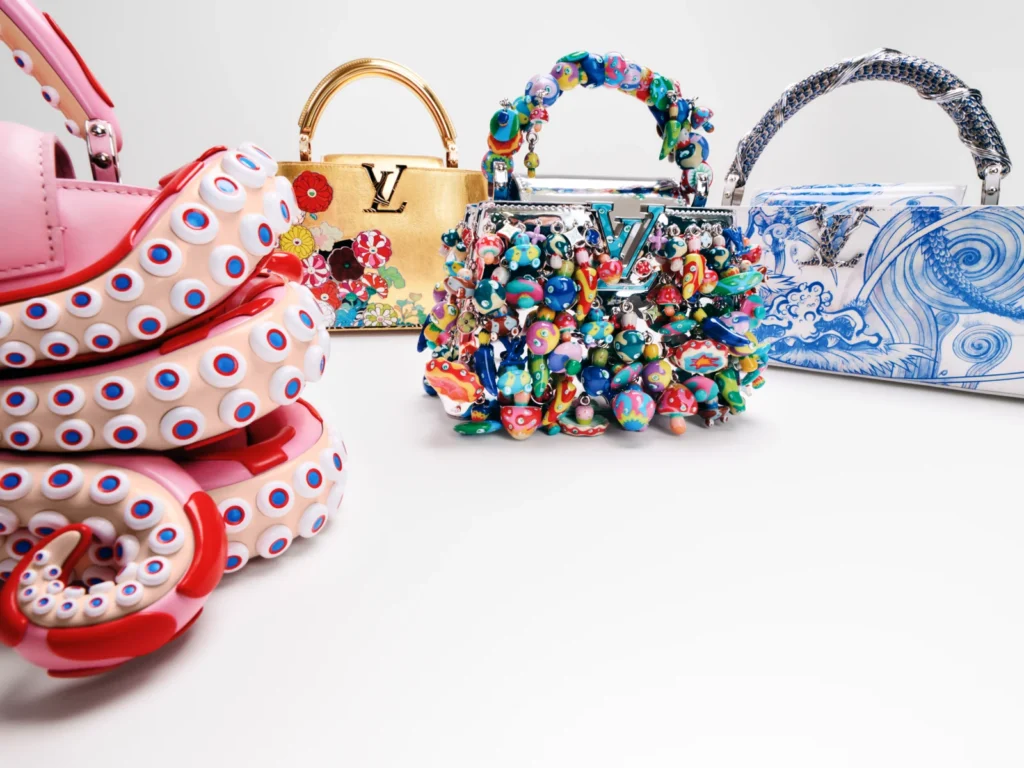
Another striking piece, the Capubloom, transforms the entire Capucines silhouette into a sphere adorned with smiling flowers in over 115 candy-colored shades. Drawing inspiration from Murakami’s “Flower Matango” from 2007, exhibited at Versailles’s Hall of Mirrors in 2010, the bag features 133 design components shaped from colored resin and meticulously hand-applied to the spherical surface. Inside, a metallic-silver leather pouch functions as a removable second bag.
Louis Vuitton has created its first oversized, unisex Capucines with the XXL Camo version. Showcasing khaki washed-denim with a skull-in-camouflage pattern created through intricate jacquard techniques, it references Murakami’s “TIME” artwork from 2009. Side rings are reshaped into skulls using high-definition cutting and finished with aged gold-tone metal, while the Louis Vuitton signature recalls the Monogramouflage from the artist’s early 2000s collaborations with the house.
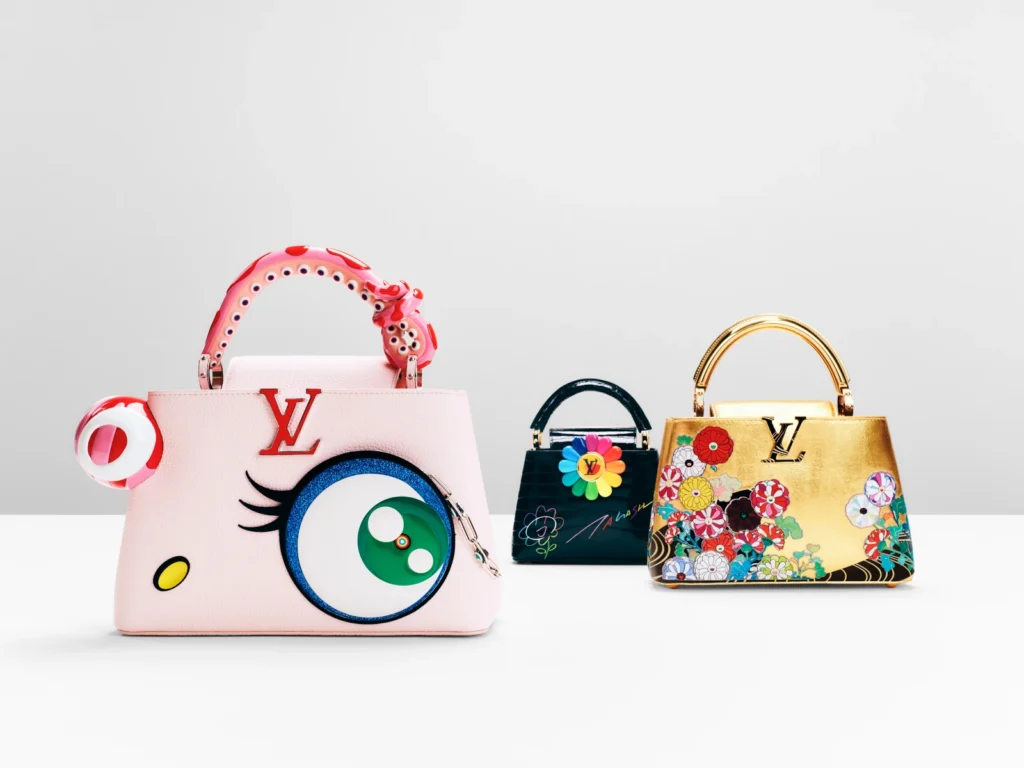
Other notable pieces include the Capucines BB Golden Garden, which draws inspiration from Murakami’s 2024 artwork “Ogata Kōrin’s Flowers.” It showcases five different textures of leather marquetry depicting floral renderings on a gold-leaf-covered body, with a handle employing watchmaking techniques, brass filigree laser-cut into flower motifs with each petal hand-painted in ultra-fine enamel. Meanwhile, the Capucines EW Rainbow reworks the bag’s construction to take the form of Murakami’s Rainbow Flower motif, with thermoformed leather overlaid with mink fur in seven vivid colors, featuring a smiley face on one side and a sleeping face on the reverse.
Three Plush Balls, spherical works Murakami has developed since 1995, anchor the exhibition. Originally inspired by M.C. Escher’s “Hand with Reflecting Sphere,” these three-dimensional sculptures offer kaleidoscopic visions of the artist’s aesthetic. A 2008 Multicolor Plush Ball showcases his Smiling Flowers motif, while two new spheres, Cherry Blossom and Plum, were created specifically for Art Basel Paris 2025.
Additional pieces include the Capucines MM Eye, which abstracts facial features from “Mr. DOB Original Edition” (2016) with embossed leather elements and a hidden pocket mirror attached via metallic chain. There’s also the Capusplit BB, featuring light blue crocodile leather that unveils an internal Monogram Multicolore panel, a nod to the 2003 Spring/Summer collection. Finally, the Capucines Mini Autograph features a reproduced Murakami signature and smiling flower motif hand-painted on black crocodile leather, with an LV signature that transforms into a smiley face through a lenticular flip effect.
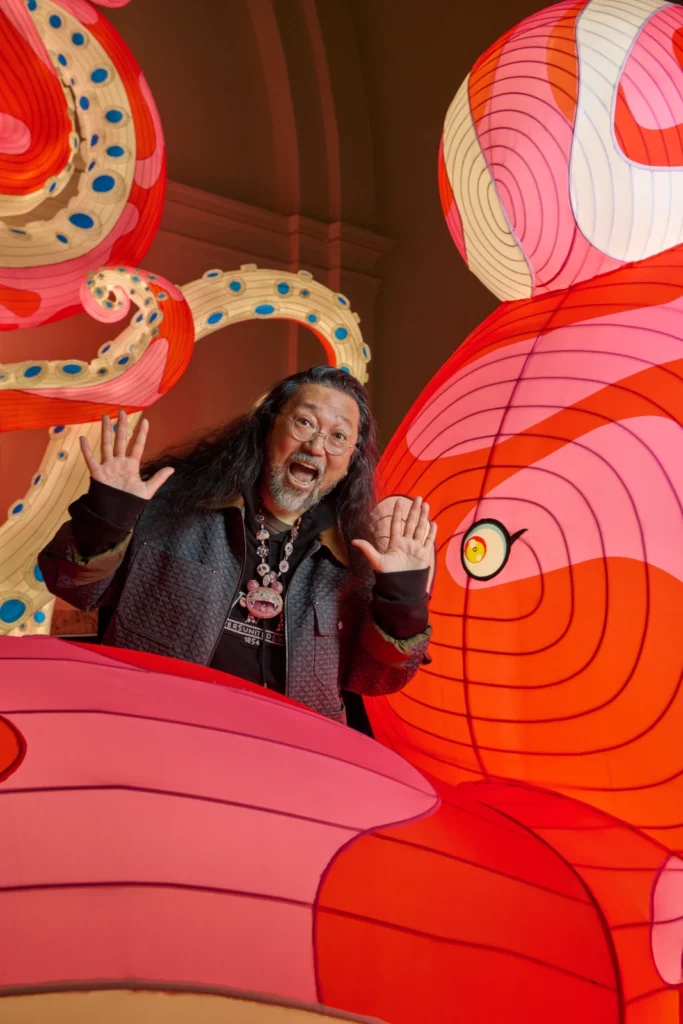
In an interview to Vogue Arabia, when asked about collaborating with Louis Vuitton’s artisans, Murakami reflected on the technological evolution he has witnessed over two decades. He said, “Over the past 20 years, from my first collaboration to this 2025 project, I believe Louis Vuitton’s atelier has made remarkable technological advancements. For example, denim was not an option as material back then, and the progress in three-dimensional modeling and metalworking is truly impressive. The pursuit of high-end savoir faire at Louis Vuitton is extraordinary, and I am constantly amazed by the quality of artisanship, reaching heights even artists’ studios like mine cannot attain.”

The first Artycapucines collection was launched in 2019, which has since featured more than 30 designs by artists including Beatriz Milhazes, Zhao Zhao, Daniel Buren, Vik Muniz, and Paola Pivi. Artist collaborations have been part of Louis Vuitton’s DNA since the 1920s when Gaston-Louis Vuitton commissioned artists for window displays and advertisements. Since 1988, the house has worked with legends like Sol LeWitt, Yayoi Kusama, and Richard Prince, with the 2014 opening of the Frank Gehry-designed Fondation Louis Vuitton cementing this commitment to contemporary creation.
Born in 1962 and trained at Tokyo University of the Arts, Murakami has gained international acclaim since the 1990s for blending traditional Japanese art with anime, science fiction, and pop culture. His work has earned solo exhibitions at institutions from MoCA Los Angeles to the Guggenheim Bilbao, with pieces in permanent collections at MoMA and Centre Pompidou. Recent collaborations with Louis Vuitton include “The Flower and the Child” sculpture displayed at Paris’s Jardin d’Acclimatation in late 2024 and several re-releases of iconic works in 2025.
Regarding the emotional resonance of his Artycapucines designs, Murakami offered an unexpectedly candid perspective to Vogue Arabia on reconciling Japanese and European luxury traditions. “European high-end culture exceeds the realm of cultural comprehension, and to be honest, there are aspects I struggle to fully understand. This is because in modern Japanese society, the kind of social hierarchy it implies doesn’t exist. We can relate to such sensibilities of refinement through the lens of fantasy, stories, animation, games, where the palace unfolds in breathtaking splendor. These settings are rich with detail, elegance, and imagination, and characters move through aristocratic, dreamlike scenes. I believe Artycapucines sits very close to that spirit, possessing a kind of fantasy point of view,” he said.
All bags in the Artycapucines VII collection will be available in highly limited editions, followed by a reservation period. Pricing remains undisclosed, though previous Artycapucines pieces have ranged from tens of thousands to hundreds of thousands of dollars. What stands out is how these pieces blur the line between handbag and artwork. Murakami’s admission that he relates to European luxury through fantasy rather than lived experience reflects in creations that bridge Japanese pop culture with French craftsmanship. Whether they end up in museums or closets, these bags represent luxury ateliers reaching technical capabilities that rival dedicated art studios.