
We climb a long stairway, counting each step, the way our local guide tells us to. Somewhere halfway up, the outside world seems to dissolve. What remains is 50 shades of blue – luminous blue, turquoise, cobalt, lapis, in a cascade of intense colour. This is Shah-i-Zinda, a necropolis whose name translates as “The Living King,” a narrow corridor of mausoleums and tombs built between the 11th and 15th centuries in Samarkand, the Silk Road city of Uzbekistan, the double landlocked country in Central Asia.
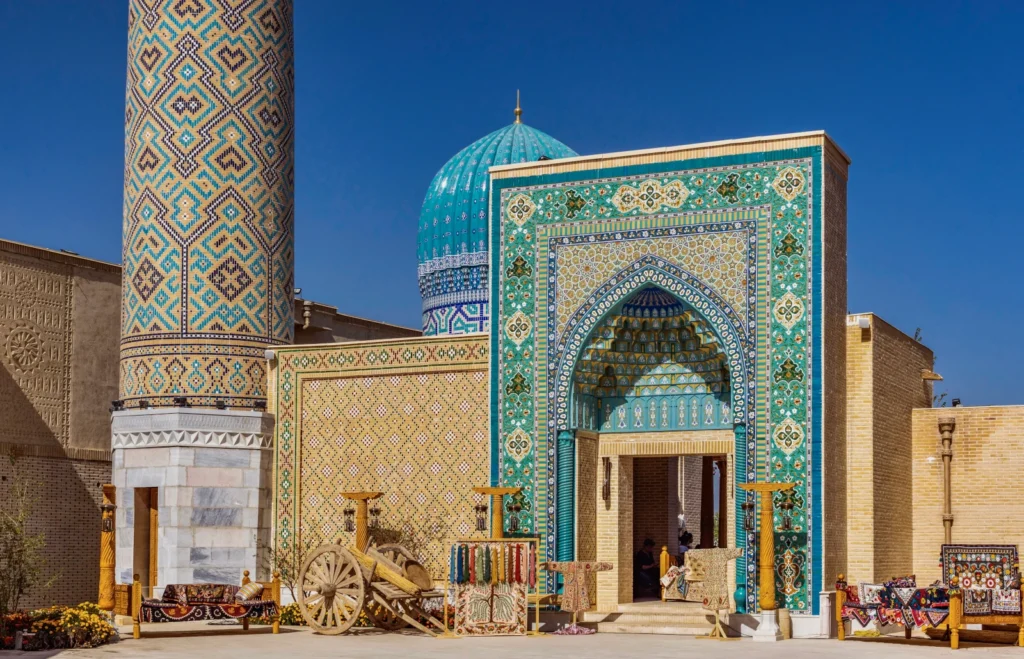
Our local guide Azamat, from Orient Star company, one of the largest tour companies in the country, explains that the mausoleums were built for royalty and relatives of Timur, clustered around what is believed to be the grave of Qusam ibn Abbas, a cousin of the Prophet Muhammad who is said to have brought Islam to this region in the seventh century.
Many of the double terracotta tiles were painted before they were fired and glazed, their colours layered deeply. In the late afternoon the sunlight glides across the surfaces, softening the brilliance.
Samarkand, Uzbekistan, one of the oldest cities in Central Asia, has lived through a turbulent history. Over centuries it was ruled by the Samanids of Iran, by Turkic dynasties and Arab conquerors, and was devastated by the Mongol armies of Genghis Khan. Its golden age arrived under Timur, the 14th-century conqueror, who turned the city into the capital of a vast empire.
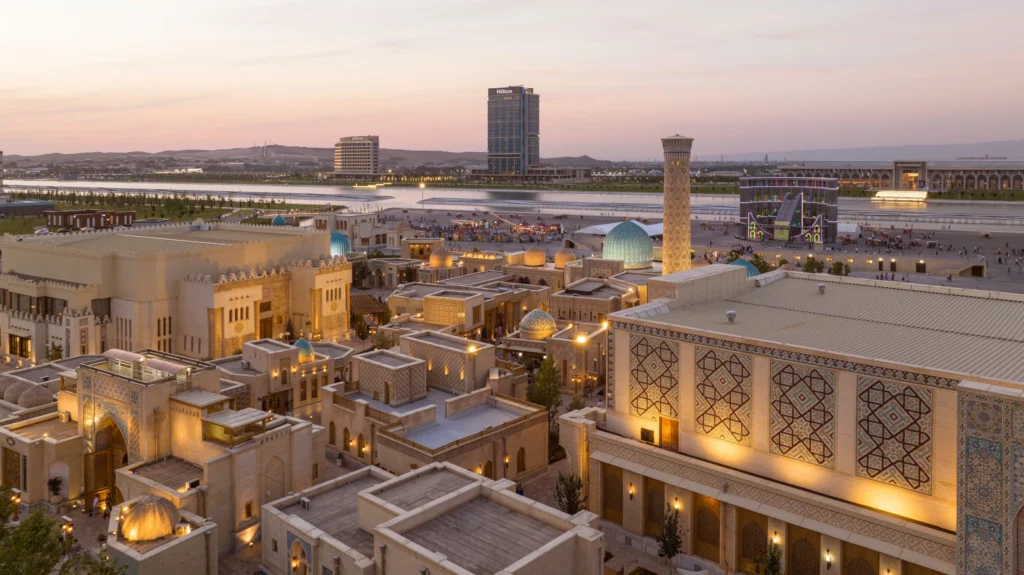
Our base in Samarkand is the city’s brand-new tourism district called Silk Road Samarkand, which opened in September 2022. It took two and a half years to build, with investment from oil and property entrepreneur Bakhtiyor Fazilov and Minyoun Hospitality in China.
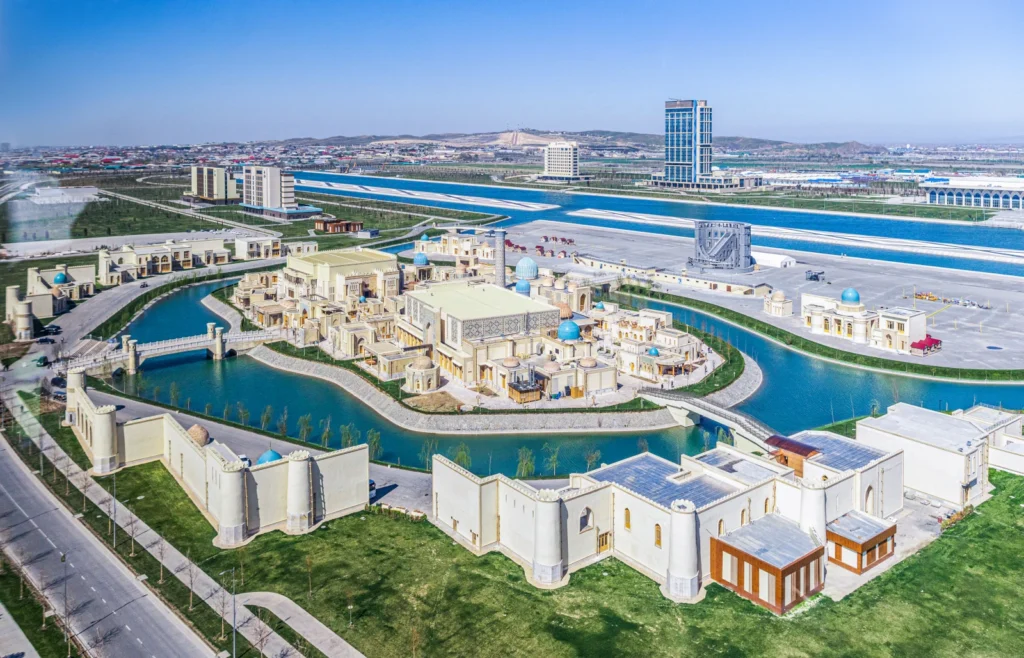
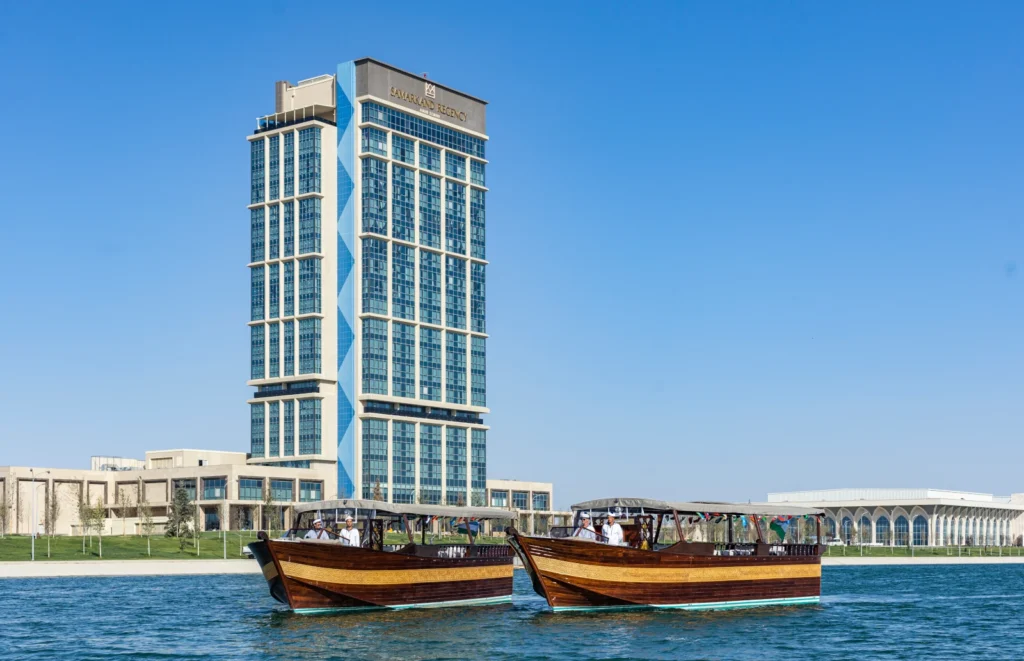
The complex, a 20-minute drive from the Registan square, the heart of the city, is designed as a modern gateway to the ancient city. Eight modernistic glass-and-stone high-rise hotels are arranged in a crescent around a long canal, their stepped façades, and reflections in the water designed to echo both modern aesthetics and the geometry and symmetry of Timurid architecture like the Registan.
Gardens and reflective pools mirror Persian and Central Asian Garden traditions. The southern portion has hotels with wellness centres that focus on wellness as well as preventive care, detoxification, pulmonology, and treatments for the spine and joints.
The complex blends international luxury standards, with regional design elements like domed pavilions, patterned screens, turquoise accents, which take their cue from Islamic latticework, and pale stone, that harks back to Samarkand’s historic madrasas. Nearly all of Samarkand’s international events are hosted here. Its long canal was once used by Soviet rowing champions as a training course. The area also houses the Eternal City cultural and entertainment complex, where artisans demonstrate over 40 traditional Uzbek crafts from 12 regions.
The setting itself feels theatrical, designed by award-winning Uzbek artist Bobur Ismailov, to evoke a Silk Road Town from the past, where Samarkand balances its glorious past with a carefully staged present. Silk Road Samarkand is a meticulously planned range of unique experiences. The eight luxury hotels can accommodate over 3000 people, complemented by an international congress centre and an expo complex, positioning the destination as much for global gatherings as for leisure. Fourteen private villas offer seclusion, while an artificial lake invites a slower rhythm.
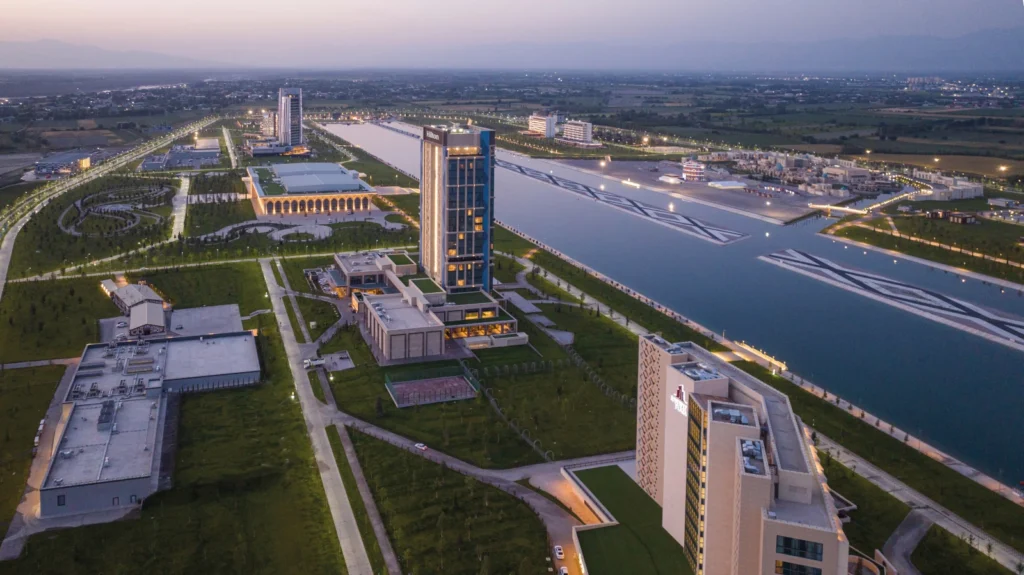
There are parks and shaded promenades, recreational and sports areas, and a collection of restaurants, cafés, and bars. The entire project, conceived by leading international architects is an ensemble that is still rare in this part of Central Asia. Hotels in the complex, like Hilton Samarkand Regency and Silk Road by Minyoun have luxurious wellness centers that offer exclusive treatments.
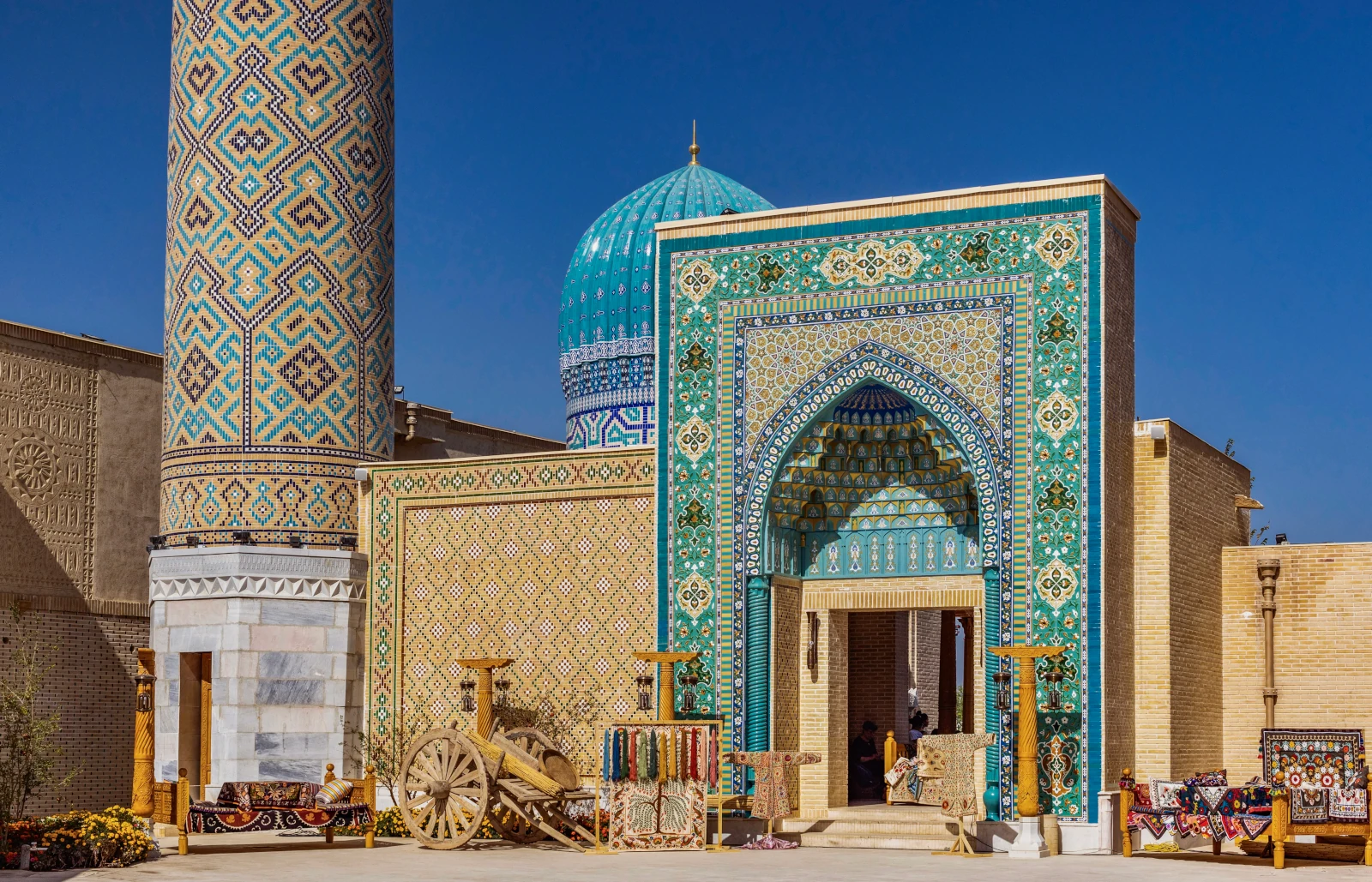
The heart of the complex is the Eternal City spread across 11 hectares, where the past is reinterpreted with a kind of deliberate romance. It’s like walking into a time warp with narrow streets winding past workshops where artisans shape silk, clay, and metal, their craft echoing centuries-old traditions. The pavilions, inspired by descriptions in ancient texts, recreate the intimacy of old neighbourhoods, courtyards opening into squares, even if newly built.
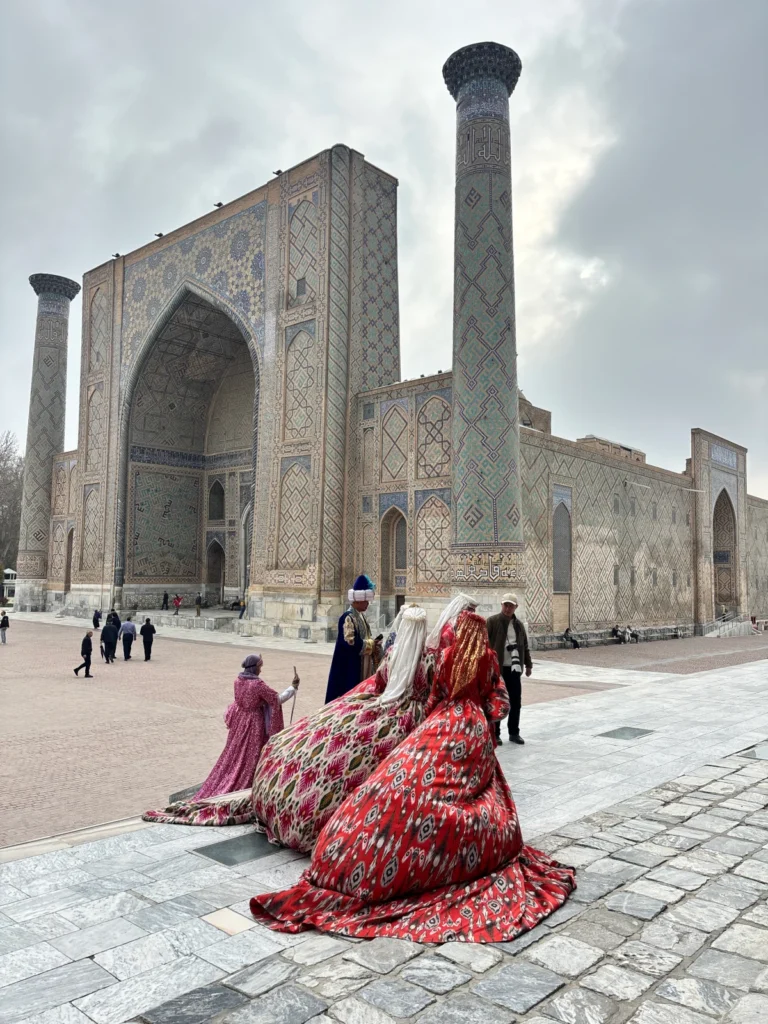
Turquoise domes rise above it all, mosaics shimmer across palace walls, and slender minarets pierce the sky. Here you can wander from Bukhara to Fergana Valley, from Tashkent to Khorezm, without ever leaving the resort. Even regions like Kashkadarya, Surkhandarya, and Karakalpakstan find expression here, distilled into architecture, craft, and cuisine.
Craft demonstrations, and folk performances enliven the complex. Master craftsmen, such as the sixth-generation ceramics master Abdulla Narzullaev, demonstrate their craft here. Others demonstrate making silk paper from mulberry.
Come night, the complex is lit up. There are musical fountains and laser shows, and it’s easy to believe that you are in the Samarkand of yore.