
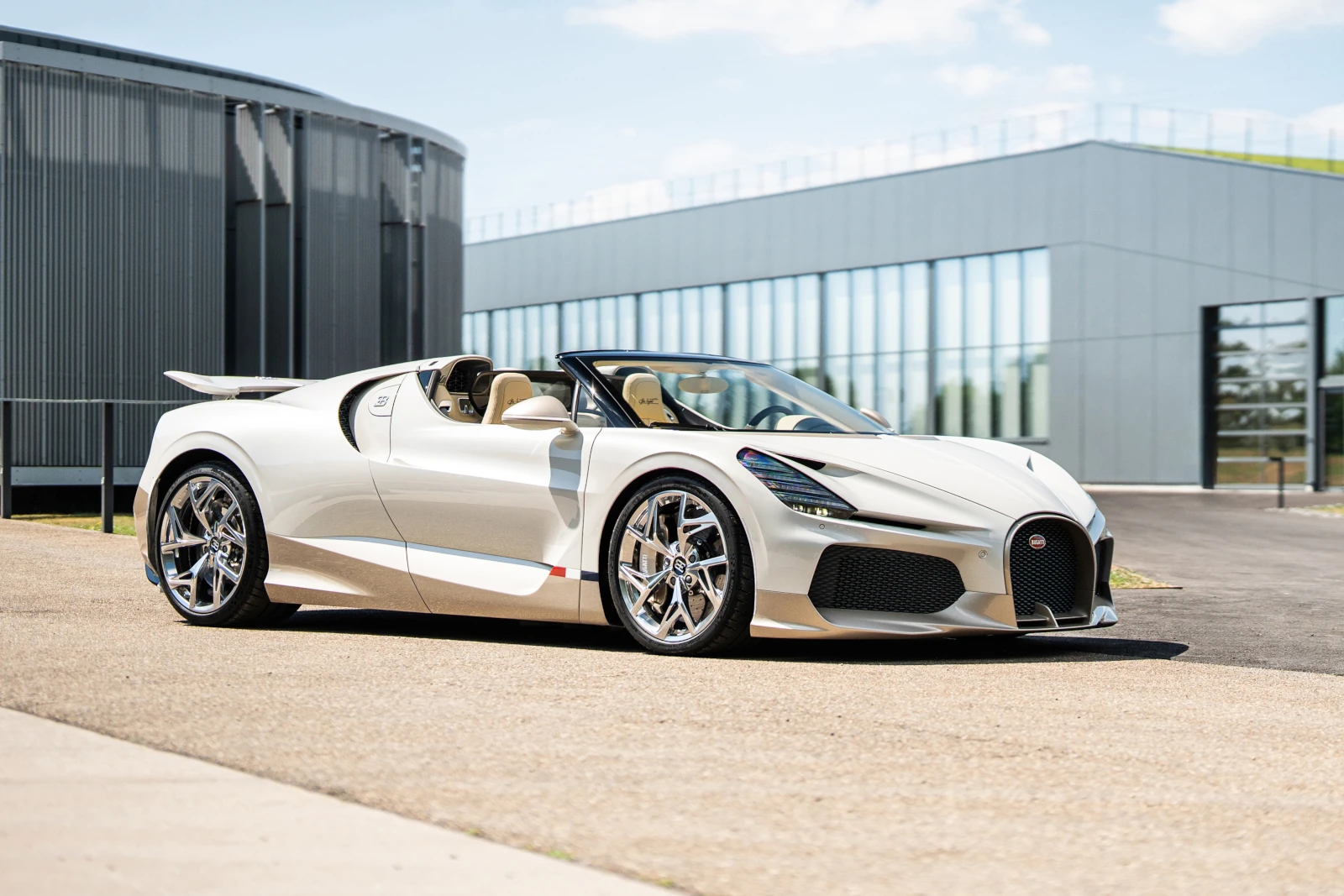
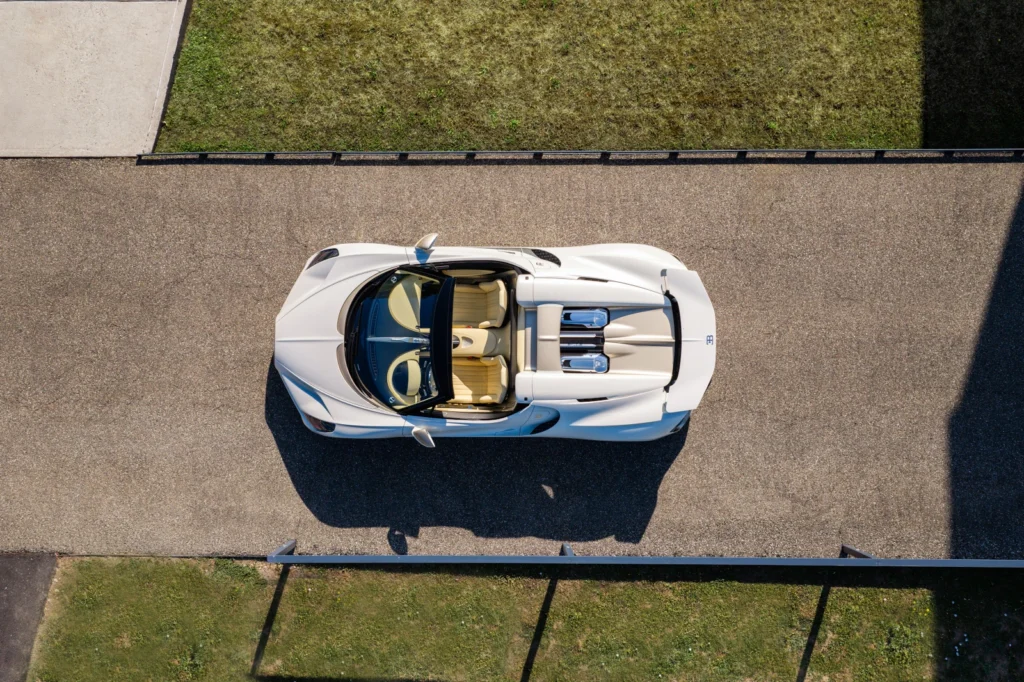
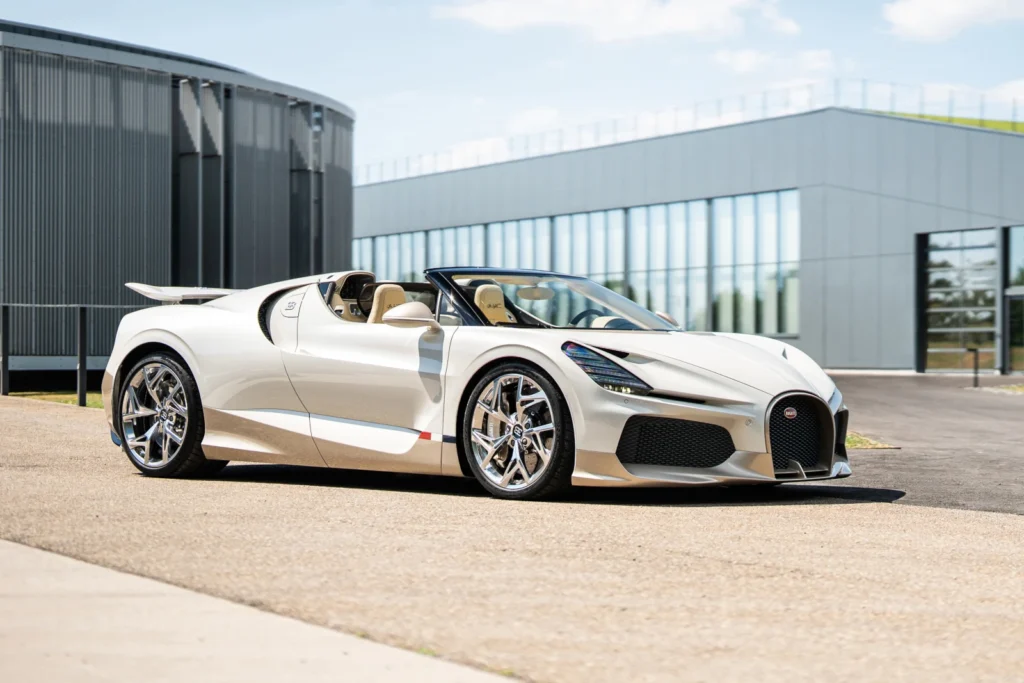
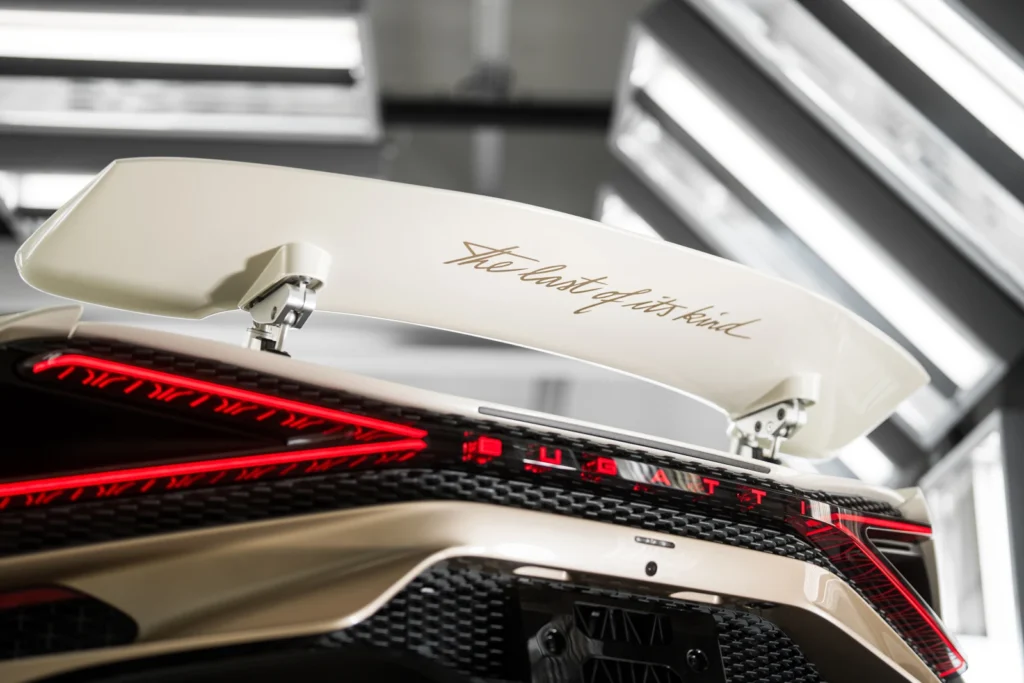
Bugatti, the French hypercar maker known for building some of the fastest and most expensive production cars in the world, has completed production of the W16 Mistral, ending the run of the engine that has defined the brand for two decades. The last car is finished in a two-tone “Pearl” and “Sparkle” livery, and it carries a line that has followed the model since it was first shown in 2022: “The last of its kind.”
This final car arrives just days after Bugatti opened La Manufacture, its new site for building the Tourbillon. One factory is closing a chapter almost the same week another is opening one. The W16, an 8.0-litre quad-turbocharged engine used in the Veyron and later the Chiron, does not simply fade out of production. It gets one last model, one last world tour, and one last handover to a customer.
The W16 Mistral was initially revealed by Bugatti at Monterey Car Week in the year 2022. In a span of two years, the car travelled Japan, Singapore, Riyadh, and Dubai before a single unit reached a buyer. In November 2024, Bugatti test driver Andy Wallace drove the one-off W16 Mistral World Record Car to 453.91 km/h at ATP Automotive Testing Papenburg. This speed made it the fastest open-top production car in the world.
Series production began weeks later, in early 2025, so the car reached its first owners already holding a record.
Bugatti has used this approach before. The Veyron Super Sport and the Chiron Super Sport 300+ were both pushed to record speeds ahead of wider deliveries, giving the brand a verified number to attach to each car before it reached customers or reviewers. The Mistral’s record run follows the same approach.
Bugatti’s Sur Mesure personalization division has worked directly with buyers on the car’s specification. Teams in Molsheim and Berlin took care of the requests, assuring that each of the 99 units produced were unique. The most recent of these, a one-off called “Blanc Éternel” and revealed earlier this month, used porcelain techniques from Königliche Porzellan-Manufaktur Berlin.
Jascha Straub, Manager of Sur Mesure and Individualization at Bugatti, said, “With this car, we wanted to bring together everything the W16 Mistral has stood for since the first sketch: an incredible open-top driving experience paying tribute to the incomparable character of the W16, alongside details that hark back to the brand’s rich heritage, and to Ettore in particular. The color combination feels effortlessly elegant, true to the spirit of the W16 Mistral in every detail. It is a deeply personal car, and a fitting one to close out production.”
Design elements on the final car point back to two moments in Bugatti’s history. Its shape takes cues from the Type 57 Roadster Grand Raid, an older Bugatti model. Its engineering goal goes back further, to Ferdinand Piëch’s original brief for the W16 engine, a car that could pass 400 km/h and still arrive at the opera looking composed. Bugatti has repeated this same brief for every W16 flagship since the first Veyron launched in 2005, and this Mistral is the last car built to meet both halves of it.
The cabin has a strong connection to Ettore Bugatti, the founder of the company. His signature is stitched into the headrests, worked into the aluminium door sills, and placed on the engine cover’s inner trim in place of the usual Bugatti signature. The armrest plate is made with Lalique in cast crystal glass and titled “Spirit of the Wind.” It points to a working relationship between Ettore Bugatti and glassmaker René Lalique that goes back nearly a century.
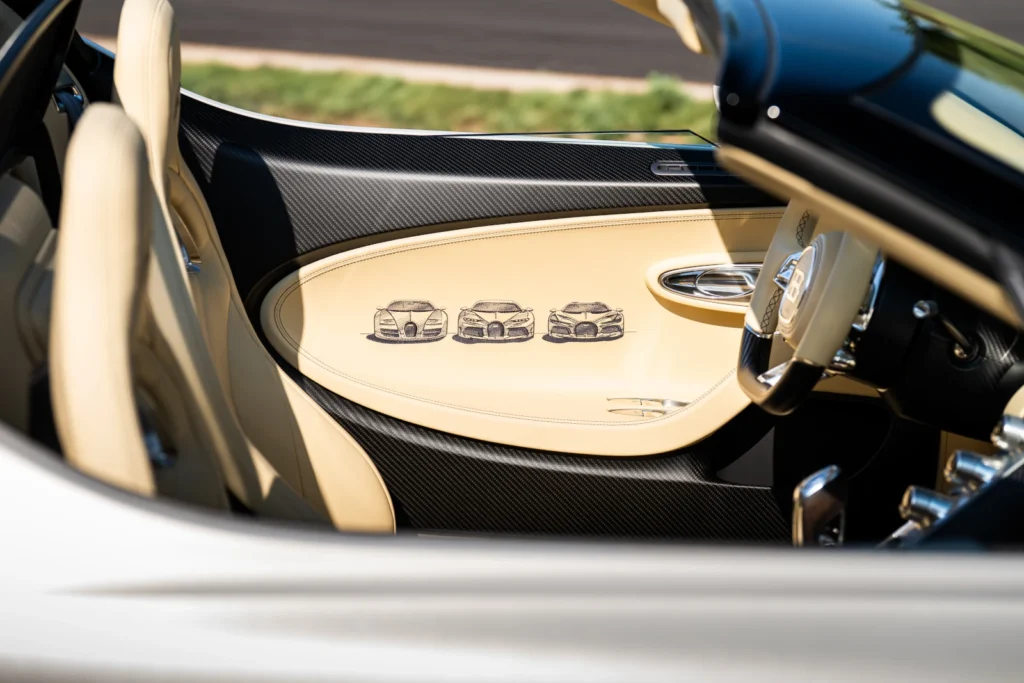
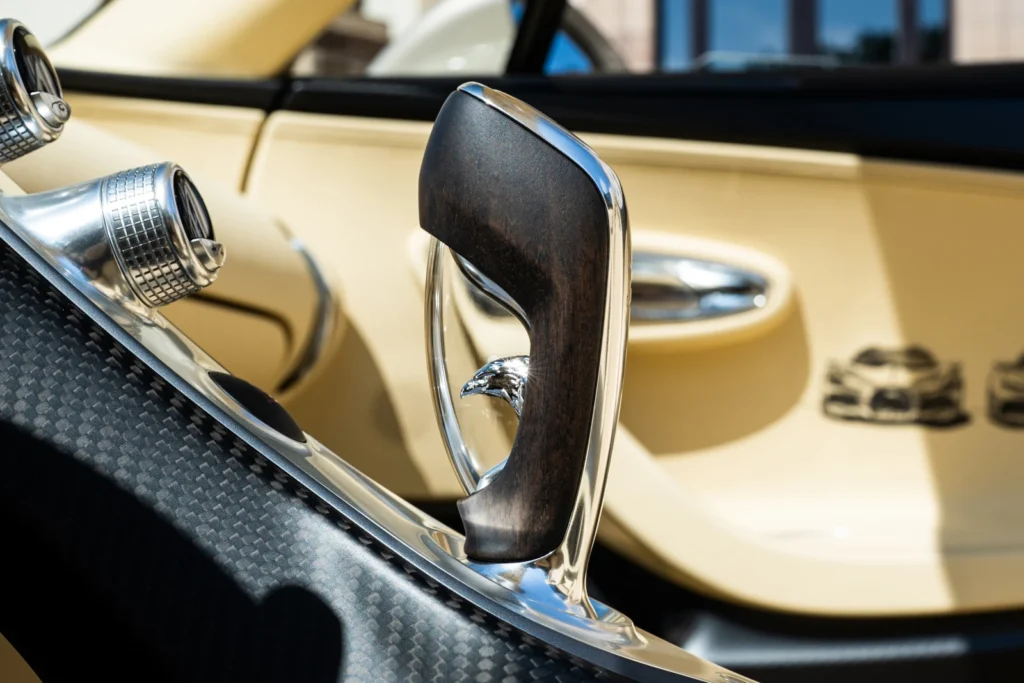
A falcon head takes the place of Bugatti’s usual elephant sculpture on the gear shift, the modification request made through Bugatti Riyadh to represent the customer’s home region. The door panels feature an embroidered sketch in Anthracite.
“The W16 Mistral was always conceived as the ultimate open-top expression of the W16 engine – a car built to let our customers feel that incredible engineering masterpiece in its purest form, with the roof down. Seeing production of this model complete, a few days only after opening La Manufacture, is a special moment for everyone who worked on it – and perfectly sets the tone for what’s still to come from Bugatti,” said Hendrik Malinowski, Managing Director of Bugatti.
Ninety-nine cars is a small number compared to output from most other manufacturers, and it follows a naming pattern Bugatti has used since the Veyron, where names tied to wind, such as Chiron, Divo and now Mistral, each represent a separate model line. The W16 engine has no successor in Bugatti’s current lineup. The Tourbillon, now entering production at La Manufacture, uses a naturally aspirated V16 paired with electric motors. This makes the final Mistral the last new car to carry the W16 engine that Bugatti has used since 2005.