

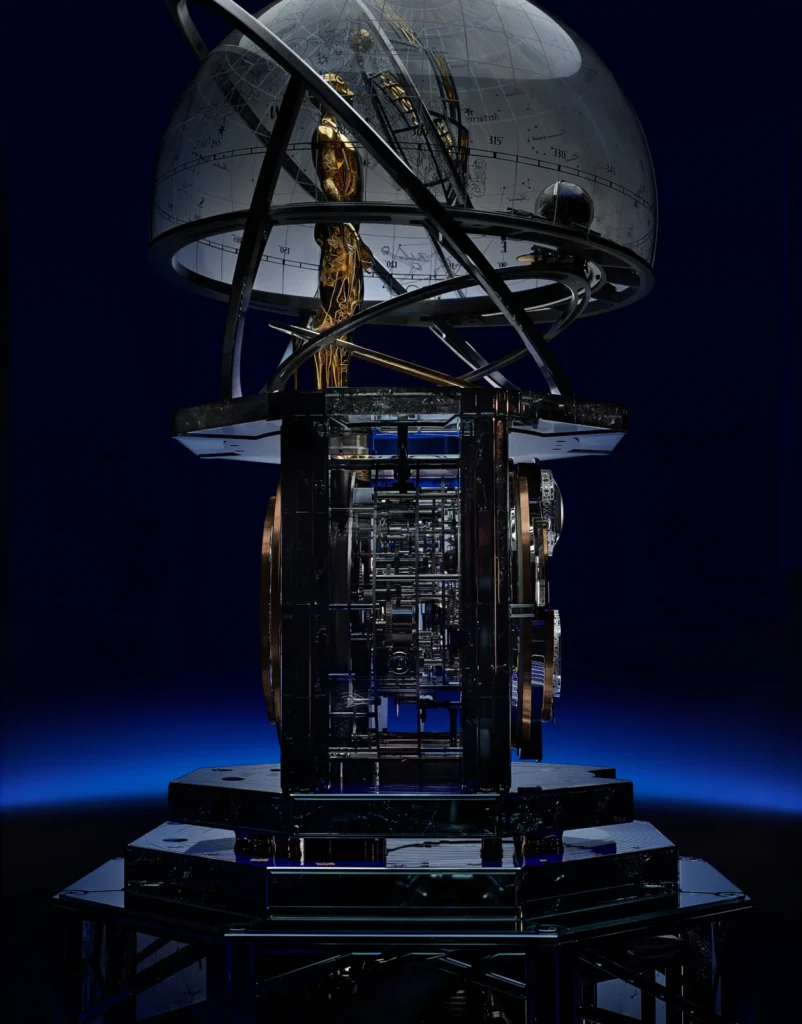
Vacheron Constantin is celebrating its 270th anniversary not with a watch alone, but with something far bigger: a monumental astronomical clock and automaton titled La Quête du Temps. The creation is exhibited at the Louvre in Paris, as the highlight of the “Mécaniques d’Art” exhibition, until November 12, 2025.
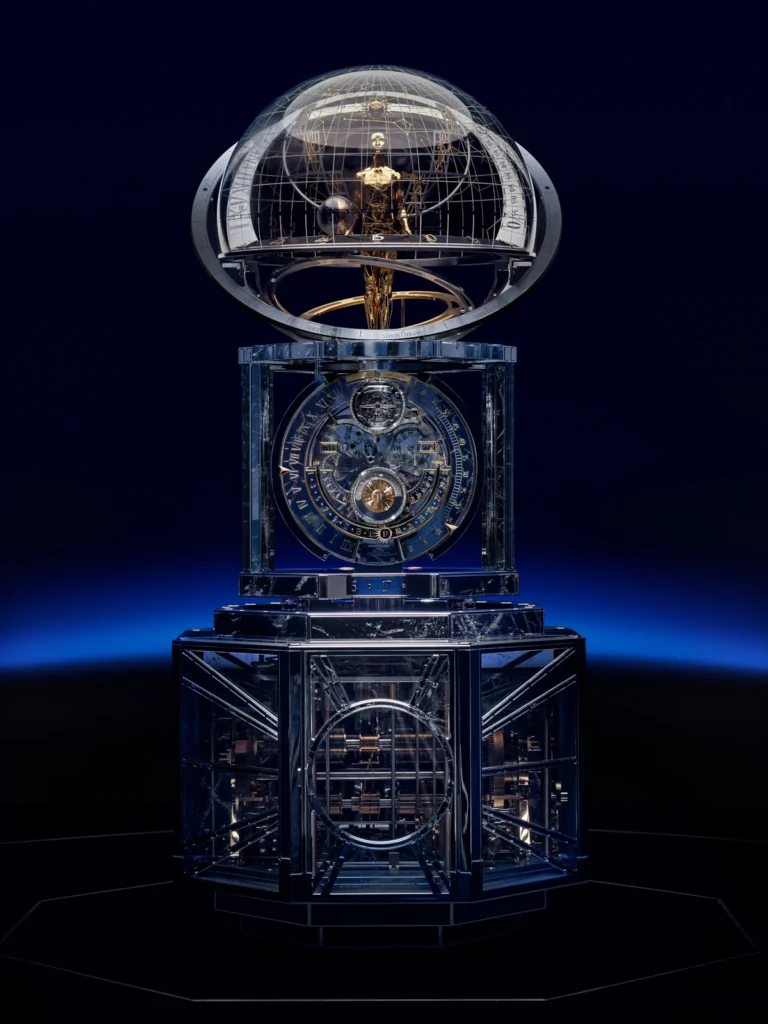
La Quête du Temps has been in development for seven years, uniting master watchmakers, artisans, designers, engineers, automatier François Junod, and astronomers from the Geneva Observatory. It features Calibre 9270, a movement with 2,370 components, 23 complications, and an automaton that indicates the time. Standing over a metre tall, it combines horology with choreography, music, and métiers d’art.
Laurent Perves, CEO of Vacheron Constantin, said, “Is it always possible to do better? Is it always possible to be amazed? Undeniably. At Vacheron Constantin, the pride and emotion we feel with each new project comes from the freedom and passion to create, which is fuelled by the quest for excellence and innovation. The result of seven years of work, this unparalleled collaborative project has given life to a marvellous object, a mécanique d’art that brings together mankind and the universe, in an unprecedented cultural and artistic statement. It also inspired, as is always the case at Vacheron Constantin, a Métiers d’Art wristwatch like no other.”
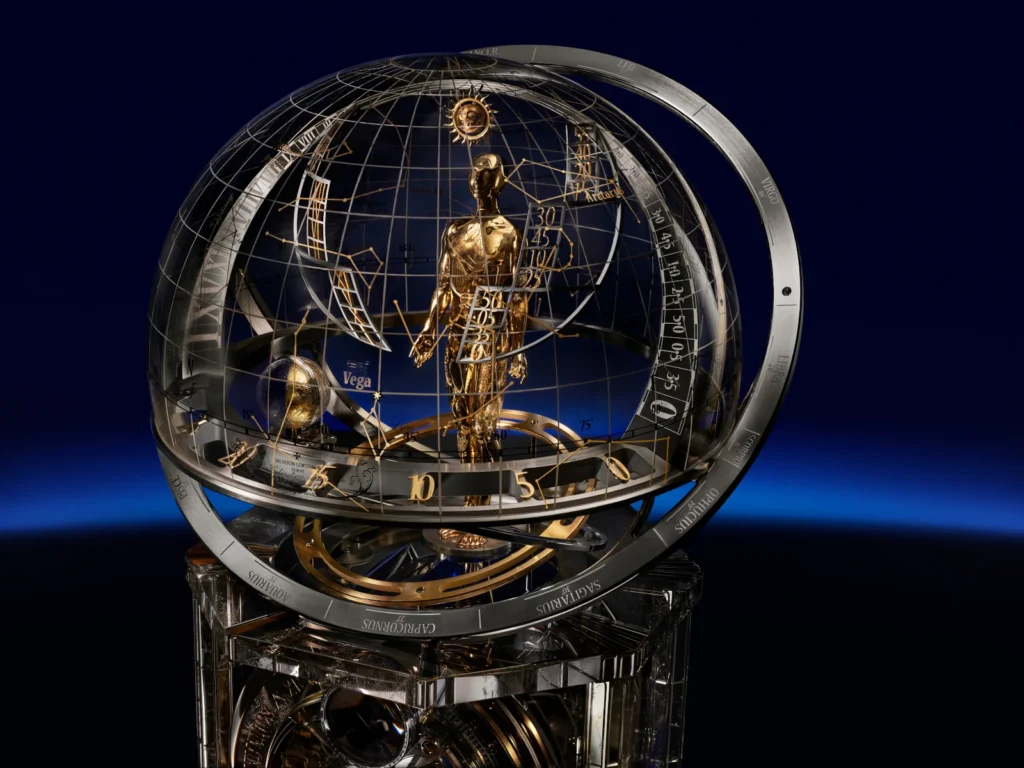
The automaton takes the form of an Astronomer whose gestures invite viewers to contemplate the cosmos. Its choreography unfolds in three sequences, lasting a total of a minute and a half, activated on demand or set to run in advance. A mechanical “music machine” designed with Junod provides sound, including three melodies composed by Woodkid. Unlike traditional automata that simply add animation to clocks, this one acts as a horological complication, displaying hours and minutes on curved, randomly ordered scales suspended beneath a glass dome.
That dome, 40 cm in diameter, is painted with constellations as they appeared in Geneva on September 17, 1755, the exact day and hour that Jean-Marc Vacheron signed a contract with his first apprentice. Astronomers confirmed that at 10:00 am on that morning, Venus, Mars, Jupiter, Saturn, and a rare Sun–Jupiter conjunction were visible above the city. The dome also depicts Orion, Ursa Major, and Ursa Minor, constellations often first recognised in childhood.
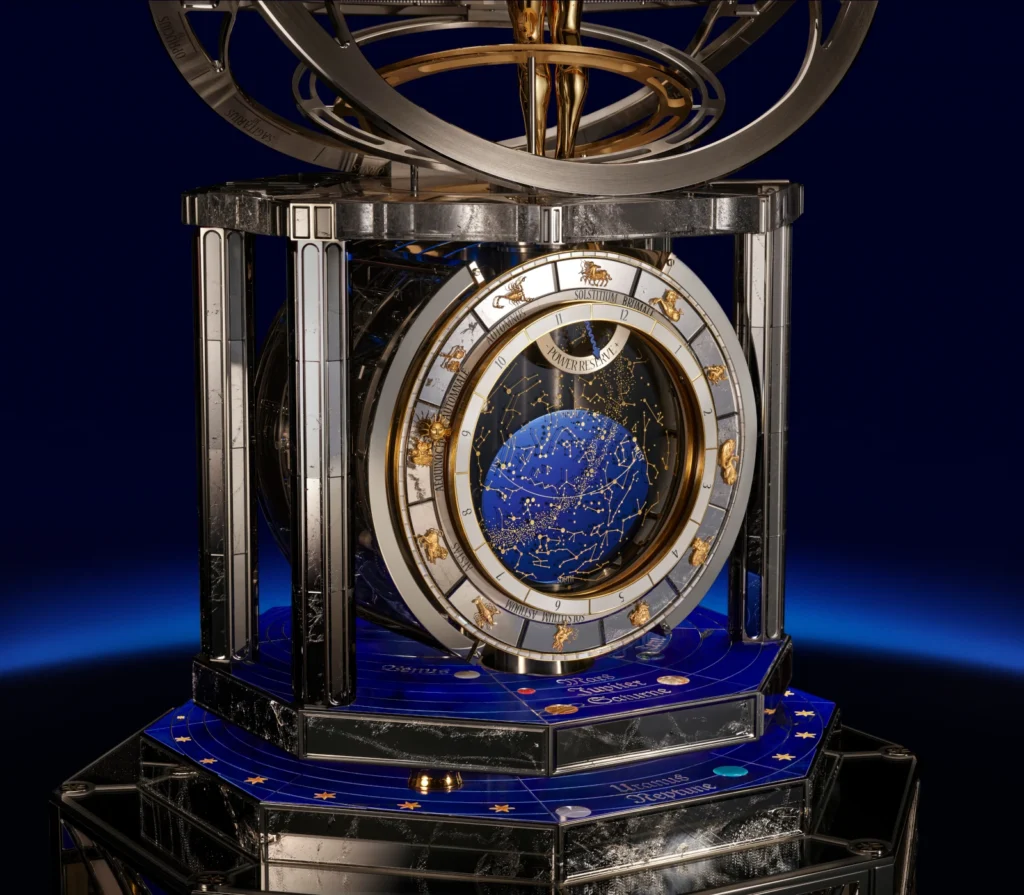
The astronomical clock itself is built with two main dials. On the front, rock crystal layers frame a large tourbillon at 12 o’clock with Vacheron Constantin’s Maltese Cross cage surrounded by baguette-cut diamonds. A perpetual calendar, sunrise and sunset indicators, a 24-hour display, and a retrograde date tracked by a gold sun pointer enrich the display. On the reverse side, a sky chart rotates to show constellations in real time and indicate the sidereal day, accompanied by zodiac, seasonal, and equinox rings.
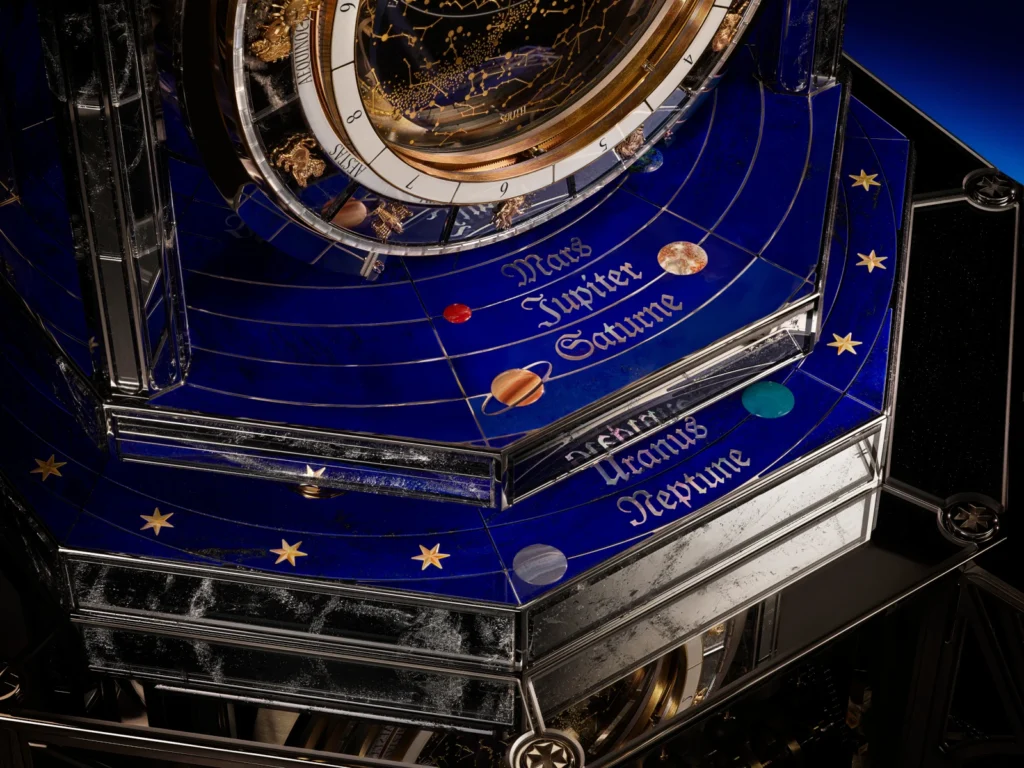
The base of the clock is inlaid with lapis lazuli to depict the solar system, with planets represented by ornamental stones, Earth in azurite, Mars in red jasper, Jupiter in crazy lace agate, and Mercury in silver obsidian. The octagonal plinth houses the mechanism for both the automaton and its music, clad in rock crystal to allow visibility of its moving parts.
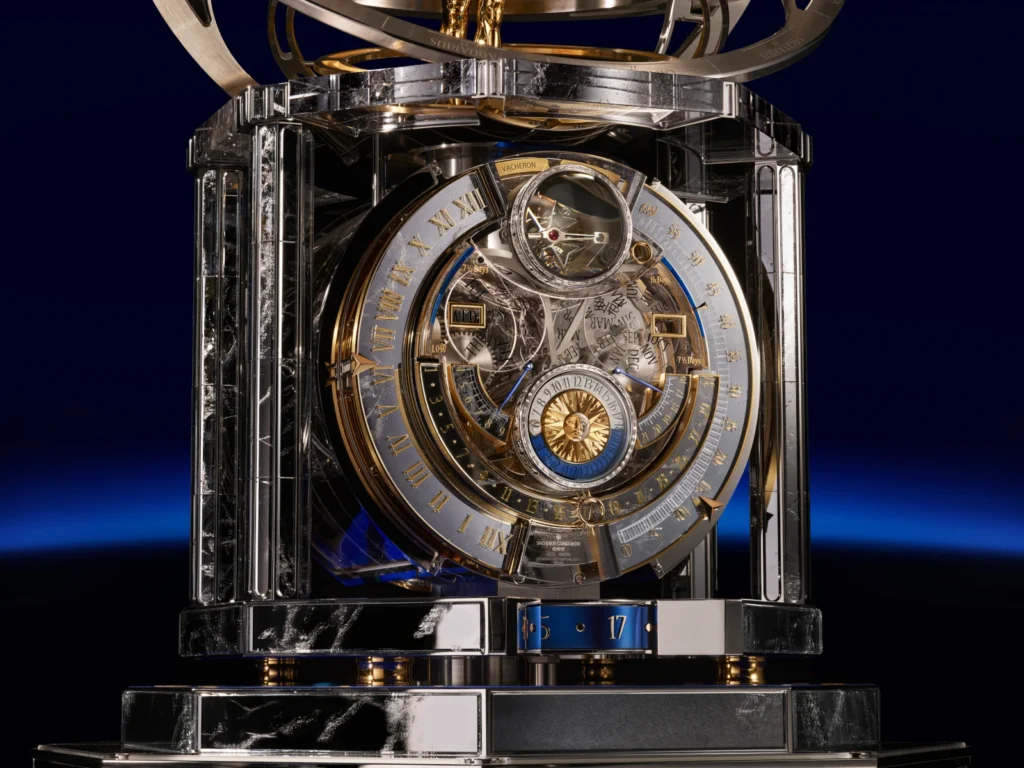
The Astronomer figure, 28 cm tall, was cast in bronze, hand-engraved with constellations, grain-set with diamonds to represent stars, and gilded with 3N yellow gold. The celestial dome required freehand miniature painting on the inside of the glass, a process that took months of trials and three weeks of execution. Diamond-setting, guillochage, enamel, engraving, rock crystal marquetry, and hard-stone inlay are combined throughout the clock.
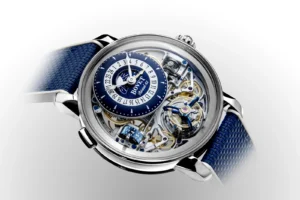
La Quête du Temps also continues Vacheron Constantin’s tradition of translating monumental creations into wristwatches. Inspired by the clock, the Métiers d’Art Tribute to The Quest of Time is a double-sided wristwatch limited to 20 pieces, developed over three years.
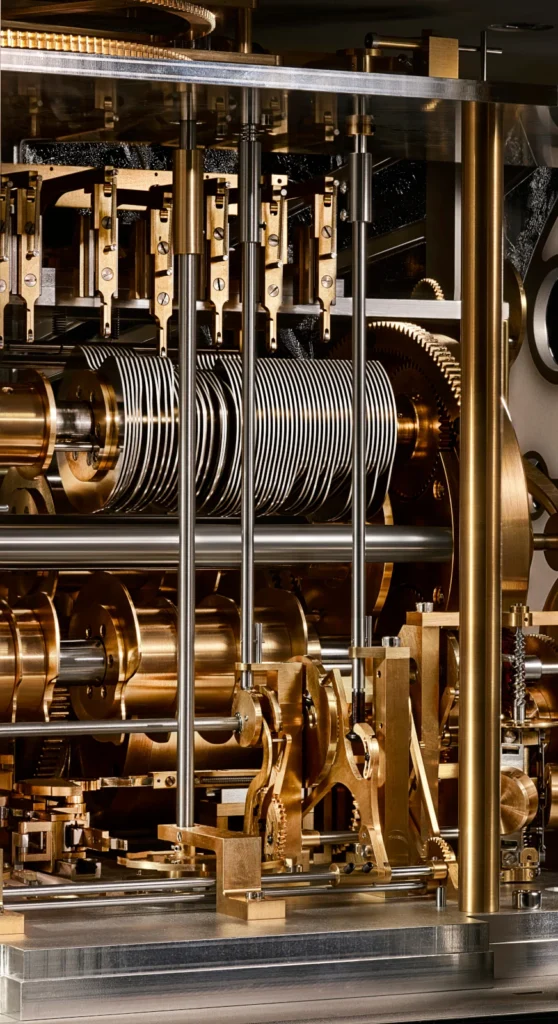
Patent applications linked to the clock include new mechanisms for power reserve displays, rapid date correction, dual gear trains, and retrograde functions. Altogether, the project comprises 6,293 components, each finished by hand to Haute Horlogerie standards, with special attention to the large-scale bridges, tourbillon cage, and visible structures.
Olivier Gabet, Director of the Department of Objets d’Art at the Louvre, said, “Echoing the automaton imagined by Vacheron Constantin, the exhibited works from the Louvre collection evoke the extent to which they all represent an ancient, even immemorial, passion for complex mechanisms and more or less scientific machines. While La Quête du Temps evokes the great Cordovan automatons, or Egyptian water clocks, many of its constituent elements bring to mind the armillary clocks or polyhedral dials of the 17th century. Artistic crafts are part of a genealogy that spans the most diverse eras and civilisations.”
Vacheron Constantin’s La Quête du Temps stands as both a milestone and a statement. By presenting it at the Louvre alongside historical mechanical marvels, the Maison places its creation not just within its own 270-year legacy, but within a broader continuum of humanity’s enduring fascination with time and the cosmos.