

Franck Muller has made a career out of disrupting how we perceive time on a wristwatch. Since 1991, the Geneva manufacturer has consistently prioritized conceptual audacity over convention, earning its self-proclaimed title of “Master of Complications” through a string of world premieres that includes the first tri-axial tourbillon in 2004 and the Aeternitas Mega, which held the record as the world’s most complicated wristwatch from 2010 to 2025 with its 36 complications and 1,483 components.
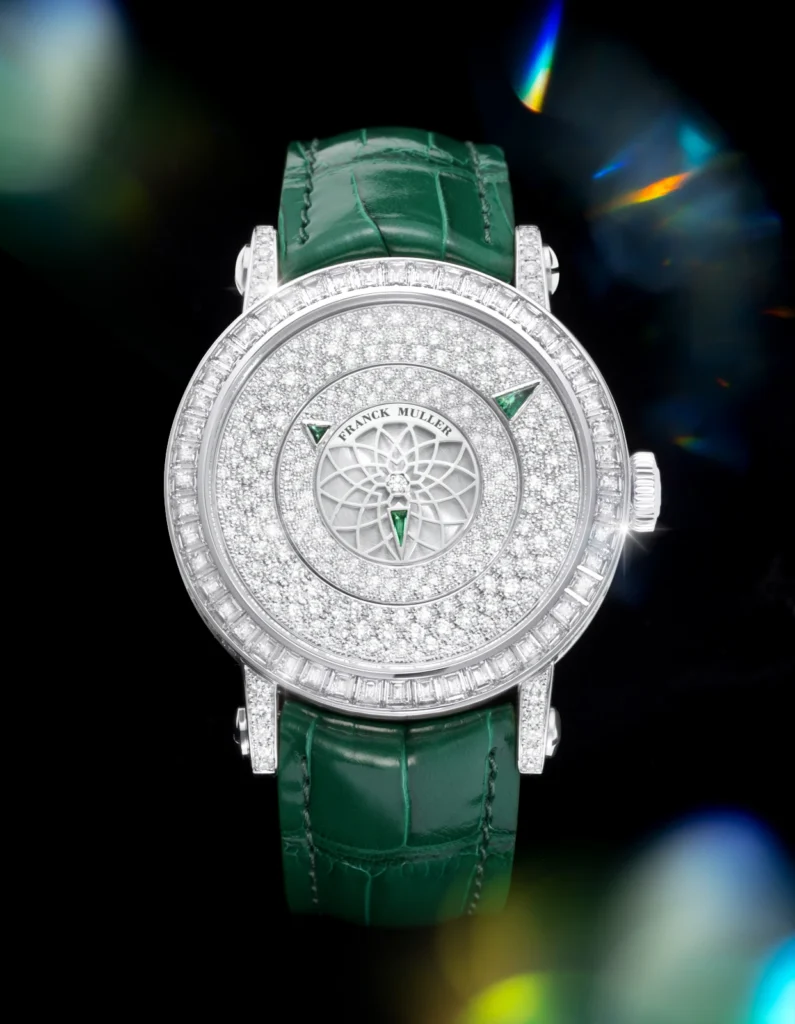
Round Triple Mystery in rose gold represents the latest iteration of this philosophy. It earned finalist status in the Ladies’ Complication category at the Grand Prix d’Horlogerie de Genève 2025 – which was eventually won by Chopard – competing against five other timepieces for one of the industry’s most coveted awards. For a watch that eliminates traditional hands entirely, this recognition validates an approach that many would consider too radical for commercial viability.
Mystery collection’s origin story traces back to a business trip taken by Franck Muller, the brand’s co-founder and namesake. He encountered cultures where time functioned as a fluid construct rather than a rigid framework, where schedules bent to human rhythms instead of dictating them. This cross-cultural experience challenged his assumptions about temporal display and sparked the creation of the first Mystery watch, which replaced conventional hour and minute hands with a single rotating disc showing only the hour.
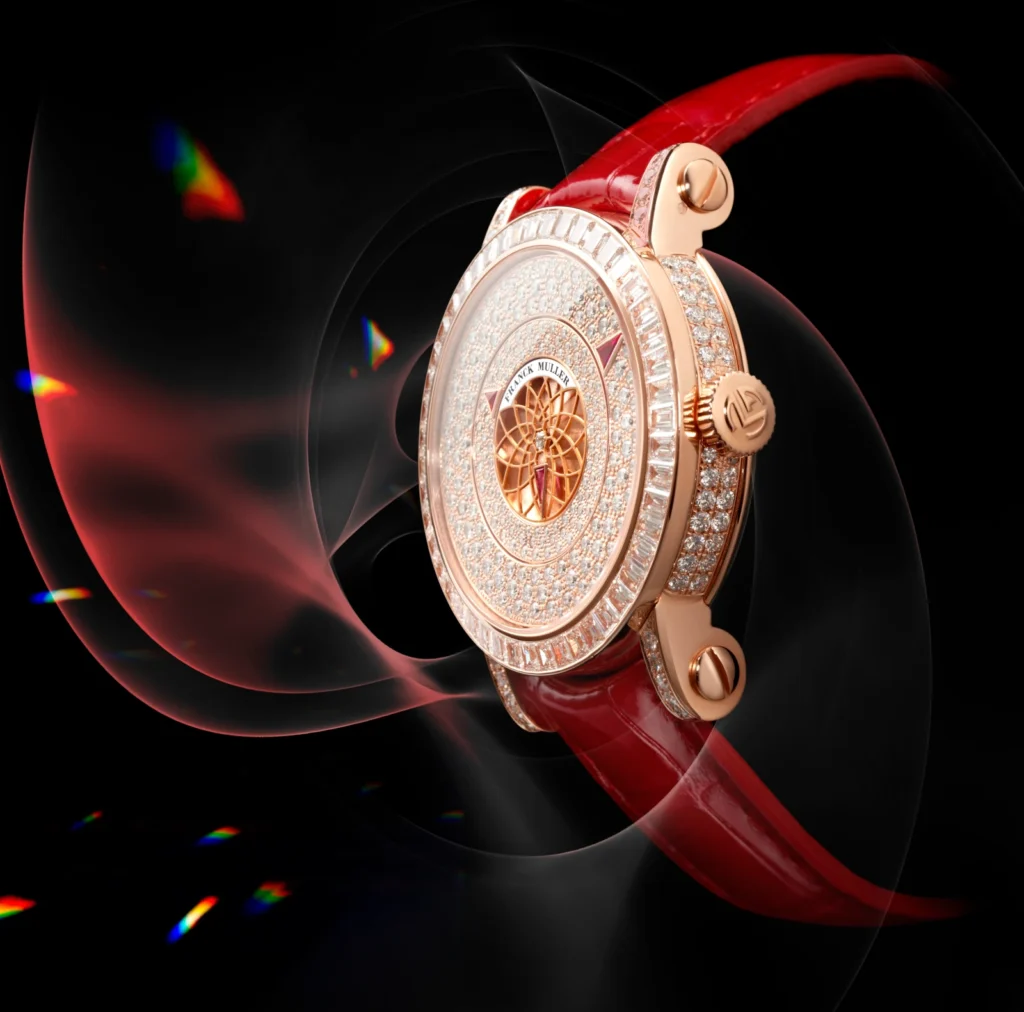
That initial Mystery model appeared in a market dominated by traditional time displays that had remained largely unchanged since the 16th century. Two years later, Franck Muller introduced the Double Mystery, adding a second rotating disc for minutes. Triple Mystery now completes this evolution by incorporating a third disc dedicated to seconds, a progression that might seem inevitable but actually required solving engineering challenges that have consumed watchmakers for generations.
Round Triple Mystery measures 39mm in diameter and is available in rose gold or white gold cases. Its dial features diamonds arranged in a spiral pattern, with three triangular indicators rotating independently on separate discs to mark hours, minutes, and seconds. A version with a baguette-cut diamond bezel offers additional surface decoration for those who prefer it.
Technical complexity escalates significantly with the addition of the seconds disc. Because it completes a full rotation every 60 seconds, this component needed to be extraordinarily light to avoid exhausting the movement’s power reserve or compromising accuracy. Franck Muller’s engineers achieved this through skeletonization, creating a lattice structure that maintains structural integrity while reducing weight to an almost absurd degree.
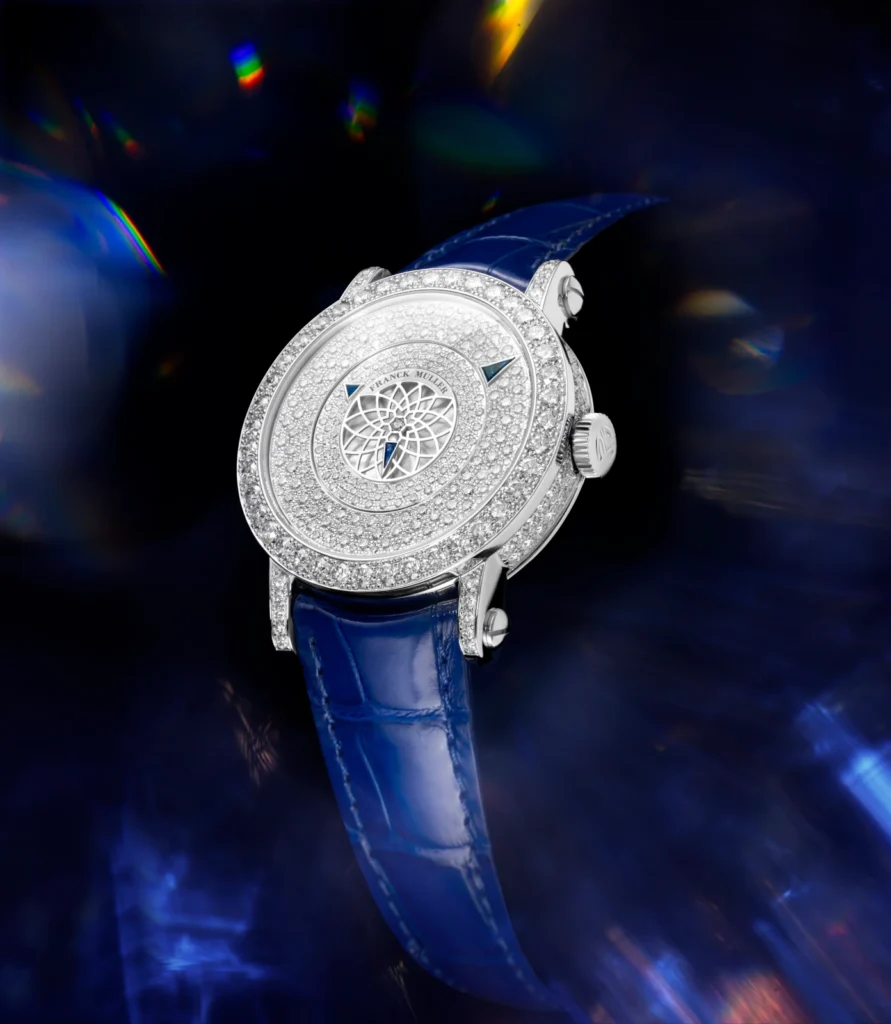
The complete seconds disc weighs just 0.052 grams. Within that figure, the arrow indicator accounts for 0.002 grams, the diamond for 0.003 grams, and the skeleton plate for 0.047 grams. For perspective, a standard paperclip weighs approximately one gram. These specifications represent some of the lightest rotating components in contemporary watchmaking, comparable only to the most extreme complications produced by houses like Vacheron Constantin and Patek Philippe.
Material selection proved as critical as weight reduction. After extensive testing, the engineering team chose aluminum for the central seconds disc, balancing lightness with the structural rigidity necessary for consistent performance. Machining aluminum components at this scale demands surgical precision. Each bridge on the skeletonized disc measures just 0.3mm in width, leaving virtually no margin for manufacturing error.
The central plate carries a single diamond set within a geometric pattern resembling a spirograph drawing. This design choice serves multiple purposes beyond aesthetics. It emphasizes the rotational movement that defines the watch’s function while echoing the diamond-encrusted case, creating an interplay between motion and light that shifts with viewing angle. Seconds indicator itself is a triangle-cut diamond or gemstone that traces a continuous path around the dial, departing from traditional seconds hands that move in jumps.
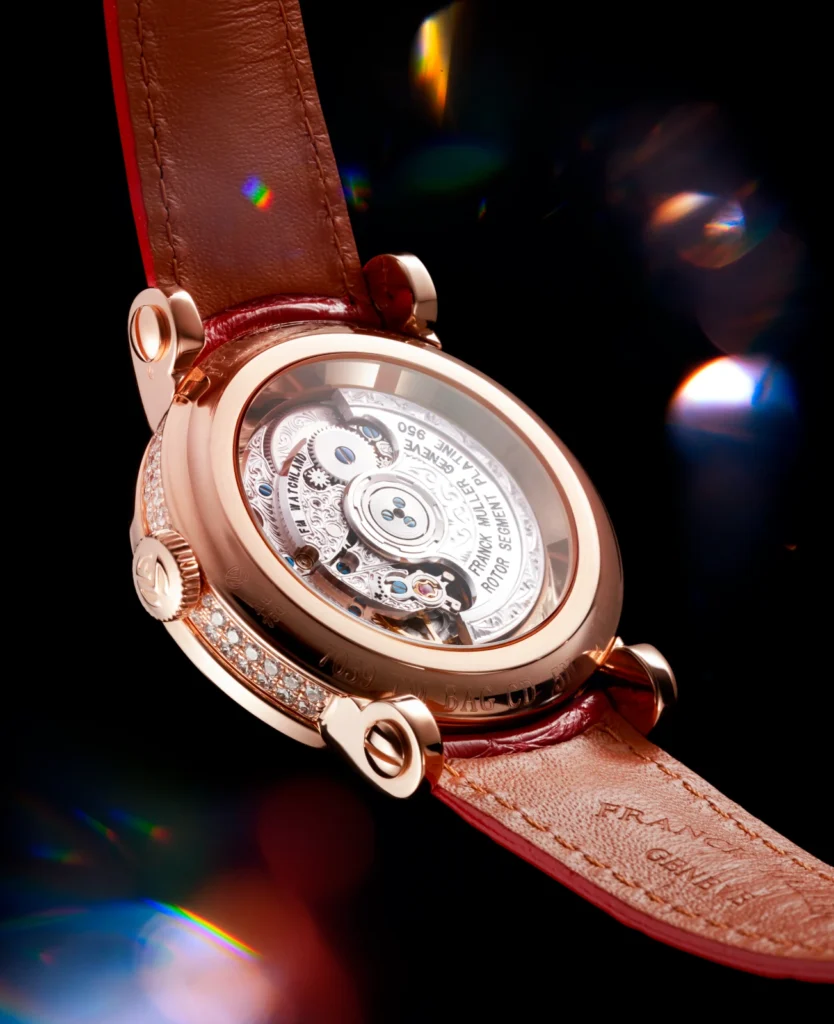
Franck Muller’s approach to watchmaking has always positioned the brand outside the mainstream luxury segment. While houses like Patek Philippe and Audemars Piguet anchor their identities in centuries of unbroken heritage, Franck Muller, founded just over three decades ago, has built its reputation on technical innovation presented through deliberately unconventional designs. The watchmaker introduced the Crazy Hours in 2003, a timepiece that displays numerals in complete disorder while maintaining perfect time through a jumping hour mechanism. That model became one of the brand’s most emblematic creations precisely because it challenged fundamental assumptions about legibility and function.
Franck Muller describes the Round Triple Mystery as “a tribute to the spirit of invention, and to those who believe mystery is not something to be solved, but something to be savoured.” For collectors who view timepieces as preservers of tradition, the Mystery’s approach may seem unnecessarily disruptive. For those who see watches as platforms for creative expression, the three rotating discs offer exactly what contemporary horology should provide: a compelling reason to choose mechanical complexity over digital simplicity.