
Piaget’s relationship with ornamental stone is one of the longest-running creative commitments in Swiss watchmaking, and at Watches and Wonders 2026, it is also one of the most layered.
Everything behind it starts with a technical decision. In 1957, the maison developed the 9P ultra-thin movement, a calibre so slim it gave the watch dial room to become something more than just a surface for hands and numbers. Gérald and Valentin Piaget, grandsons of founder Georges-Édouard Piaget, understood what that meant. By 1963, they were setting dials in tiger’s eye, turquoise, malachite, lapis lazuli, coral, mother-of-pearl, and ruby root, at a time when most of the watchmaking industry was moving toward steel and trying to reach a wider market.
Piaget chose to go the other way, making the watch into a jewelled object rather than a more accessible one. Gold bracelets on these early pieces were crafted with the same level of care as the dials themselves, some woven from gold strands fine enough to move like fabric, others hand-engraved with a pattern the maison would later name Decor Palace, a decorative technique that has remained part of Piaget’s vocabulary ever since.
The 1960s were producing a new kind of luxury buyer, younger, more culturally switched on, and less drawn to the rigid formality that had defined fine watchmaking until then. Ornamental stone dials offered something metal simply could not, each piece carried its own natural markings, its own colour, its own personality. Piaget formalised this thinking with the Style Selector in the mid-1960s, a service that allowed clients to put together their own watch from a selection of gold bracelets, stone dials including tiger’s eye, lapis lazuli, malachite, opal, mother-of-pearl, coral, rhodonite, and ruby root, numeral styles, and diamond bezel options. It was a personalisation model that the rest of the luxury world would not fully catch up to for decades.
With the 21st Century Collection in 1969, Piaget pushed the concept into entirely new territory. Cuff watches that wrapped around the forearm and long necklaces with watch pendants, known as sautoirs, made it hard to say where the jewellery stopped and the watch started. Designer Jean-Claude Gueit spent the following decade developing that idea further, working with jade, rhodonite, and opal across a range of case shapes including trapezoids, ovals, and cushions. Piaget also explored coins, ingots, and envelope shapes during this period, turning everyday forms into precious objects.
In 1972, the Kimono pocket watches arrived, carved from malachite into smooth, irregular shapes designed to sit naturally in the hand. That piece directly informs one of the most talked-about releases at Watches and Wonders 2026. Central to this entire creative period was Yves Piaget’s inner circle, known as the Piaget Society, an international group of celebrities and personalities from the worlds of film, art, and media, whose tastes and lifestyle shaped much of what the maison produced through the 1970s. Opal, one of Yves Piaget’s personal favourites, became closely associated with this era and with that community.
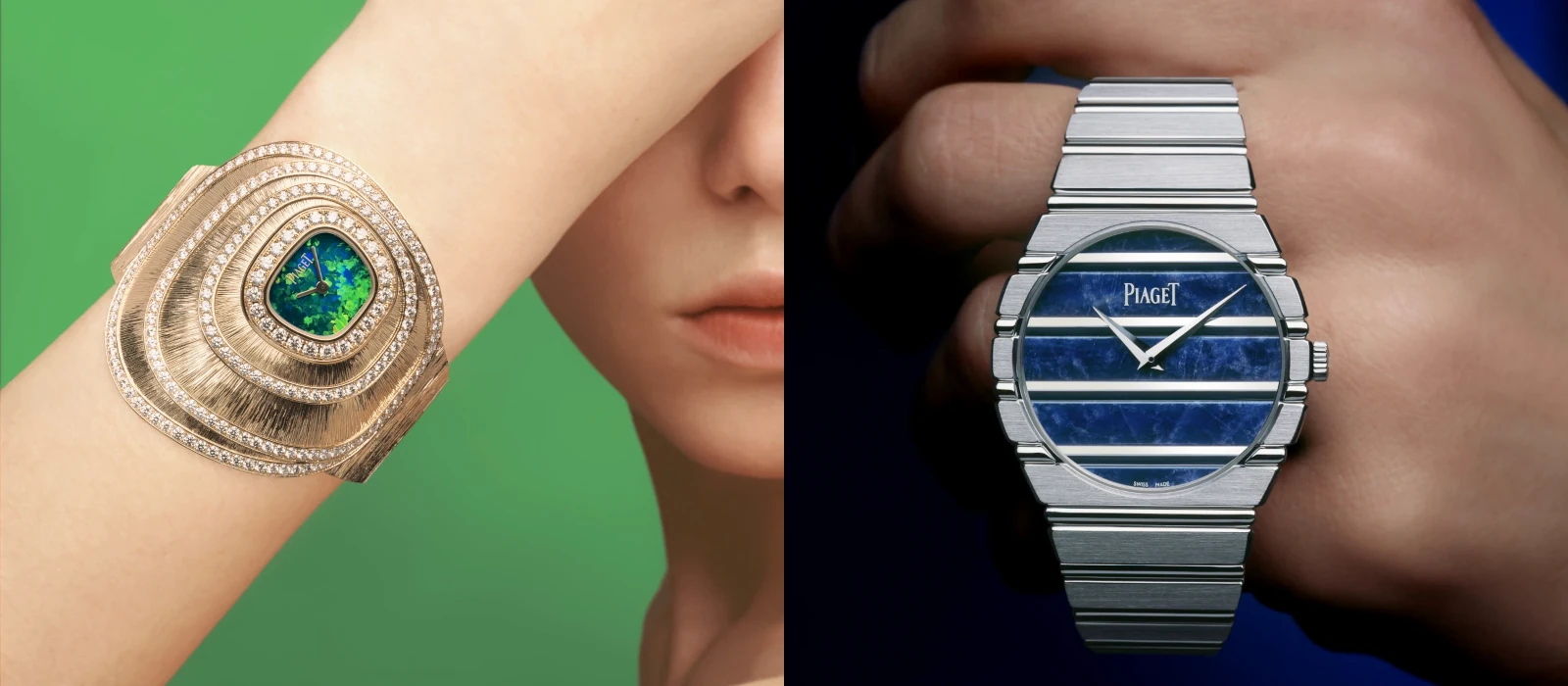
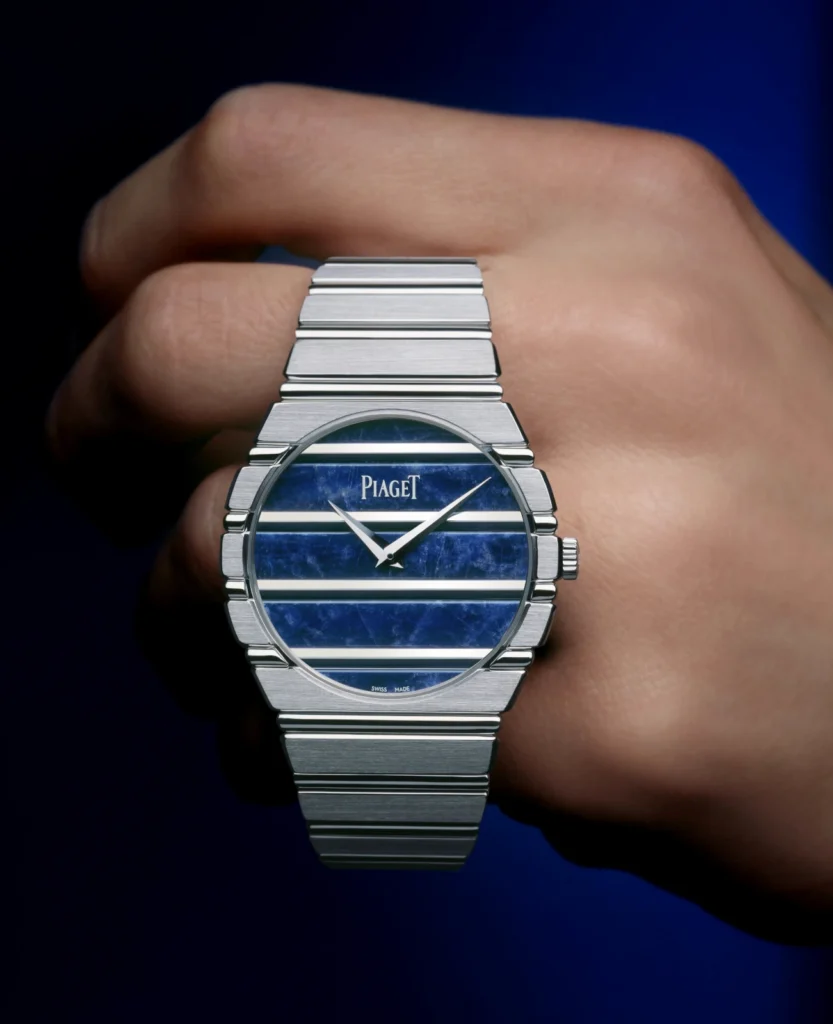
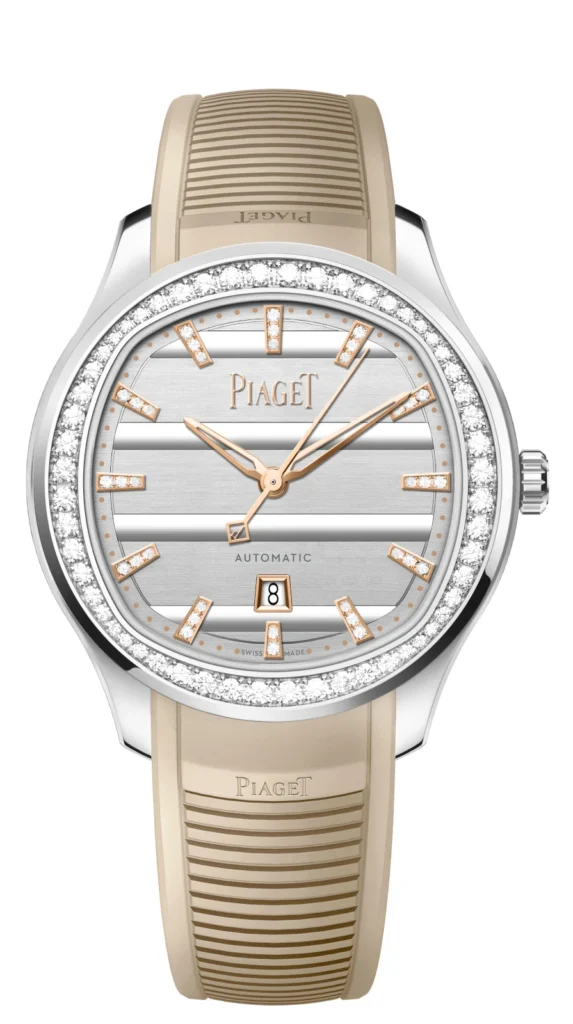
Piaget’s Polo, launched in 1979, has always been the maison’s most grounded and widely worn reference. Built in solid gold with an integrated bracelet and designed for everyday wear, it brought the ornamental stone idea into a more familiar watch format. For 2026, the Polo 36mm in pink gold gets a blue quartz dial, tying this year’s colour focus to one of the maison’s most established pieces. It is a move that carries the ornamental stone thread through the whole collection, rather than confining it to the more experimental or high jewellery end.
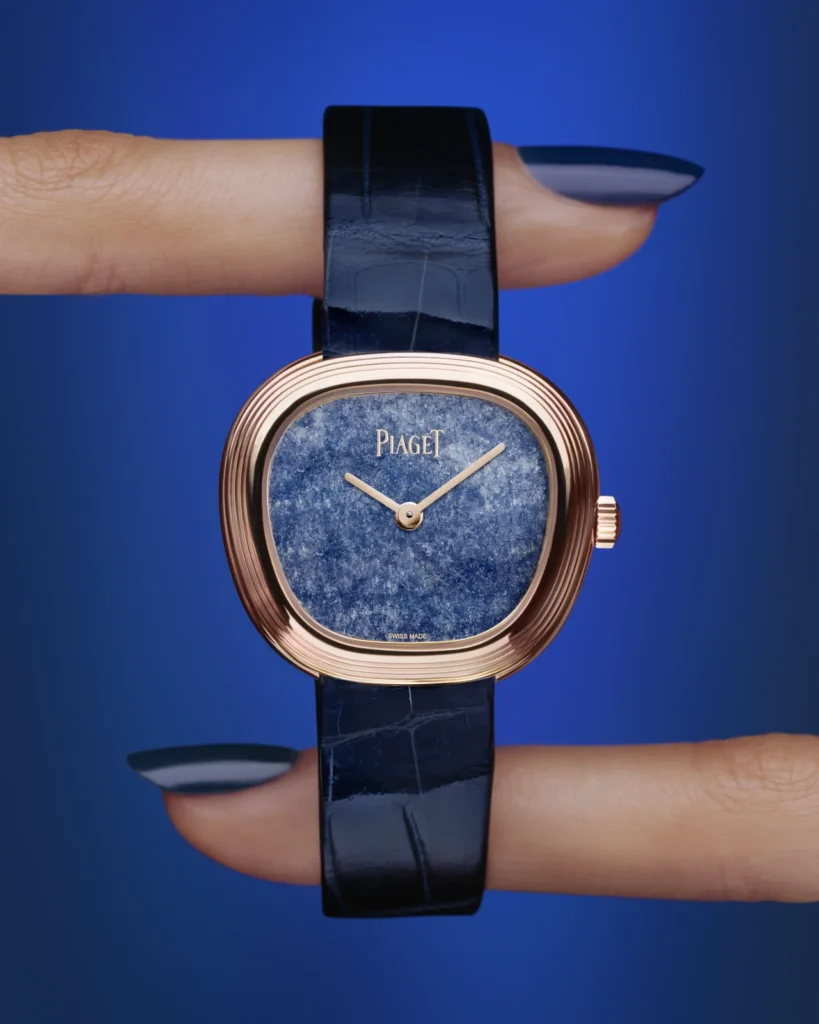
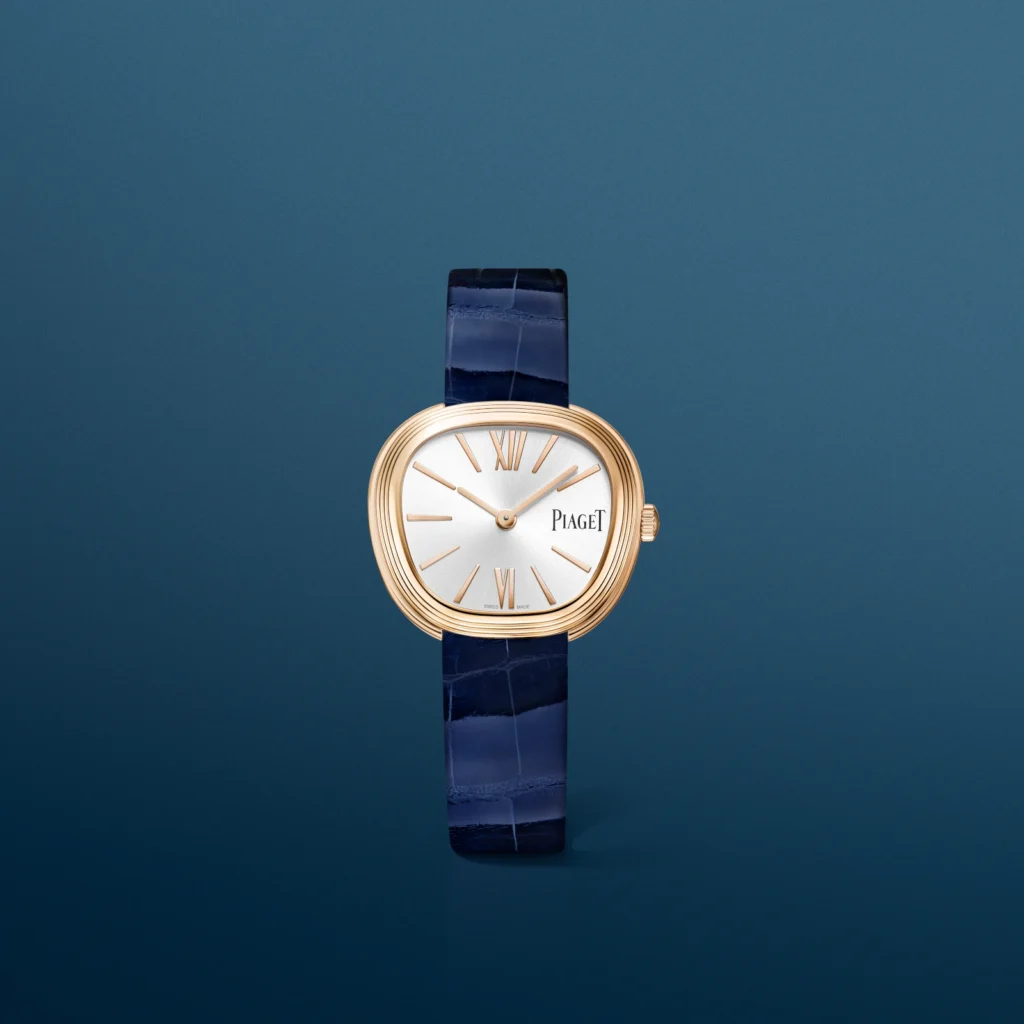
Drawing directly from the trapezoid cases Piaget was producing in the late 1960s, the Sixtie was introduced in 2025 and gets two new versions this year. Both come on deep blue alligator straps, with a trapezoid-shaped buckle carrying the same hand-etched Decor Palace decoration as the watch case. One dial is a silvered, brushed finish with gold Roman numerals. Another is blue quartz, a dense, hard material picked for its longevity as much as its looks, with a marbled surface streaked with darker veins.
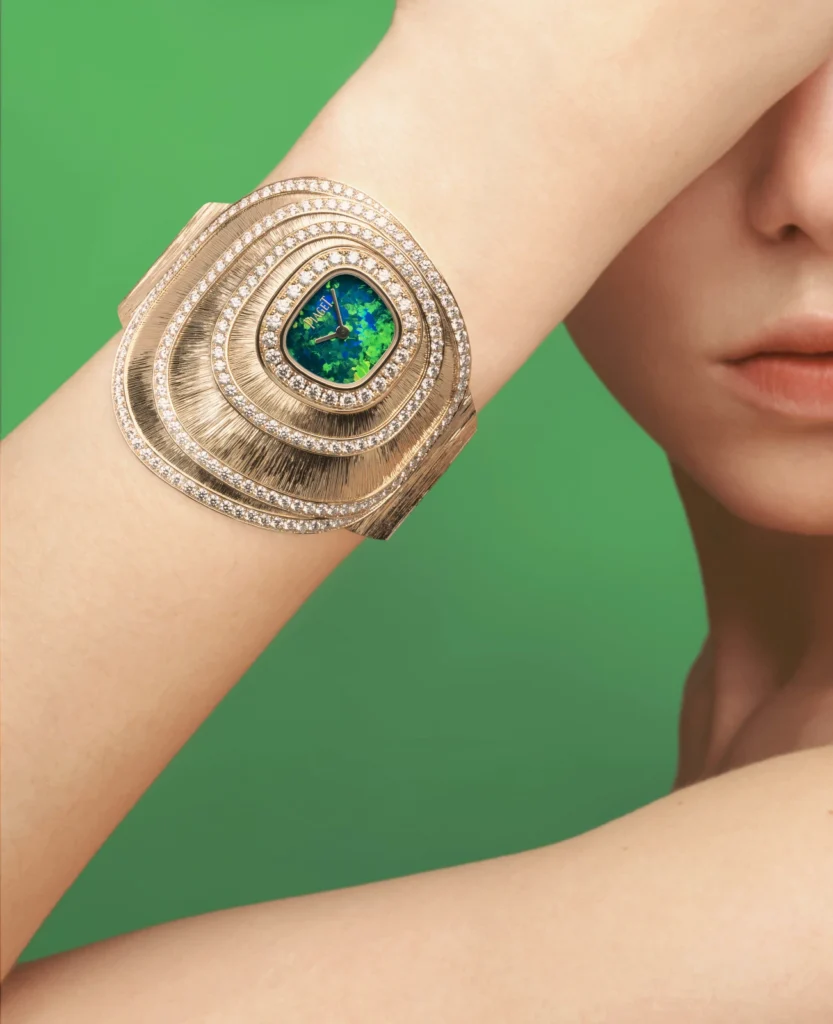
No two dials will look exactly alike because the stone itself makes that impossible. A separate High Jewellery version of the Sixtie also features in the 2026 lineup, this one a cuff watch set in opal and hand-engraved with the Decor Palace pattern, a direct reference to the 1970s cuff watches and to the Piaget Society that defined that period.
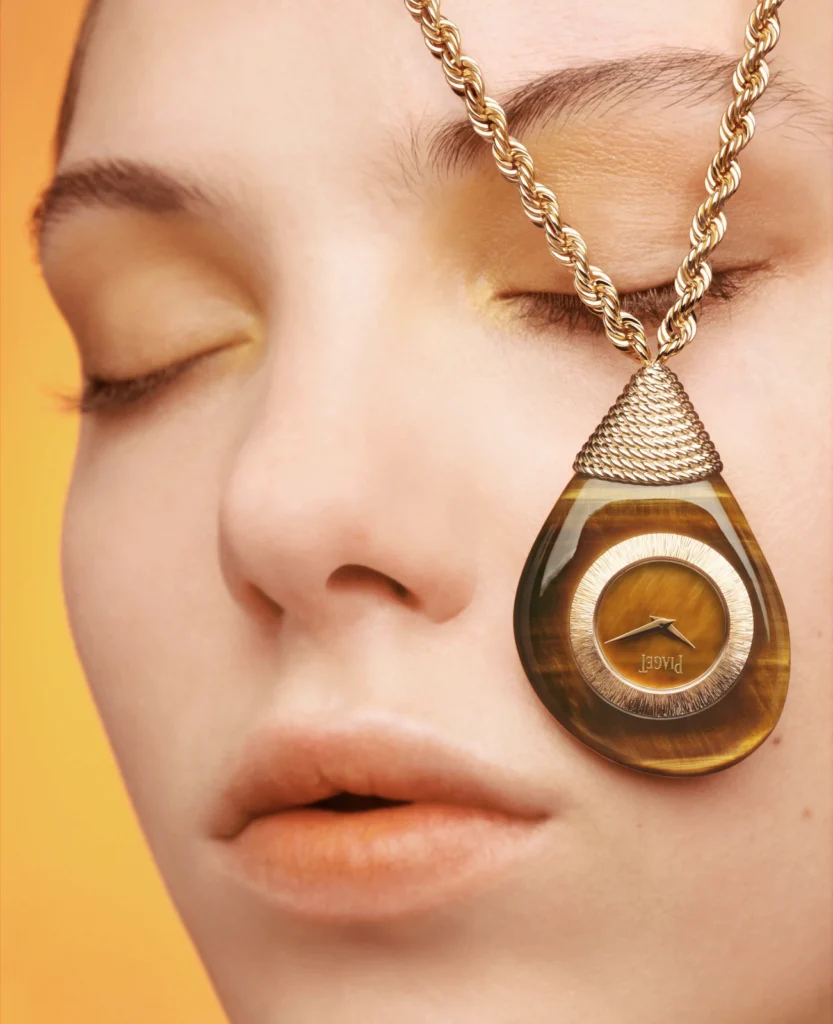
Each Swinging Pebble is a pendant watch carved from a single slice of ornamental stone, available in tiger’s eye, grass-green verdite, or pietersite. Each stone is hollowed out to hold a movement, then sealed into a smooth, rounded shape and attached to a hand-twisted gold chain. There is no visible separation between the stone and the watch, the two are the same object. Rooted in the 1972 Kimono pocket watch, the Swinging Pebbles bring that concept into a necklace format using three stones that did not feature in the original. As Yves Piaget once said, “A watch is first and foremost a piece of jewellery,” and the Swinging Pebbles make that point more directly than almost anything else in the 2026 lineup.
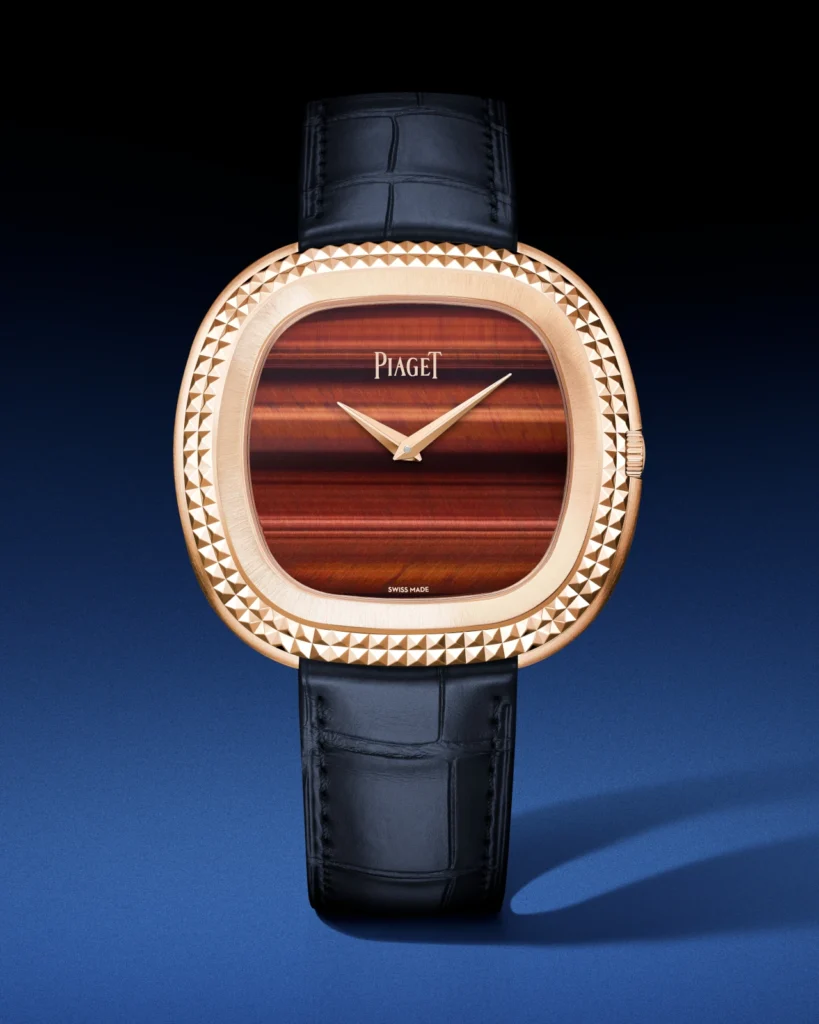
Holding a loyal collector following within the Piaget range, the Andy Warhol watch receives a new dial in bull’s eye stone, a warm reddish-brown material with a natural optical quality called chatoyancy, which causes the surface to appear to shift and catch the light differently depending on the angle. It sits in a Clou de Paris studded case, a surface treatment Piaget has been using since the 1960s. Worth noting is that this combination was first introduced in 2024 in a white gold version, making the 2026 release a continuation of that reference rather than a new introduction. Together, the stone and the texture produce a warmth and depth that neither would achieve on its own.
Widely regarded as one of the highest levels of craft in watchmaking, a tourbillon is a small rotating cage inside a watch movement, developed originally to make timekeeping more precise. Piaget’s Altiplano Ultimate Concept holds the record for the world’s thinnest at 2mm, and for 2026, an ornamental stone has been worked into that 2mm profile. To achieve this, the stone has to be cut to just 0.4mm thick, at which point it is extremely fragile and highly prone to breaking. Once inside the movement, any residue left from the process has to be removed with a 0.15mm needle, the smallest tool Piaget uses. A main version pairs tiger’s eye with pink gold, and a choice of four case colours and four stones, tiger’s eye, blue sodalite, jade, and onyx, is available, a direct callback to the choice-led structure of the original 1960s Style Selector.
Piaget’s 2026 collection brings together the Polo, the Sixtie, the Swinging Pebbles, the Andy Warhol reference, the Altiplano Ultimate Concept Tourbillon, and the High Jewellery Sixtie cuff in opal. Across every piece, ornamental stone is the starting point of the design, not a surface treatment added at the end.
Cutting and polishing these materials to the required thinness, and spreading the use of stones this year, represents the widest ornamental stone range Piaget has presented in a single collection in recent memory.