
Ikat is one of the oldest resist-dyed textile traditions in the world, with roots stretching across Asia. The craft is defined by its precision and patience: yarns are tied, dyed, untied, and retied before they ever reach the loom, so that the design emerges not on the surface, but from within the weave itself. Unlike printed or embroidered textiles, Ikat patterns are never perfectly predictable; their beauty lies in a gentle blur, a softness at the edges that reveals the human hand behind every metre of cloth.
In India, Ikat has evolved through distinct regional identities, each shaped by geography, materials, and cultural exchange. The Ikat traditions of Telangana are known for their bold, graphical motifs and fluid geometry, developed over generations of warp-dyed weaving. Once worn primarily as traditional attire, Ikat today is being reinterpreted by contemporary design voices who see it not merely as heritage, but as a living language.
Indian brand Translate is one such brand that’s redefining Ikat for the modern world. Founded in 2010, Translate is a Hyderabad-based concept apparel and textile label dedicated to presenting Ikat in a contemporary form while preserving its handcrafted integrity. Co-founded by Vinita & Vickas Passary, and textile revivalist-designer M. V. Chandrashekar, the brand works at the intersection of heritage craft and modern design. From its design studio in Telangana, Translate develops apparel and lifestyle textiles defined by relaxed silhouettes, versatility, and a timeless aesthetic. Over the years, it has grown into a recognised craft-led label in India, available through its own retail channels and select multi-designer platforms.
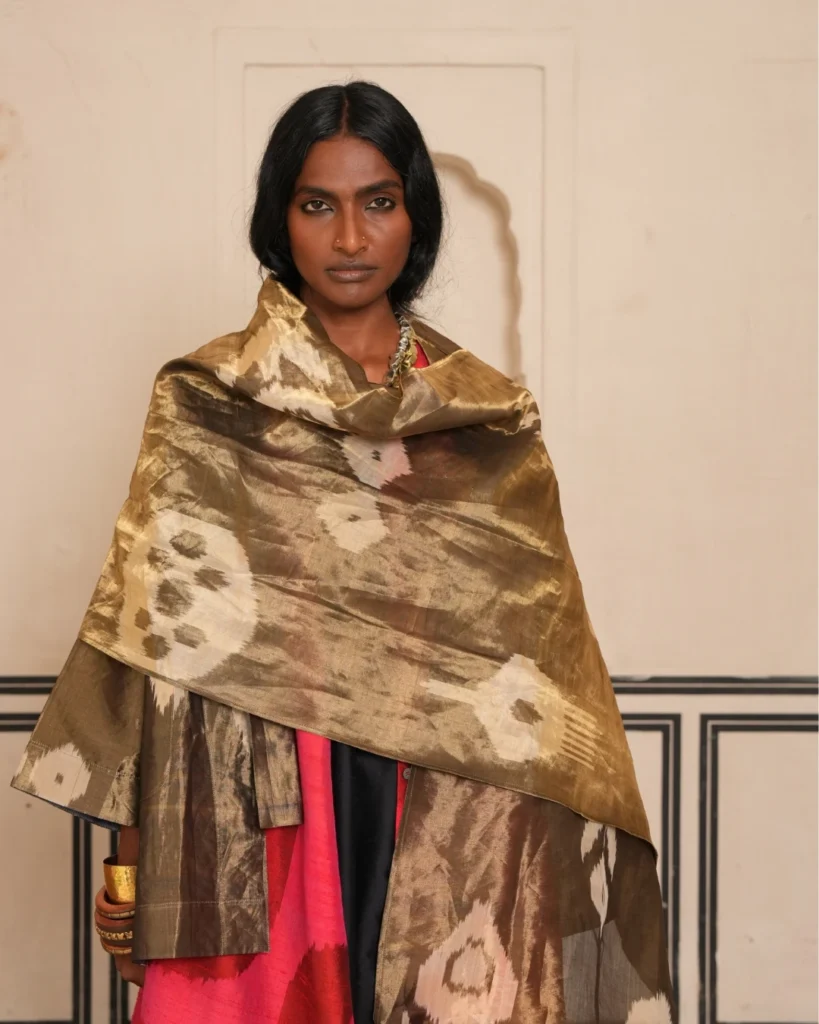
Traditionally, you see silks or cotton Ikats, but blending Ikat with zari in this way is quite unusual. It hasn’t really been seen in the market before.
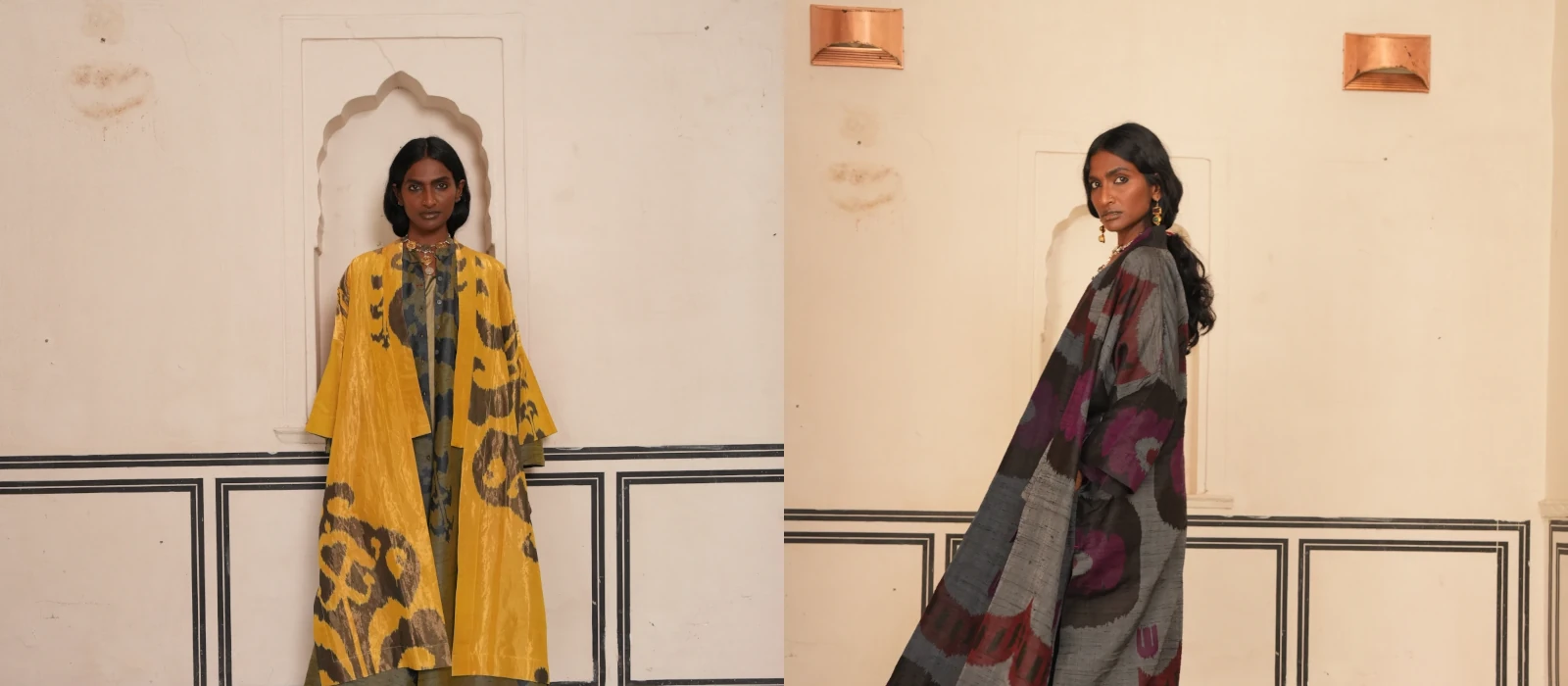
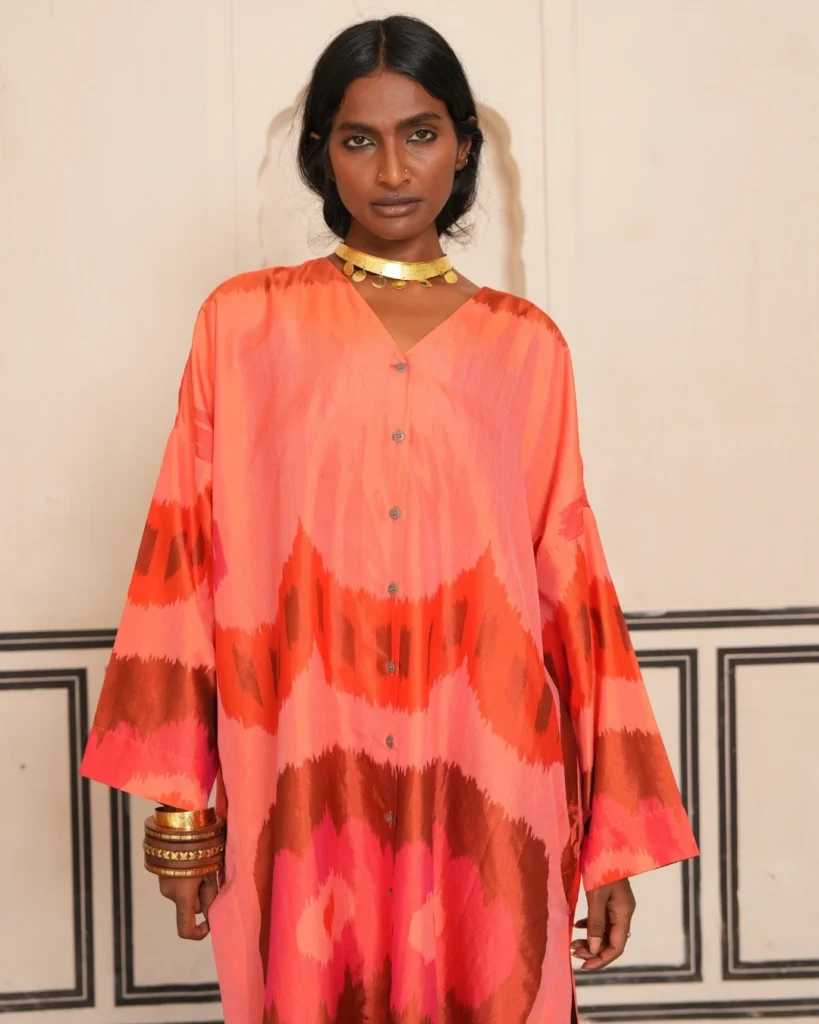
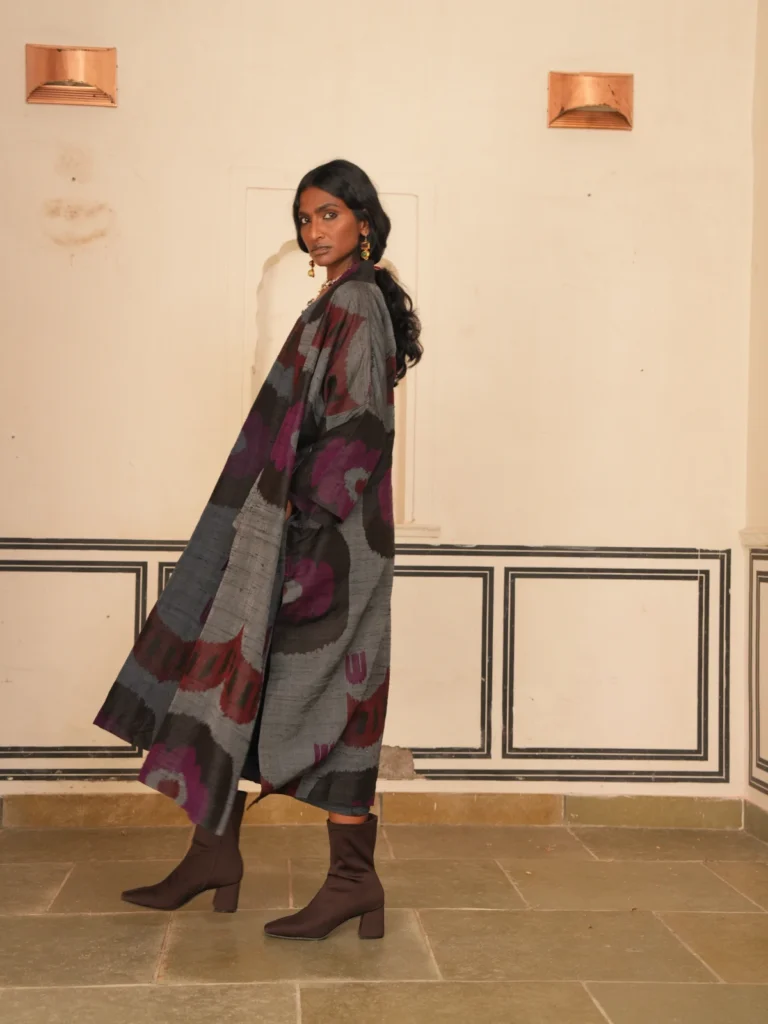
Silk Odyssey, their recent collection, reimagines traditional Ikat weaving by blending silk-on-silk fabric with the richness of zari. In our conversation with Vinita Passary and Chandrashekar, we delved into the inspiration behind the collection, and craftsmanship and philosophy that shape Translate’s vision.
What was the starting point for Silk Odyssey?
M.V. Chandrashekar (MVC): Silk Odyssey is essentially a silk-on-silk Ikat collection with zari woven into the fabric. Zari is relatively new for us. We had earlier introduced it through a small capsule, and the response was very encouraging, which gave us the confidence to explore it further.
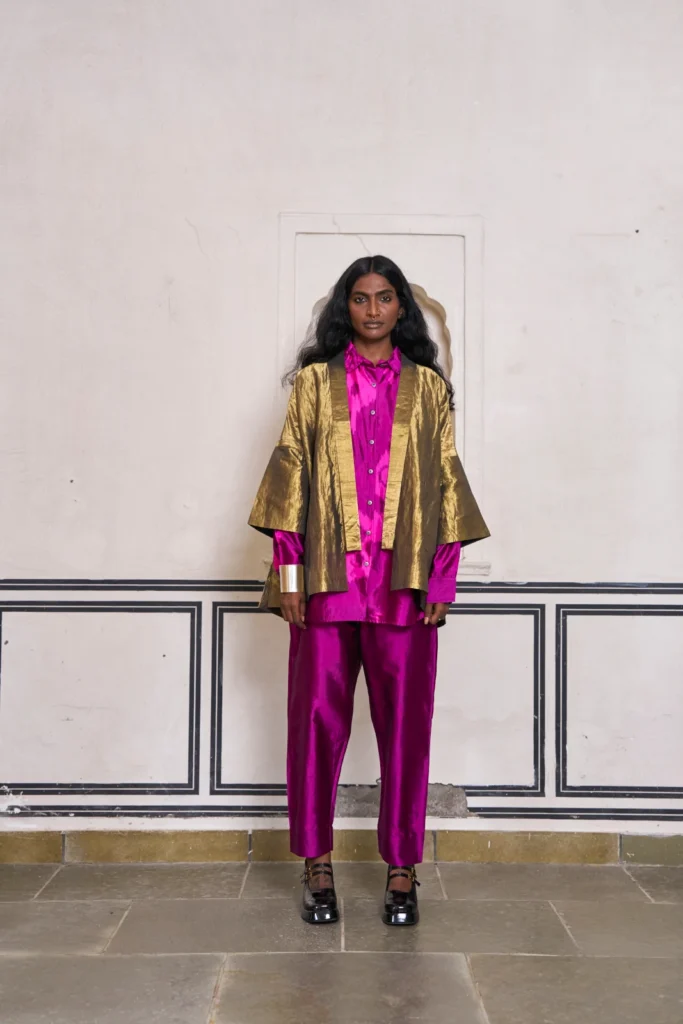
Traditionally, you see silks or cotton Ikats, but blending Ikat with zari in this way is quite unusual. It hasn’t really been seen in the market before. At the heart of this exploration is our long-standing relationship with weaving families, whose generational knowledge makes such experimentation possible.
Silk is both strong and delicate. What kind of challenges come with working with it?
MVC: We work with weavers from Pochampalli, Telangana, who are fifth- and sixth-generation practitioners, so silk itself isn’t really a challenge for them. In fact, silk gives you much better finesse than cotton. The clarity of motifs, the lustre, the way colours show up. Everything is far more pronounced in silk, and that finesse is what makes silk so beautiful to work with.
There are so many processes involved in creating a fabric. Are all of these handled in-house?
MVC: Yes. Everything is done under our supervision. Design ideation happens in our studio. The designs are then sent to the weaving belt, where the yarns are dyed and woven by the same weavers who have practised this craft for generations. Once the fabric comes back to us, we wash it in-house before converting it into garments.
This is very important to us. Loom-finished fabrics are usually starched, which makes them stiff. We want our garments to feel luxurious and lived-in. We even wash our silks before garmenting. This removes the natural gum that can make silk stiff. After washing, the fabric becomes much softer, more fluid, and more drapey. That softness is intentional.
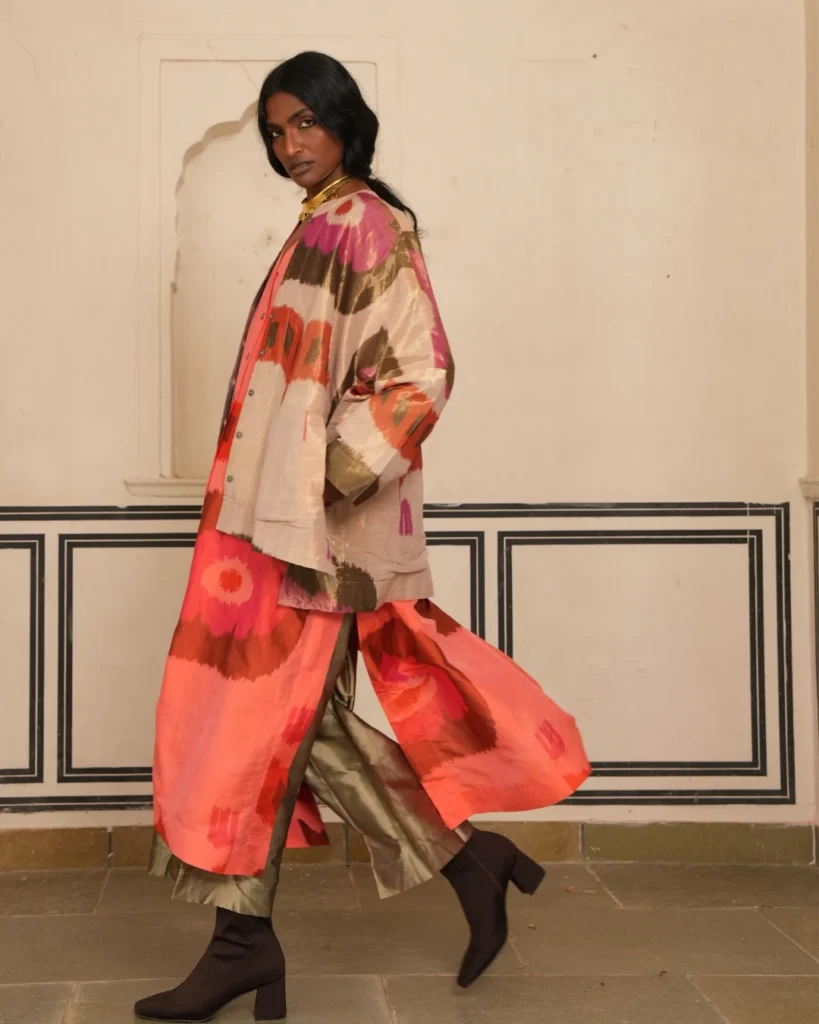
If a design has multiple colours, the yarns are tied and dyed repeatedly, over days and sometimes weeks by weavers who have inherited this knowledge across generations.
Roughly how many steps go into creating a garment, from start to finish?
MVC: If you look only at the weaving process, it starts with translating the design onto a graph sheet. That’s where the entire resist-dyeing plan is mapped out. Then the yarns are tied, dyed, warped, and woven.
Once the fabric is ready, it comes back to us, is washed, cut, and sewn. The most tedious part is the tying. Every colour requires its own resist (a barrier created on the yarn to prevent dye from reaching certain areas). If a design has multiple colours, the yarns are tied and dyed repeatedly, over days and sometimes weeks by weavers who have inherited this knowledge across generations. That repetition is what makes Ikat such a meticulous and time-consuming craft.
Tell us about the design inspiration behind Silk Odyssey.
MVC: The inspiration comes from Central Asian Ikats. We actually introduced these influences into the Pochampalli belt back in 2011. Weaving communities are naturally conservative—it’s their livelihood, so that caution is understandable. But over the years, through consistent work and trust-building, we’ve been able to challenge and expand what’s possible.
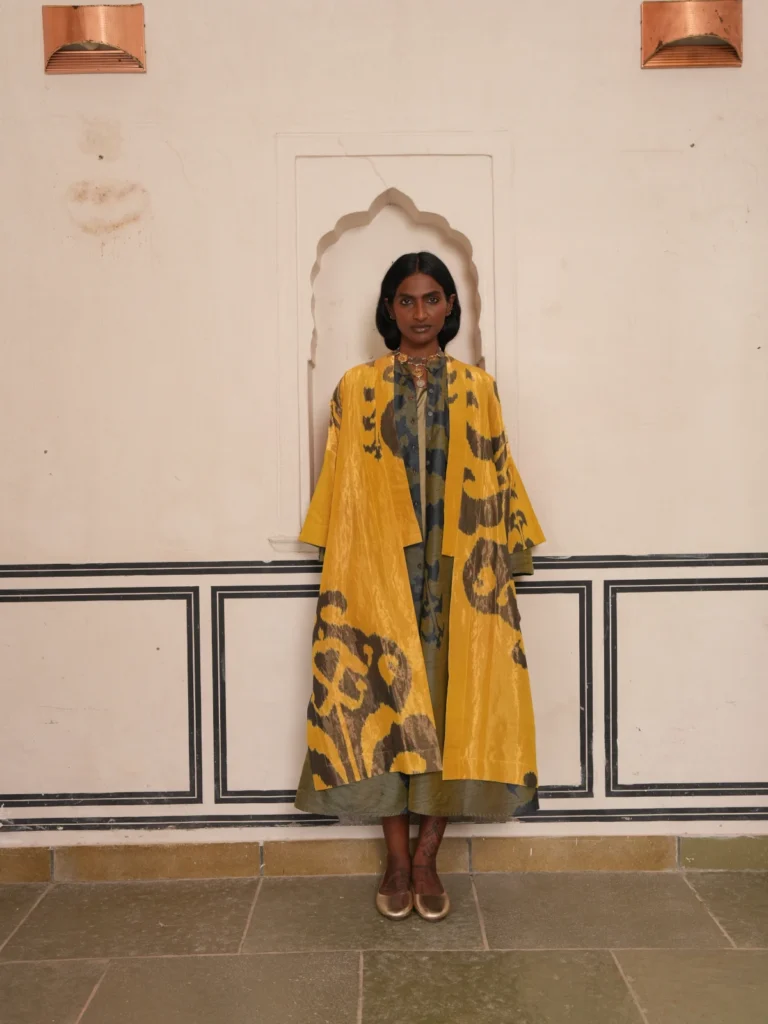
Vinita Passary (VP): For Silk Odyssey, scale played a big role. Design is very much about scale—how much space a motif occupies, how colours interact, how the eye reads the fabric. By enlarging motifs, they become easier to comprehend, both for the weaver executing them on the loom and for the wearer experiencing them.
We’re trying to move people away from “what you see” and towards “what you feel.”
One thing that stands out is that no two garments look the same.
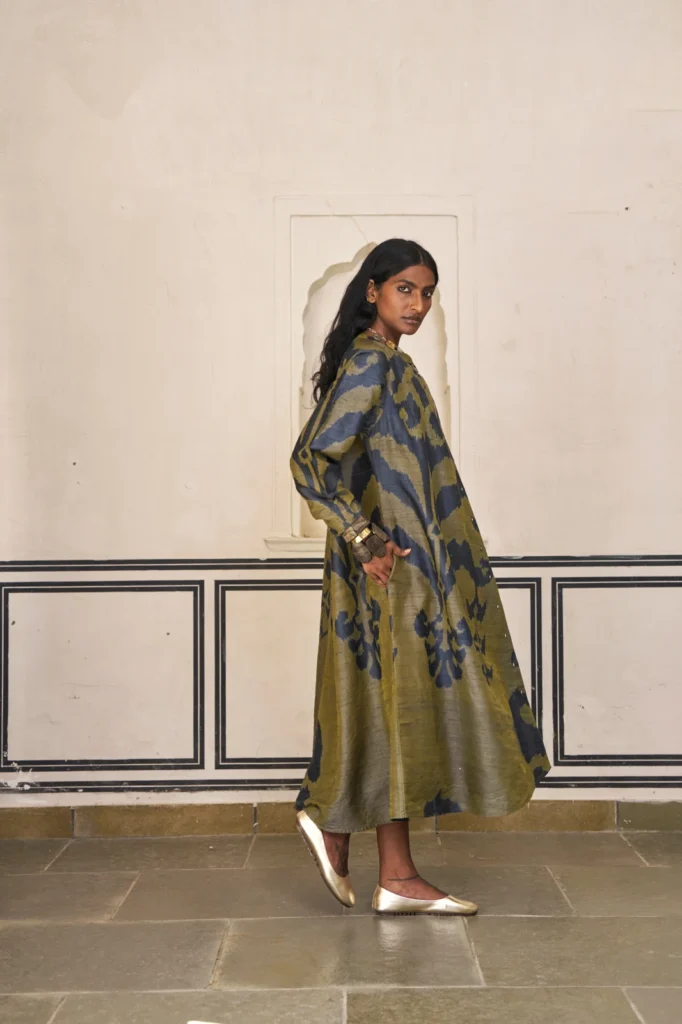
VP: Yes, and that’s the beauty of it. The colour palette remains consistent because the fabric comes from the same length, but the motifs shift across garments. Sometimes this is deliberate, sometimes it isn’t. But each garment ends up with its own balance of foreground and background.
The same silhouette can look completely different depending on how the motifs fall. That variation is not a flaw—it’s the visible imprint of the weaver’s hand, reminding us that each garment is made, not manufactured. We are also, very subtly, training people to see differently. They may not consciously understand it, but they feel it—and that’s far more powerful than explaining it intellectually.
This must sometimes be challenging for e-commerce, where people expect exact replicas.
VP: Very much so. E-commerce has conditioned people to expect identical pieces. But handwoven textiles don’t work like that. When someone receives a piece that’s different from what they saw online, what they’re really receiving is freshness and individuality. In stores, people understand this instinctively. They try the garment on and see how it comes alive on them. We’re trying to move people away from “what you see” and towards “what you feel.”
How long does a collection like Silk Odyssey take to come together?
MVC: At least eight to ten months. We always begin with a small sample batch because these are very technical textiles. There can be gaps between what is designed and what is produced. We observe, learn, recalibrate, and then build the full capsule. This is slow work. There are no shortcuts. It’s a process rooted in patience and trust, between designers, weavers, and everyone involved.
Over the years, how has the market changed? Has awareness around Ikat evolved?
VP: When we started 15 years ago, the audience was older. Appreciation largely came from senior wearers. Today, that has changed significantly. Through continuous design evolution and communication, we’ve connected with a much broader and younger audience. People are beginning to see Ikkat not just as a craft, but as art.
We’ve also made it more luxurious. There are cottons for everyday wear, silks for ceremonial wardrobes. India is a very ceremonial country, and silk allows people to experience Ikat in that context.
There’s often concern about whether younger generations are continuing traditional crafts. Are younger weavers returning to Ikat today?
VP: When we started, there was a lot of resistance. Most young people were leaving the craft behind and moving to cities. Today, we do see change–not dramatically, but meaningfully. Young weavers are engaging with design, colour, and reinterpretation. They see a future in this work. It’s not a large percentage, but it’s enough to give hope and continuity to the craft.
Is Translate involved in skill development initiatives?
MVC: We don’t operate skill development in a formal sense. What we do is more integrated within the existing ecosystem. Without trade, there is no craft. Skill development happens organically when we challenge the craft, and when weavers are paid fairly for meeting that challenge. We work directly with weavers, not through exploitative systems. The ecosystem remains intact. We don’t uproot it. We grow within it.
Indian Ikat exists across regions. What differentiates this belt?
MVC: Ikat is very regional. Telangana Ikat has always been more graphical, with polkas, zigzags, and geometric forms. It’s less figurative and more contemporary in nature. Because this belt primarily practices warp Ikat, motifs are more open and fluid. That openness lends itself beautifully to modern reinterpretation.
Our garments age well. People wear them for a decade and come back to tell us stories about them.
You’ve spoken about past collections as well. Is there one that stands out?
MVC: Amalgamation was a turning point. It wasn’t just a collection, it became a way of working. Traditionally, Ikat repeats the same motif across the yardage. With Amalgamation, we brought multiple motifs together in one textile. That changed our entire dialogue with design. Later collections may have different names, but that ideology continues.
Were there any evergreen collections?
VP: Sounds of Basant and Mosaic were both deeply loved. They ran for years and were consistently appreciated. Some collections naturally fade out, but their impact remains.
Finally, what truly sets Translate apart?
VP: We don’t look outward. We don’t condition our work based on the market. What sets us apart is depth; depth of engagement with one craft, depth of process, depth of intention. From dyes to fabric count, from washing to wearability, everything is thought through. Our garments age well. People wear them for a decade and come back to tell us stories about them.
We’re not creating fashion alone. We’re creating modern heirlooms. The pieces are meant to be loved, lived in, and passed on. That’s the legacy we care about,