


Vacheron Constantin has released La Quête, a collection of three single-piece edition watches incorporating astronomical complications, minute repeaters, and tourbillons, collectively representing over a thousand hours of handwork by specialized artisans in decorative crafts.
La Quête, unveiled to mark the manufacture’s 270th anniversary, comprises watches that few manufactures would attempt even once. Founded in 1755, making it the oldest continuously operating watch manufacture in the world, Vacheron Constantin has chosen to celebrate this milestone not with accessible designs or marketing spectacle, but with extreme technical and aesthetic challenges.
This approach stands in stark contrast to the industry’s recent trajectory. While competitors chase younger demographics with sports watches and collaborations, the Geneva-based manufacture has moved decisively in the opposite direction. La Quête translates to “The Quest,” and the name reveals something fundamental about how Vacheron Constantin sees itself in 2025.
Les Cabinotiers The Labours of Heracles
Four watches comprise this series, each depicting one of the Greek demigod’s 12 legendary tasks through two-level dials constructed from 18K white gold. Construction begins with a reproduction of a 17th-century map of Greece, hand-engraved using the taille-douce technique.

Four separate firings at temperatures between 800 and 900 degrees Celsius are required after applying layers of translucent enamel. What distinguishes this work is the technical challenge of maintaining enamel integrity during subsequent engraving, a reversal of typical sequencing that adds considerable difficulty. Eight hours of engraving, another eight for enamelling.
Two additional precision challenges follow: inscribing Arabic minute numerals onto the uneven surface of glossy enamel and textured gold, then placing polished cabochons of 18K yellow gold measuring just 0.4mm in diameter at exact map coordinates corresponding to each Labour’s location. This level of precision approaches the limits of what human hands can achieve without magnification.

Upper dial plates depict Heracles mid-battle as three-dimensional micro-sculptures measuring just 0.5mm thick. Each figure requires approximately 40 hours to complete, with detailed work extending to individual muscle striations, facial features, and the scales or feathers of the creatures he battles. Despite minimal thickness, the sculptures create the illusion of volume and dynamic movement.
Painted backgrounds beneath demand 50 hours of work across 10 layers of enamel. These landscapes provide geographic context for each labour, creating miniature paintings that echo the tradition of 18th-century pocket watch decoration, when Vacheron Constantin created snuffboxes and cases for European nobility.

Calibre 1120 AT provides a time display through a wandering hours module built on an ultra-thin manufacture movement. Hour numerals slide along a 120-degree arc marked in ten-minute intervals on the dial’s right side, driven by a component shaped like the manufacturer’s Maltese cross emblem. This symbol was adopted in 1880 after appearing in a bridge design, making it one of the watch industry’s oldest continuously used emblems.
Movement finishing extends to components invisible once the calibre is assembled, a practice rooted in 18th-century Geneva watchmaking when guild regulations demanded comprehensive finishing regardless of visibility. More unusual is the 22K gold oscillating weight featuring a tapestry motif inspired by Greek friezes, created using a traditional machine dating to 1904.

Sandrine Donguy, Vacheron Constantin’s Product and Innovation Director, said, “First, the story of Heracles, or Hercules as he was known to the Romans, epitomises the concept and values of a quest, the pursuit of a noble and challenging goal, which has also been central to Vacheron Constantin’s identity since the Maison was founded 270 years ago,” she explains.
She continues with a point connecting the watches to their founding era. “For Vacheron Constantin, watchmaking has always been intrinsically bound to culture and history, expressed by our partnerships with major cultural institutions as well as the themes we explore through our watchmaking creations. Greco-Roman antiquity is the cultural foundation of our modern world. It had a seminal influence on the Age of Enlightenment, the period when our Maison was founded, and its echoes are still manifested today in countless areas of life, from philosophy to education, science, technology, architecture and various forms of government.”
This cultural positioning is not merely marketing rhetoric. Jean-Marc Vacheron established his workshop in 1755 during a period when Geneva had become a center for both Calvinist theology and rational philosophy, when the city’s watchmaking industry was transitioning from a guild-controlled craft to a proto-industrial enterprise.
Les Cabinotiers Grand Complication High Jewellery Moon Dust
This watch takes a different approach through 16 complications governed by Calibre 2755 GC16, a movement comprising 839 components in a case measuring just 12.15mm thick. This level of miniaturization becomes impressive when considering that a tourbillon cage, along with gongs and hammers for a minute repeater, rank among the most space-consuming components in watchmaking.

Calibre 2755 GC16 builds on research conducted for the Tour de l’Ile watch created for the manufacture’s 250th anniversary in 2005. That watch established technical foundations that subsequent grand complication pieces have refined, incorporating similar complication counts in double-faced configurations.
The minute repeater employs a rotating regulator system distinguished by two weights that generate centripetal force, creating an engine brake effect on the striking bar. Operating silently, the system regulates the duration of musical sequences and smooths the energy released by the barrel to produce clear, distinct chimes. Minute repeaters remain among the most challenging complications to execute properly, requiring not just mechanical precision but acoustic engineering.
Calendar and astronomical functions are distributed across both sides of the watch. Front dial displays include a perpetual calendar requiring no correction until 2100, a secular non-leap year under Gregorian calendar rules, along with equation of time indication and sunrise and sunset displays. The reverse side shows sidereal time, measured using a fixed star as reference rather than the sun, lasting exactly 23 hours, 56 minutes and 4 seconds.
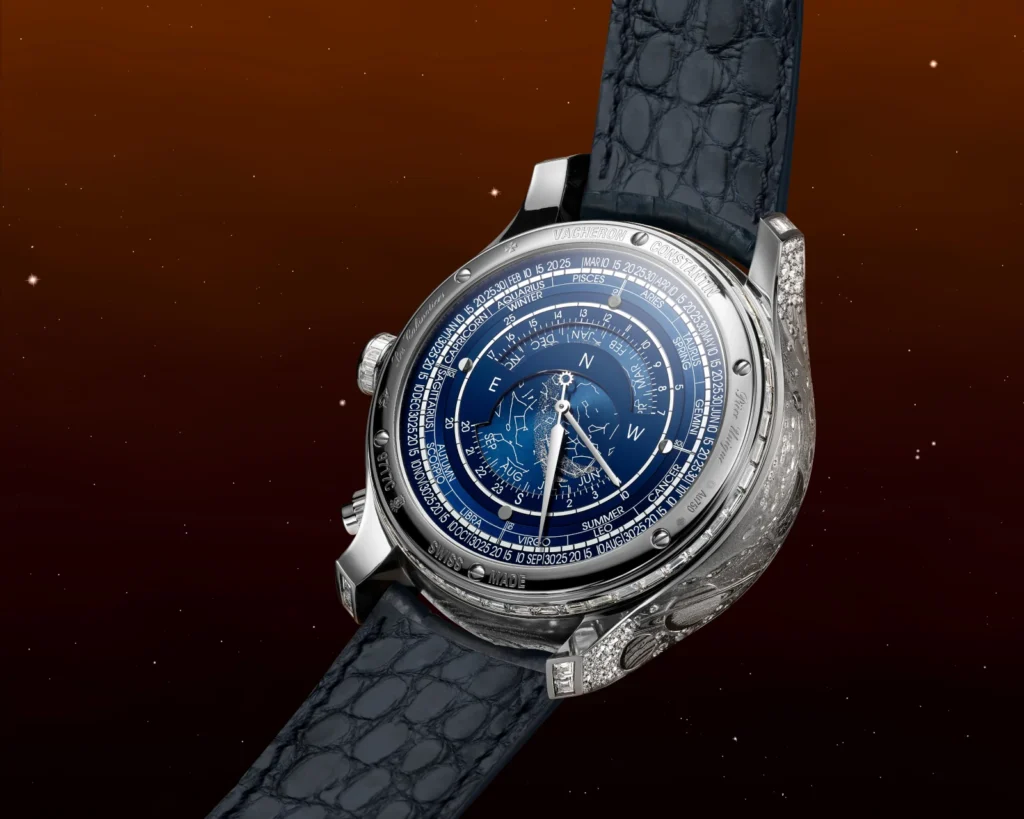
Decorative work required 230 hours of gem-setting. Rail-setting secures 200 baguette-cut diamonds totaling approximately 9 carats on flat areas, while snow-setting creates an almost unbroken expanse of light on curved surfaces using 165 brilliant-cut diamonds weighing 0.92 carats across nine different sizes. Snow-setting, which creates the appearance of randomly scattered diamonds while following precise mathematical planning, requires extraordinary skill to ensure structural security while minimizing visible metal.
Engraving adds another 180 hours. One side shows sunrays breaking through clouds toward Earth while the opposite depicts the view from the Moon looking back at the planets. Taille-douce technique combines drypoint and burin engraving to create incisions around 0.1mm deep, with more pronounced cuts of about 0.5mm for domed surfaces. Engravers alternate between polished and finely chased surfaces to build depth across fundamentally flat metal.
Front dial receives hand-guilloché work in a radiating pattern beneath blue PVD coating, complemented by a black opaline border. Guilloché’s work, dating to the 18th century, creates geometric patterns through repeated overlapping circular cuts. Vacheron Constantin maintains several antique guilloché machines in its workshops, viewing their preservation as integral to maintaining traditional decorative techniques.
Donguy said, “It is a highly complicated piece, both technically and aesthetically, engaging three artistic crafts. On a technical level, it’s important to highlight the feat of miniaturisation required to create a movement barely 12.15mm thick, comprising more than 800 components and incorporating 16 complications, including a minute repeater and a tourbillon regulator. This is especially notable, given that a tourbillon cage, as well as the gongs and hammers for the repeater, are components that take up considerable space. Ultimately, the dimensions of the case, 47mm in diameter by 19mm in height, are entirely appropriate for the complexity of the mechanism as well as achieving musical resonance. It illustrates the challenges met by Les Cabinotiers, whose mission is to offer timepieces that are technically innovative in their complications and captivating in their interpretation of the decorative arts.”
Les Cabinotiers Cosmica Duo
This watch represents perhaps the collection’s most ambitious technical proposition through its reversible architecture housing 24 complications orchestrated by the new Calibre 2756-B1. Development required four years, building from the Calibre 2756 base presented in 2020.

While reversible watches have existed since the 1930s with Jaeger-LeCoultre’s Reverso establishing the category, implementing reversibility in a grand complication piece presents exponentially greater challenges. Case construction, movement protection, and wearability all become more complex when dealing with 1,003 components.
The case measures 47mm in diameter and 20.20mm in height, dimensions that seem almost restrained given the mechanical density within. White gold case features articulated lugs with removable strap attachments that can be secured on either side of fixing bars without tools. Lugs are deliberately short with rounded profiles, designed to hold the watch in place without resting on the wrist.
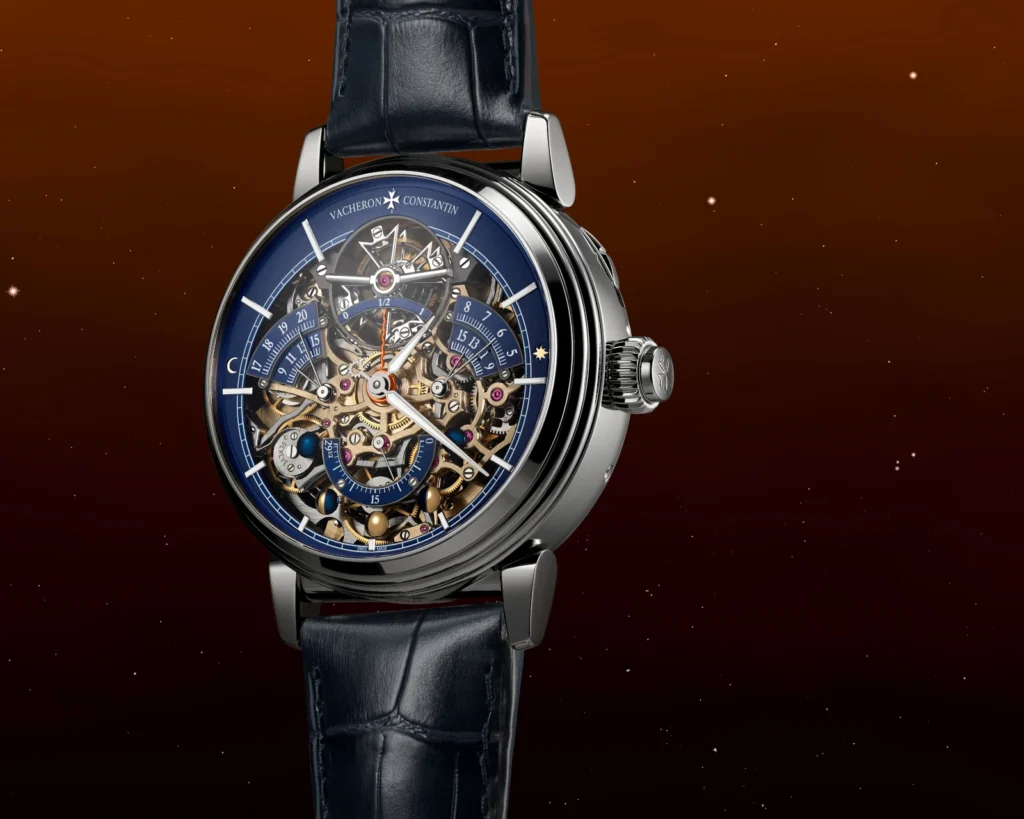
One dial offers sidereal time measurement alongside an off-center hour and minute counter displaying a Northern Hemisphere sky chart. The sky chart rotates to reproduce constellation movement according to sidereal day length, with a light-colored ellipse highlighting what an observer can see in real time. Two perpetual calendar counters display months and leap years on an 8-year cycle, and days and dates. The second time zone appears via an orange open-worked hand.
The reverse dial reveals the movement through an open-worked construction comprising 28 parts. Central hands indicate true solar time based on the sun’s apparent movement, which varies from civil time due to Earth’s axial tilt of 23.5 degrees and its elliptical orbit. This difference, ranging from minus 16 minutes 23 seconds to plus 14 minutes 22 seconds per day, constitutes the equation of time, a complication that Abraham-Louis Breguet pioneered in pocket watches during the late 18th century.
Sunrise and sunset times appear at 3 o’clock and 9 o’clock, calculated for a reference city. The retrograde hand at 6 o’clock displays moon age and phases with precision requiring correction only once every 1,000 years, achieved through a 1,027-tooth wheel that divides the lunar cycle of 29.530588 days with extraordinary accuracy.
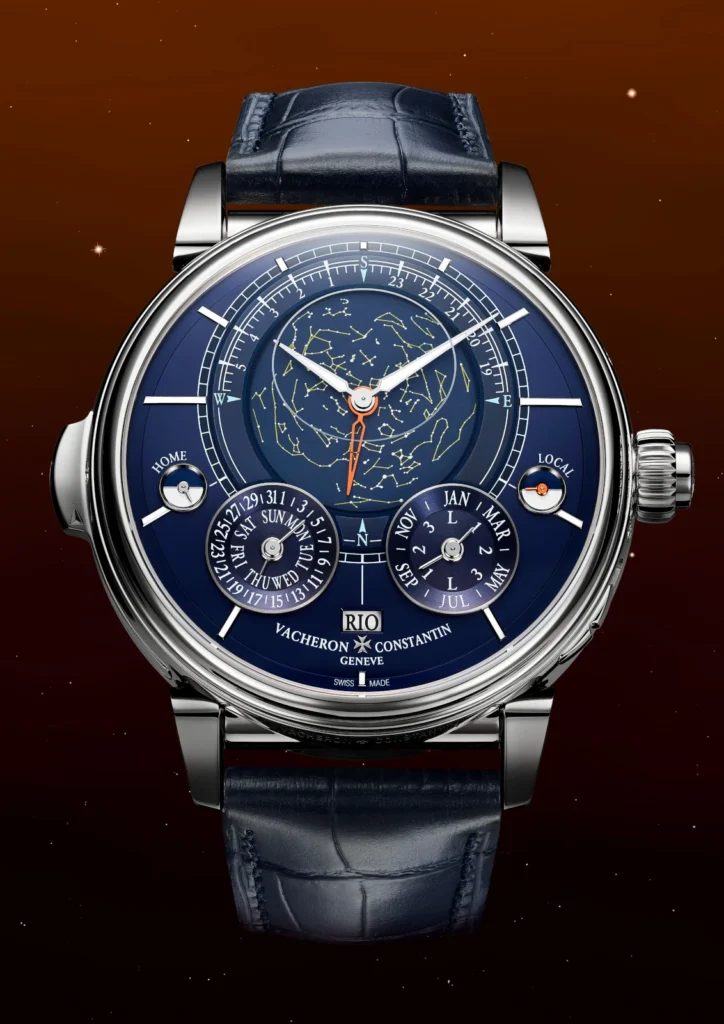
Minute repeater mechanism draws directly from the 2005 Tour de l’Ile watch, particularly its striking regulator visible through the open-worked dial. This system governs hammer strikes on gongs using two optimally shaped weights that generate centripetal force, smoothing the barrel’s energy release to ensure distinct, harmonious chimes.
Tourbillon positions at 12 o’clock in a Maltese cross-shaped cage, topped by a retrograde power reserve indicator that adds construction complexity. Operating at 18,000 vibrations per hour, the escapement maintains rates comparable to conventional movements while constantly changing the regulator’s position.
Finishing work differentiates the two dials dramatically. The celestial side features an ultramarine blue sky chart on a 0.25mm thick disc rotating under sapphire crystal engraved by metallization. Blue-tinted mother-of-pearl inserts mark the sidereal hour circle, while perpetual calendar counters receive circular satin finishing with azuré centers. The reverse side emphasizes the skeletonized calibre with champagne-colored components created through galvanic treatment, providing contrast against blued screws and polished bevels.
La Quête arrives as the luxury watch industry confronts fundamental questions about its future direction. Swiss watch exports have shown volatility in recent years, with the Federation of the Swiss Watch Industry reporting fluctuating demand across different price segments.
Yet Vacheron Constantin continues to invest in craft preservation and relevance. Skills required to execute grand feu enamel work, hand engraving, and micro-sculpture take decades to master, with few young artisans pursuing these disciplines as career paths. Vacheron Constantin, like Patek Philippe and Audemars Piguet, maintains in-house ateliers for decorative crafts, effectively subsidizing the preservation of techniques that have limited commercial application.
Each of these three watch lines represents several months of work distributed across multiple specialized artisans, movement engineers, and case designers. Production is not scalable, profit margins are difficult to calculate in traditional terms, and the potential client base numbers in dozens rather than thousands.
From a purely commercial perspective, dedicating resources to single-piece editions makes little sense. From a brand positioning perspective, however, they serve as proof points of capability that justify premium pricing across the entire collection, similar to how Formula One racing technology eventually trickles down to production vehicles.
La Quête makes Vacheron Constantin’s position explicit. Technical complications that most manufactures have abandoned as commercially unviable remain worth pursuing. Decorative crafts that demand patience beyond what automation can replicate deserve preservation. Cultural references drawn from ancient mythology provide foundations distinct from celebrity collaborations or limited-edition hype.
The collections demonstrate that for manufactures with 270 years of continuous operation, market validation operates on timescales measured in decades rather than quarterly reports. Some traditions continue regardless of their immediate commercial logic, preserved by institutions with sufficient longevity to view individual product cycles as mere chapters in longer narratives.