
Marco Tedeschi’s House of Haute Horlogerie arrives at Watches & Wonders 2026 as one of the few independent watchmaking ventures to have built its entire operation in-house, from movement conception to finished watch. His debut release, the MT1.1: Le Tourbillon 7 Jours, is the product of two decades of work across three interconnected entities: Marco Tedeschi, Kross Manufacture, and Kross Studio by Marco Tedeschi, each serving a distinct role within a single horological ecosystem.
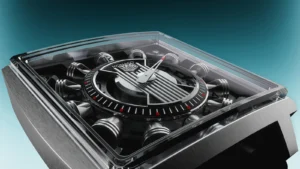
Kross Studio, notably, is where the house’s identity first took shape, built through collaborations with major entertainment partners on collector-focused projects, and it remains an integral part of the ecosystem rather than a separate venture.
Independent watchmaking has a well-documented history of founders who built their reputation on one defining idea. Journe built his around a mechanism that delivers power to the movement in perfectly equal intervals. Dufour built his around a standard of hand-finishing the industry had largely forgotten. Tedeschi’s foundational claim is the tourbillon, a rotating cage that counters the effect of gravity on a movement’s accuracy.
That claim began with a patent in 2006 for a central tourbillon, which Tedeschi has described as the origin of everything that followed. After working in multiple watch brands, Tedeschi founded Kross Studio in 2020. A second patent for a central floating tourbillon followed in 2023. The MT1.1 carries both patents forward, and is positioned as the first piece in a planned series of 12 complications, each to be developed through Tedeschi’s construction philosophy, with no fixed timeline attached to their release.
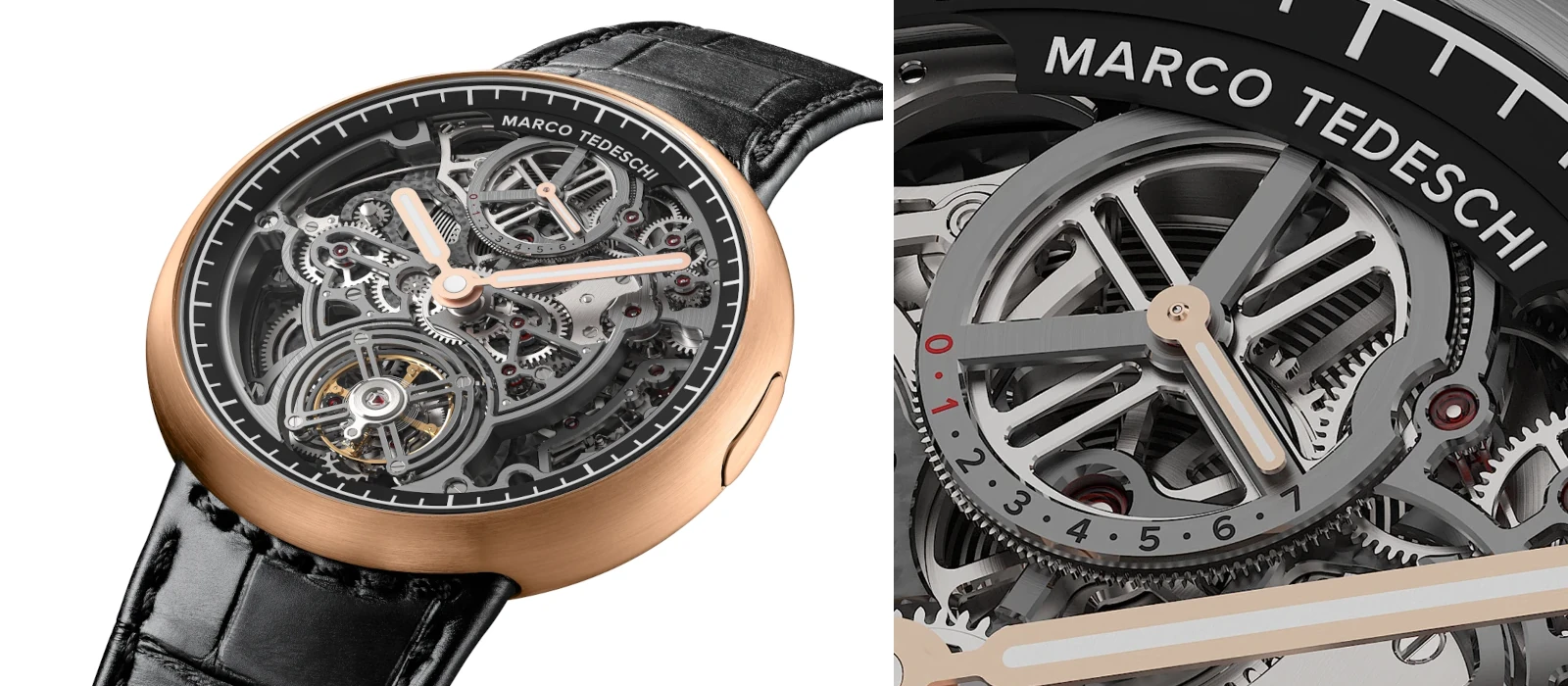
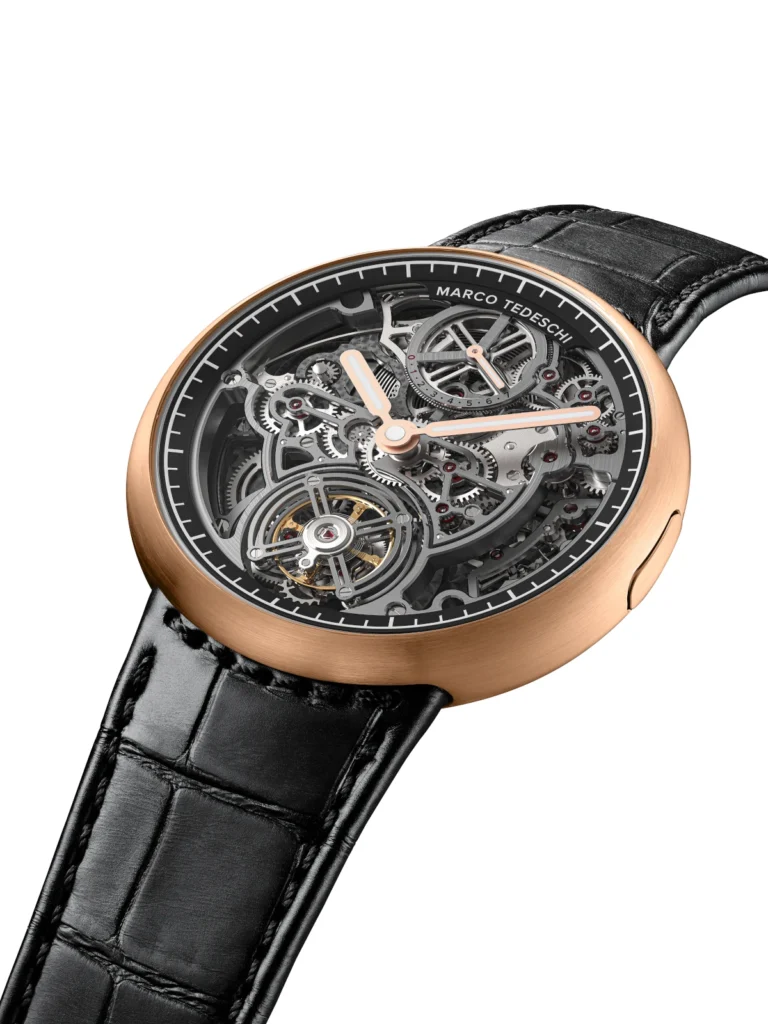
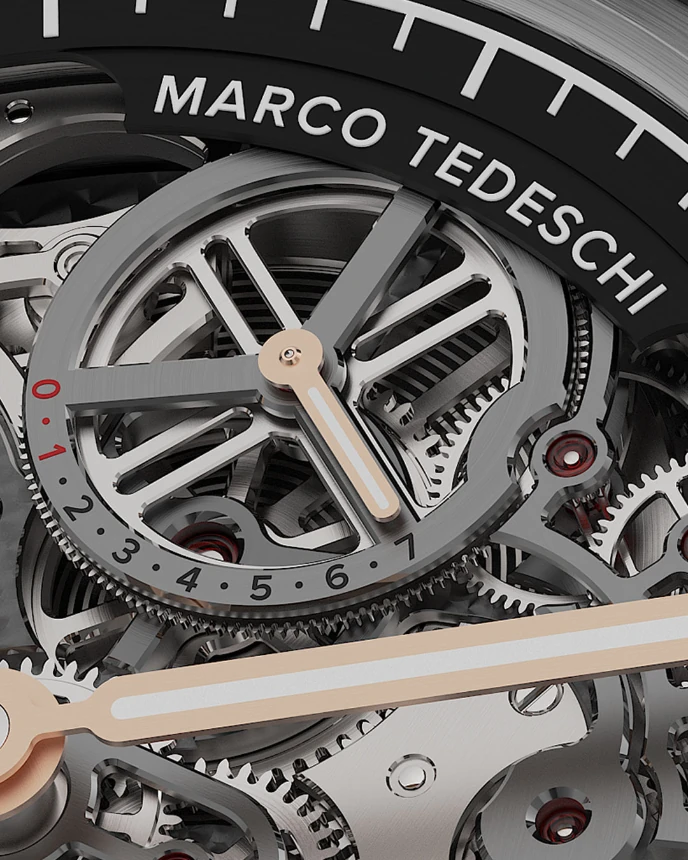
Powering the watch is the MT 7010 IRM, an open-worked movement where the inner mechanics are fully visible through the dial. It is built around a single large barrel and a flying tourbillon placed at 6 o’clock. Tedeschi sized the barrel to occupy every available millimetre of the movement plate once the tourbillon was in position, extending it beyond its standard radius. Seven days of power reserve from a single source is the result.
Most watches in this category run between two and four days on a full wind, making seven days from one barrel, without stacking multiple springs, a meaningful technical achievement.
Tedeschi has also been deliberate about the speed at which the tourbillon rotates. Several major manufactures have been pushing higher rotation speeds as a signal of technical ambition. His decision to hold at 3 Hz reflects a considered engineering stance, one that prioritises long-term reliability over visual spectacle. At 3 Hz, the movement maintains stability, precision, and long-term chronometry without placing unnecessary stress on the system.
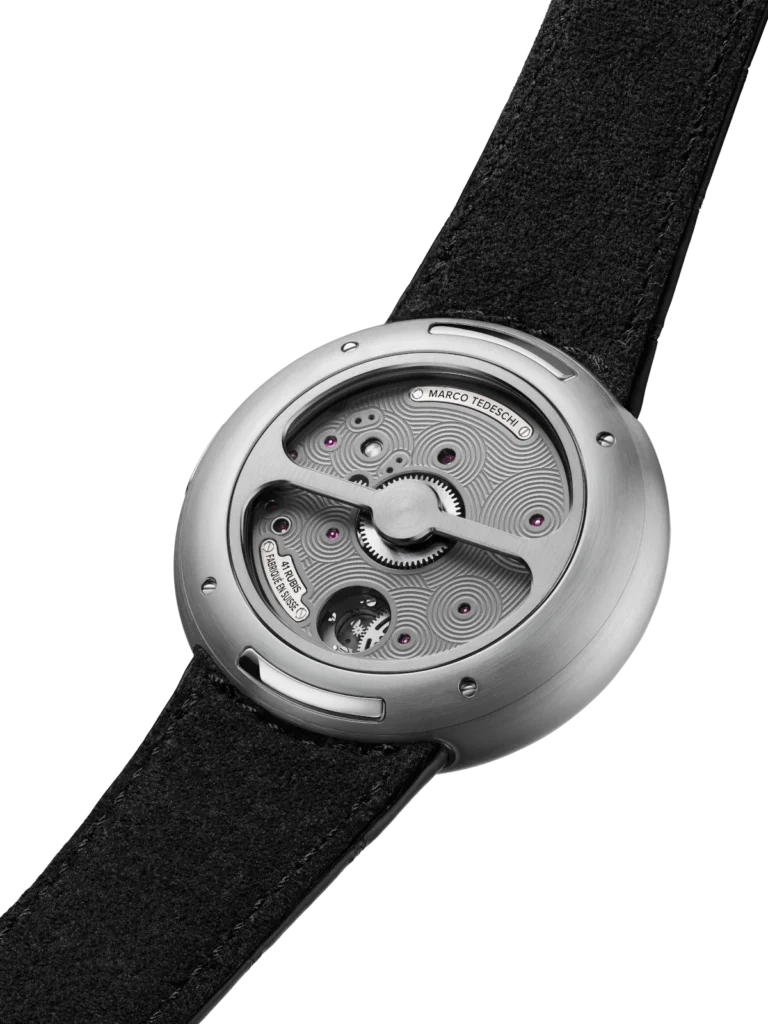
Case design follows the same internal logic. A 44mm round case carries no crown on the side, no lugs where a strap would traditionally attach, and no visible hardware on the front of the watch. Winding is done through a crown placed on the caseback, which delivers more direct energy transfer than a traditional side placement. A pusher at 3 o’clock handles switching between time-setting and winding modes, replacing the familiar pull-and-push action of a conventional crown.
Strap release also runs through the caseback, keeping the front face of the watch geometrically clean and uninterrupted. A power reserve indicator at 12 o’clock shows how much energy remains in the barrel, sitting directly opposite the tourbillon at 6.
Fully open-worked from the outset rather than skeletonised after the fact, the dial side makes the movement’s mechanics immediately readable. Movement plates are made from lead-free nickel silver, treated with a dark ruthenium coating and finished by hand with brushing, circular polishing, and hand-bevelled edges. Each wheel is open-worked and outlined, adding depth and visual consistency to the movement.

The caseback carries a single structural bridge and concentric circular patterns across its surface, a level of decoration applied to a surface most owners will rarely look at, which in fine watchmaking has always been the clearest measure of a maker’s seriousness.
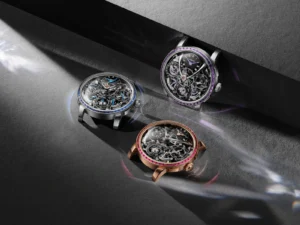
The MT1.1 is available in three case materials: Grade 5 ELI Titanium at 69,900 CHF, Tantalum at 79,900 CHF, and 5N Gold at 89,900 CHF, all excluding taxes. Each version features a circular satin finish with polished chamfers and a minimalist dial with a satin-finished flange and white decals for clean legibility. Sales run through the brand’s official website and a select group of retailers in deliberately limited numbers.
Kross Studio will also unveil a new collector set later this year, continuing its work with major entertainment partners and keeping that side of the house active alongside the MT series. As for what follows the MT1.1, Tedeschi’s roadmap points to 11 further complications, each rooted in the same construction philosophy, developed on his own terms and on no one else’s schedule.