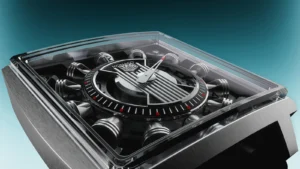

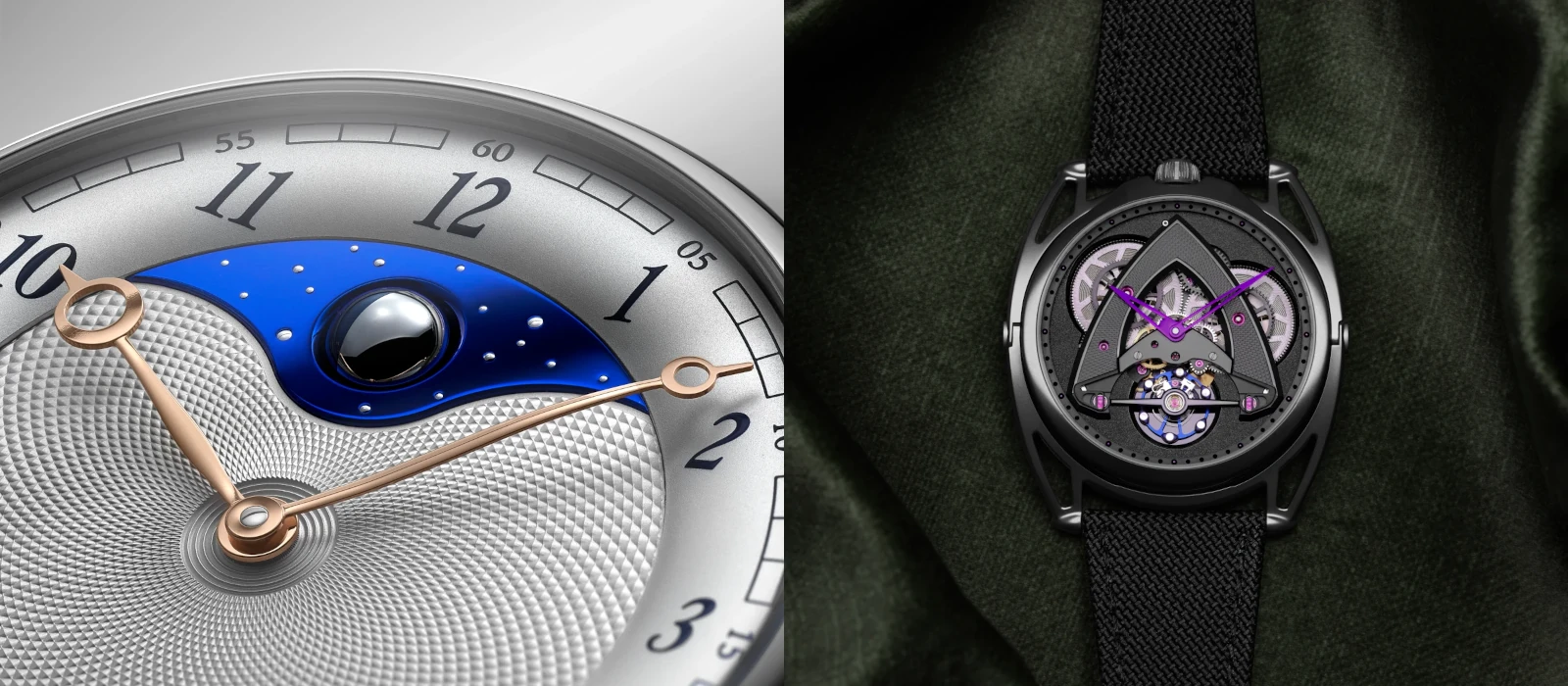
De Bethune operates on a relatively small scale, based in Le Locle in the Swiss Jura, producing watches in limited numbers and following its own approach since master watchmaker Denis Flageollet established the brand over two decades ago. This season, the brand is introducing three new references, the DB25Vxs Silver Moon, the DB28xs Dark Sand, and the DB25 Monopusher Chronograph, each exploring a different aspect of what De Bethune does best.
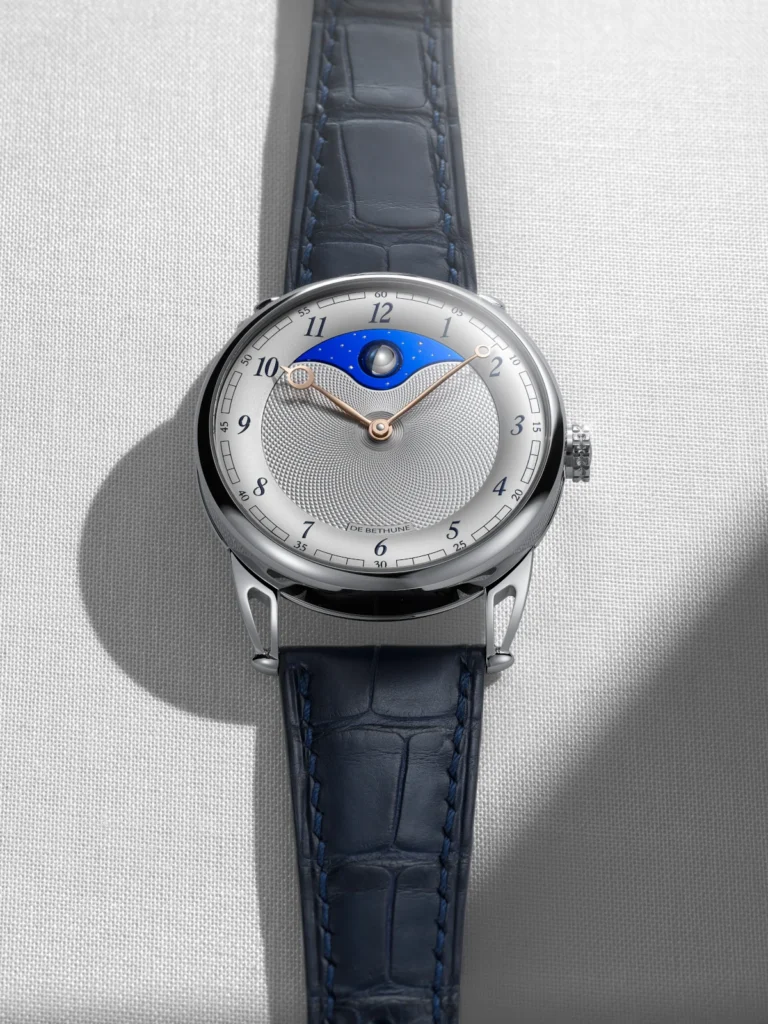
The DB25Vxs Silver Moon builds on the DB25L, a model introduced in 2009 and known for its balanced design and measured proportions. This new version brings the case down to 40 mm in mirror-polished grade 5 titanium, reconfigures the dial, and refines the movement. The design draws directly from the tall-case regulator clocks of the 18th century, precision instruments made by the great French and Swiss makers of the period, Ferdinand Berthoud, Antide Janvier, and Julien Le Roy, whose work has shaped Flageollet’s approach from the beginning.
Flageollet said, “My creative work is in a state of perpetual evolution, rooted in our in-house codes. Every De Bethune is a glimpse of the next. It invites and inspires the next timepiece.”
Regulator clocks were built, above all else, for accuracy. They separated the hour, minute, and second displays onto different dials to avoid the mechanical interference that came from stacking all three on a single point. De Bethune does not copy that layout here, but the influence shows up in the dial’s slight, elegant curvature, its spiral barleycorn guilloché pattern, a traditional hand-engraving technique that creates a fine, textured grain across the surface, and its delicately silvered finish.
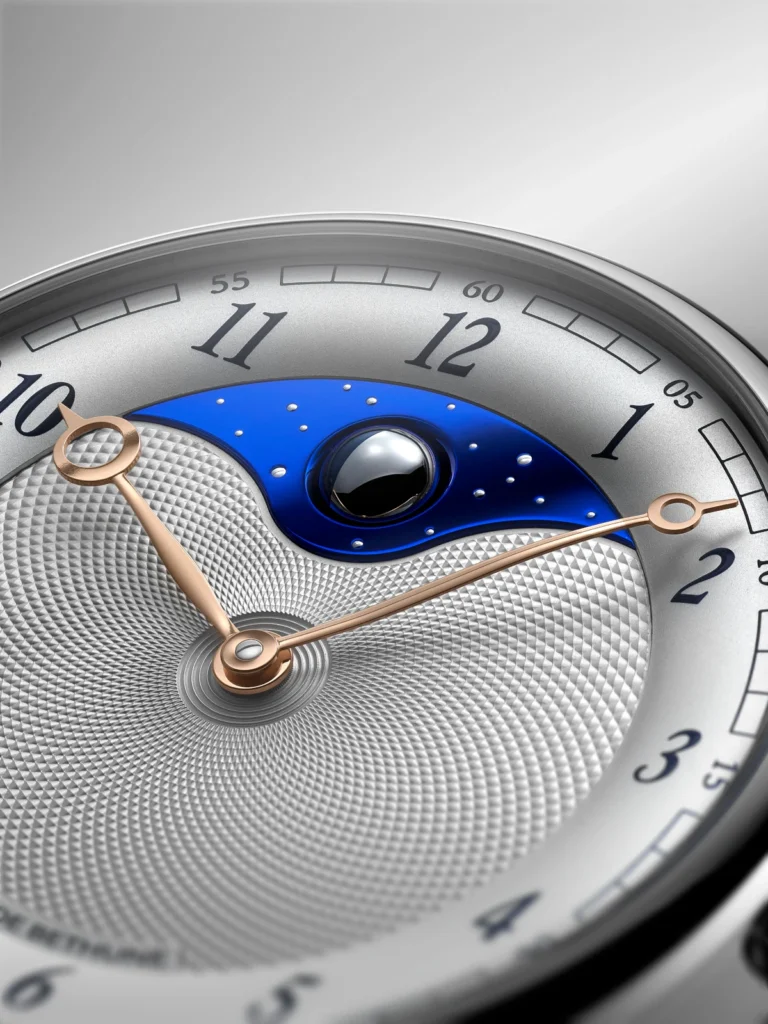
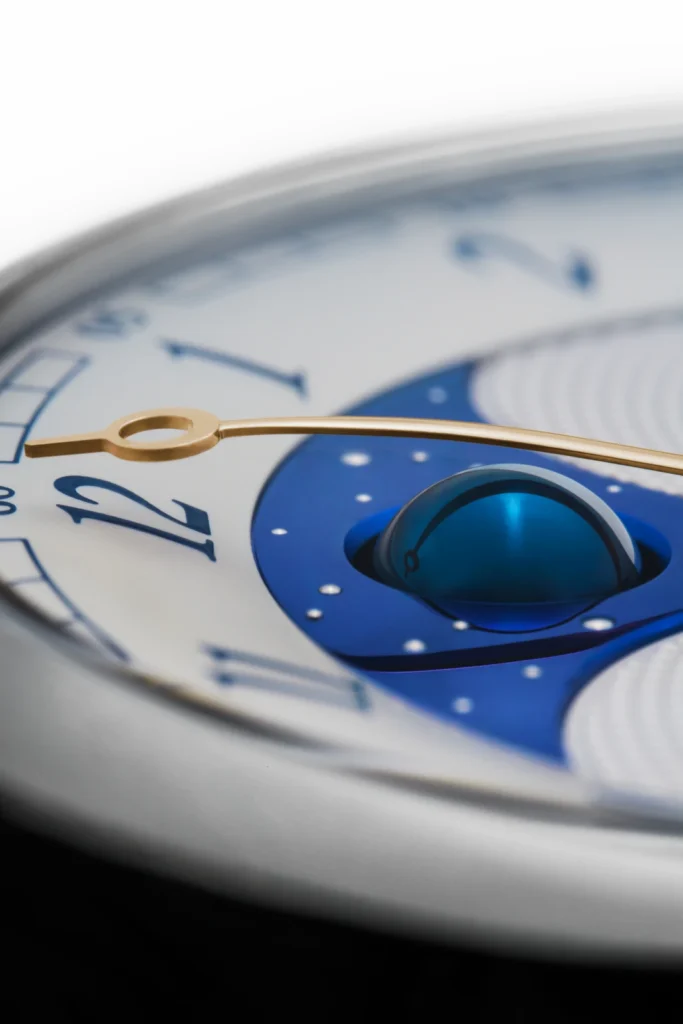
Classic rose gold hands are hand-curved to pass over the spherical moon phase display. The Breguet-style hands, the starry sky, and the guilloché work are not decorative additions. They reflect a clear position on what a formal dress watch should be.
De Bethune introduced the spherical moon phase in 2004 on the DB15, its first watch with a movement developed entirely in-house. Moon phase displays have been part of watchmaking since the 17th century, but they have almost always been shown flat, a painted or engraved disc rotating behind an opening in the dial. Flageollet drew his inspiration from astronomical clocks and from a sketch by Leonardo da Vinci in the Madrid Codex, which mapped the geometry of how the moon is lit. The result is a sphere in palladium and flame-blued steel, shaped using a traditional spirit-lamp method, set against a blued titanium sky with gold stars. It needs a correction of just one lunar day every 112 years, making it one of the most accurate moon phase mechanisms currently in production.
Calibre DB2105V5 is hand-wound and runs at 28,800 vibrations per hour. Its balance-wheel, the part of the movement that regulates timekeeping, combines a titanium body with white gold weights placed around its edge. This construction is designed to keep the wheel stable across changes in temperature and air resistance. A twin barrel, which stores and releases energy, delivers a power reserve of over six days. The movement also uses a balance-spring with a flat terminal curve, a silicon escape-wheel, and a shock absorber.
All finishing, including the decorative stripe patterns known as Côtes De Bethune, mirror-polished steel, and blued titanium, is done by hand. The movement is visible through a sapphire caseback with double anti-reflective coating. The DB25Vxs Silver Moon is priced at US$ 99,000.
Zirconium is not a common material for watch cases, and De Bethune has been working with it since 2012, longer than most manufacturers. For the DB28xs Dark Sand, the brand has taken that material into its most extreme form yet. A black satin-brushed finish on matt anthracite zirconium produces a surface that takes in light rather than reflecting it, giving the watch a dense, mineral quality. Zirconium is extremely hard and its surface colour does not change with exposure to air or regular wear, which makes it a practical choice as much as an aesthetic one.
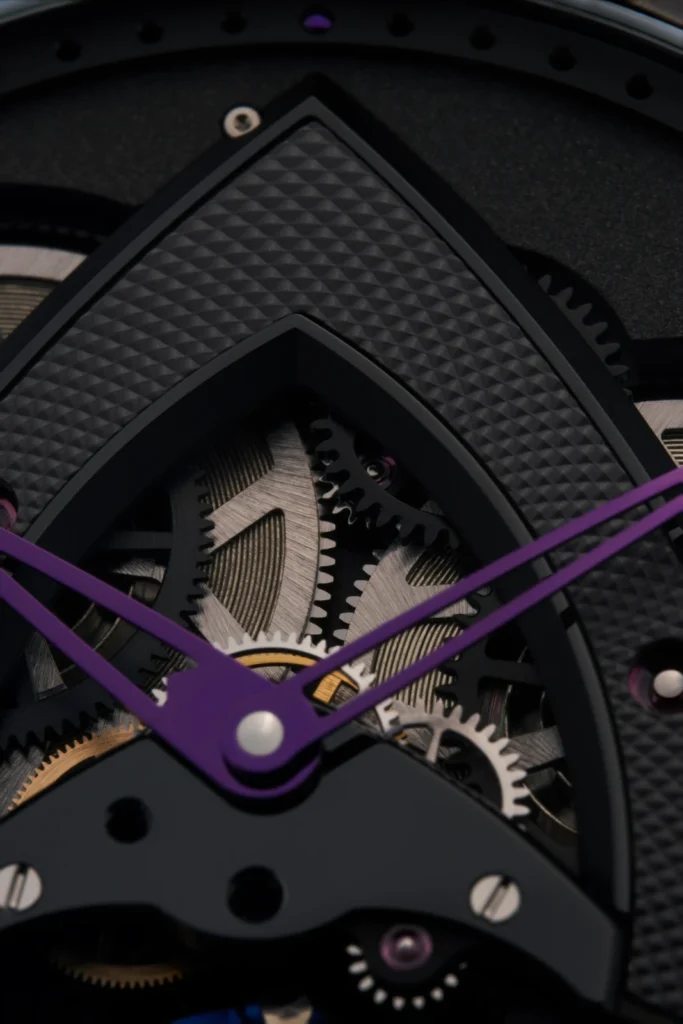
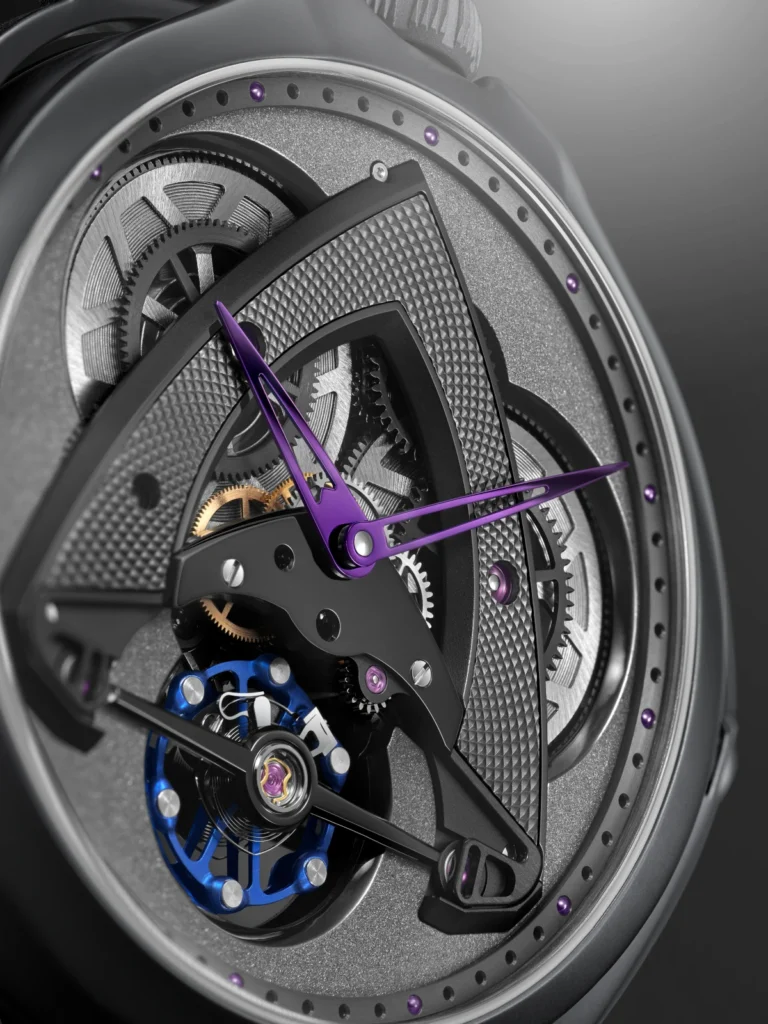
This new version keeps the open dial architecture and the crown placed at 12 o’clock from the DB28xs Steel Wheels that define the reference, while shifting the entire look into darkness. The dial base is black sandblasted titanium. The ring showing hours and minutes is circular satin-finished black titanium, marked by polished mauve titanium hour-markers that match the hands, introducing a subtle purple tone that keeps the dial readable without breaking the overall mood. De Bethune’s signature deltoid bridge, a geometric shape pointing downward, carries a barleycorn guilloché pattern, its carefully finished edges producing shifts between anthracite grey and deep black depending on the light. It reads as a layered, textured object rather than a flat one.
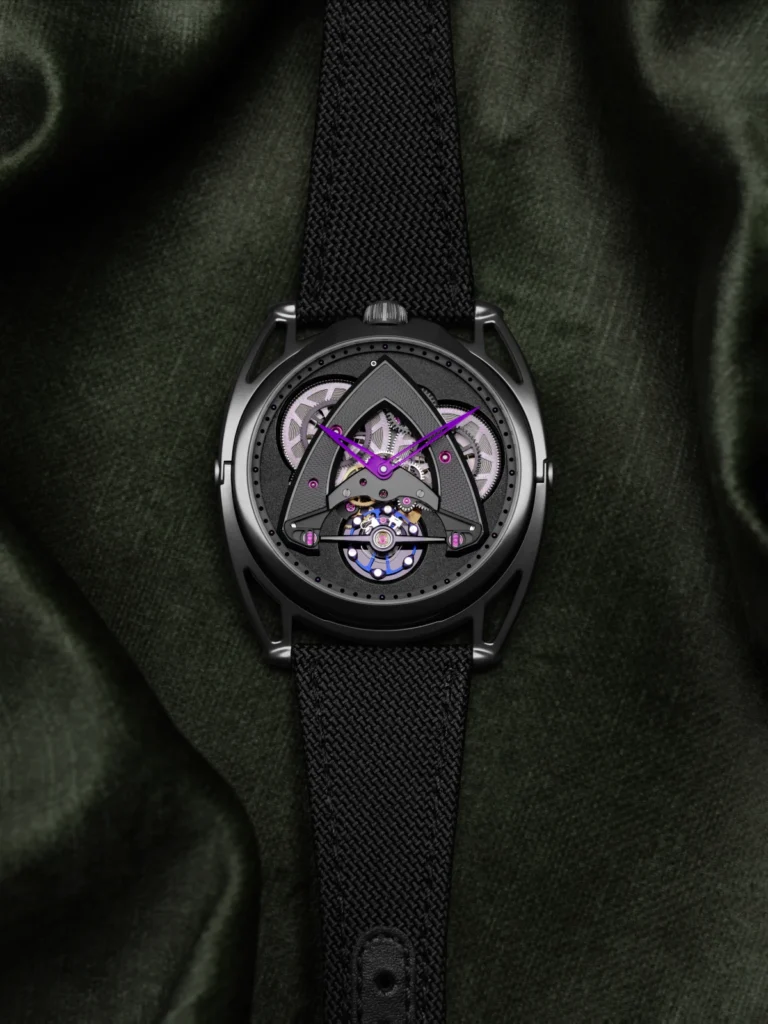
Calibre DB2115/13 powers the watch, hand-wound and running at 28,800 vibrations per hour. It uses the same titanium balance-wheel with white gold weights, the De Bethune flat terminal curve balance-spring, a silicon escape-wheel, and a triple pare-chute shock-absorbing system. On the back, the caseback carries an anthracite microlight finish. A straight-line six-day power reserve indicator, driven by a self-regulating twin barrel, is displayed in mauve and golden tones.
Sized at 39 mm in diameter and 8 mm thick, the watch uses De Bethune’s patented floating lug system, where the parts connecting the case to the strap adapt to the shape and movement of the wrist rather than sitting fixed against it. A leather-lined fabric strap and a matching zirconium pin buckle complete it. The DB28xs Dark Sand is priced at US$ 115,000.
Monopusher chronographs have a specific place in the history of Swiss timing. Favoured before two-pusher mechanisms became standard in the mid-20th century, the single-pusher format requires the wearer to start, stop, and reset the chronograph through one button, an arrangement that demands more careful interaction with the watch. De Bethune’s version, the DB25 Monopusher Chronograph reference DB25Vx552, integrates that button into the crown itself, keeping the side of the case clean and reducing external parts.
Calibre DB3000 runs the mechanism with 296 parts and 37 jewels across a 30 mm diameter. It measures elapsed seconds on a 60-second counter and tracks longer durations on a 60-minute instantaneous counter, with a 60-hour power reserve. All steel components are hand-bevelled and hand-polished. Chronograph bridges carry flat polished surfaces applied by hand. Barrels are hand-snailed, a finishing technique that creates concentric circular patterns. The titanium balance-wheel with white gold inserts runs at 28,800 vibrations per hour.
A saimon dial, a Japanese-influenced finish that produces a soft, silky surface texture, carries radiating guilloché across 12 sectors with blue Arabic numerals. The 60-minute counter sits at 6 o’clock on a matching engine-turned sub-dial. Hour, minute, second, and counter hands are in blued polished titanium.
Housed in a polished grade 5 titanium case measuring 40.6 mm in diameter and 9.15 mm thick, the watch has integrated openwork lugs, a screw-down caseback, a sapphire crystal with double anti-reflective coating, and 3 ATM water resistance. The strap is extra-supple alligator leather, alligator-lined, with a grade 5 titanium pin buckle. The DB25 Monopusher Chronograph is priced at US$ 99,000.
All three new references by De Bethune share the same core movement parts, developed and patented by the brand itself. Whether it’s the titanium balance-wheel with white gold weights or the silicon escape-wheel, none of these come from outside suppliers. They are solutions the brand built on its own, over years of research and development. In a space where independent watchmakers such as F.P. Journe, Philippe Dufour, and Voutilainen have defined what small-scale, handmade watchmaking can be at the highest level, De Bethune sits in the same company.