
MB&F has built its reputation on treating watches as three-dimensional sculptures rather than timekeeping devices strapped to wrists. Horological Machine N°11, first unveiled in 2023, pushed that philosophy to its logical extreme by transforming the case into a miniature house with functional ‘rooms’. Now, two years later, the brand has released the HM11 Art Deco editions, swapping the organic curves of mid-century futurism for the geometric precision of 1930s design.
Creative director Maximilian Büsser and designer Eric Giroud conceived the original HM11 Architect as a literal interpretation of Le Corbusier’s dictum that a house is a machine to live in. Four symmetrical rooms radiate from a central atrium, each serving a specific purpose: time display, power reserve indicator, mechanical thermometer, and time-setting module. A flying tourbillon sits at the center beneath a double-domed sapphire roof. Rotating the entire case allows the wearer to orient any room forward while simultaneously winding the movement, with each 45-degree turn delivering exactly 72 minutes of power.
Berlin-based designer Maximilian Maertens handled the Art Deco reinterpretation. His entry point into the period came through a teenage visit to the Rex cinema in Paris, where the building’s Art Deco façade stood distinct in a city known for Art Nouveau. That architectural memory informed his brief: evolve the Architect without losing its mechanical identity.
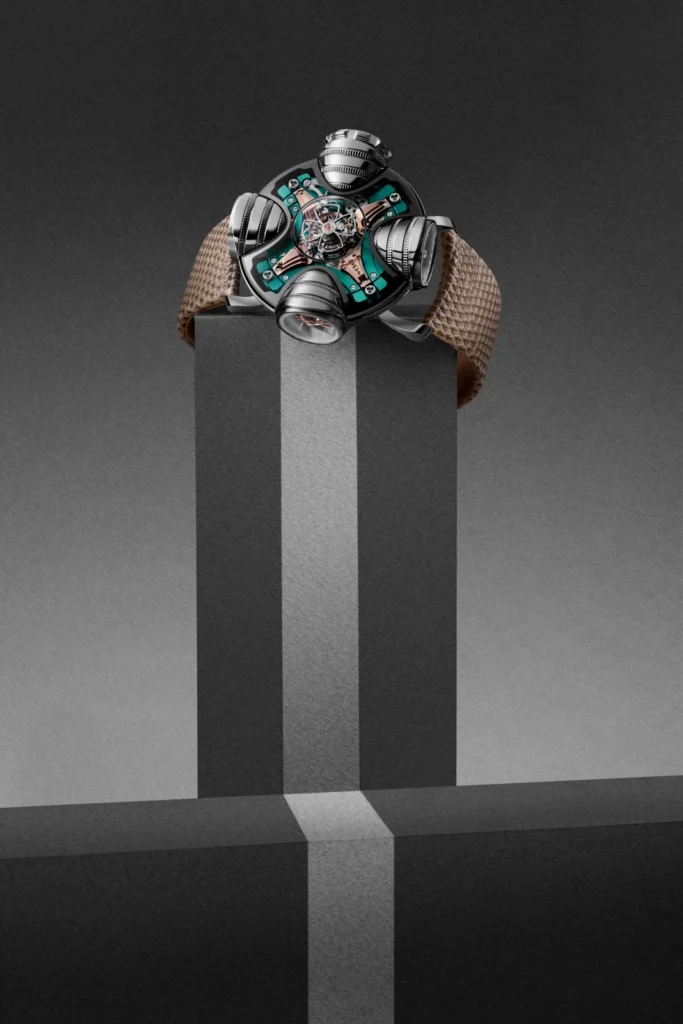
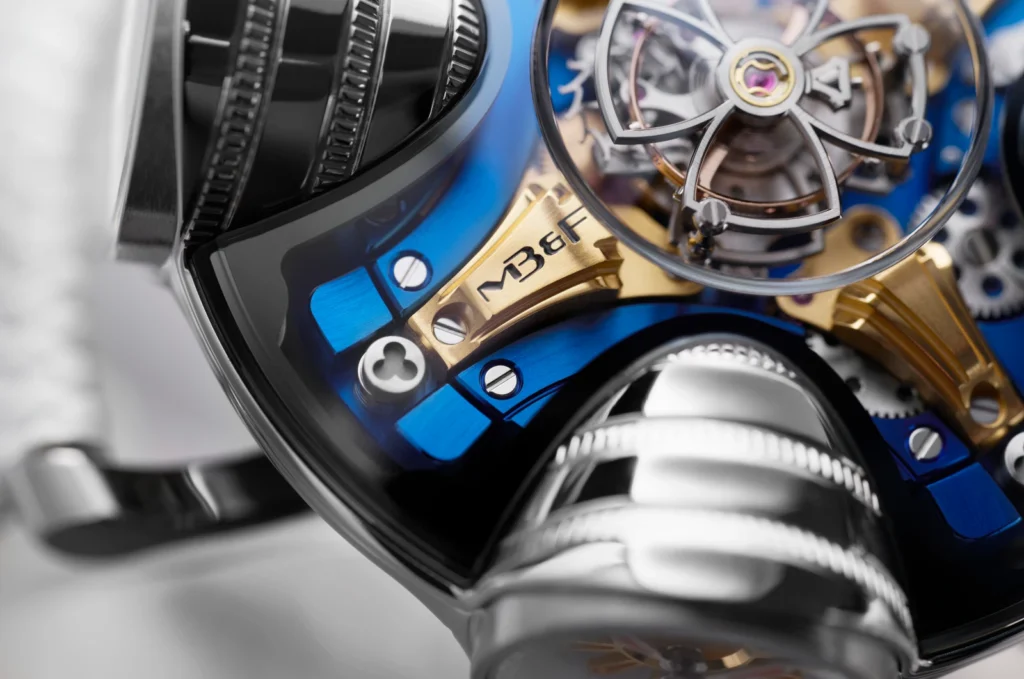
Radiating sunbeam patterns replace the original conical hour markers on the dial side. Maertens skeletonized these frames to maintain legibility, requiring laser-cutting with tolerances of approximately 0.2 millimeters. Period-appropriate typography appears on the temperature display. Hands now feature translucent enamel creating a red stained-glass effect after initial attempts with rubies proved geometrically impossible. Bridges rise in more vertical, block-like profiles that reference ornamental stonework from 1930s skyscrapers. Even the sapphire roof gained fine grooves echoing the stepped silhouettes of buildings like the Chrysler Building.
Mechanical specifications remain identical to the 2023 version. An in-house manual movement built around a central flying tourbillon beats at 2.5 hertz within a 42mm grade 5 titanium case. Four laser-cut steel springs derived from aerospace technology suspend the movement and isolate it from shocks. Power reserve extends to 96 hours, achieved through ten complete case rotations. A nearly ten-millimeter-wide sapphire crown required a multi-gasket airlock system using eight seals, bringing the total gasket count to nineteen across the entire case. Water resistance holds at 20 meters.
Production sequencing changed for the Art Deco editions. Skeletonized dial frames undergo laser cutting before final finishing to avoid risking completed components. Upper and lower cage bridges contain numerous inward angles requiring hand finishing by specialists. Four peripheral bridges alternate between polished and satin surfaces, creating light movement across the watch. Larger grooves on glass elements receive hand finishing to eliminate machining marks. Dark anthracite metallization on glass edges conceals structural components and gaskets, a technique carried over from the original HM11.
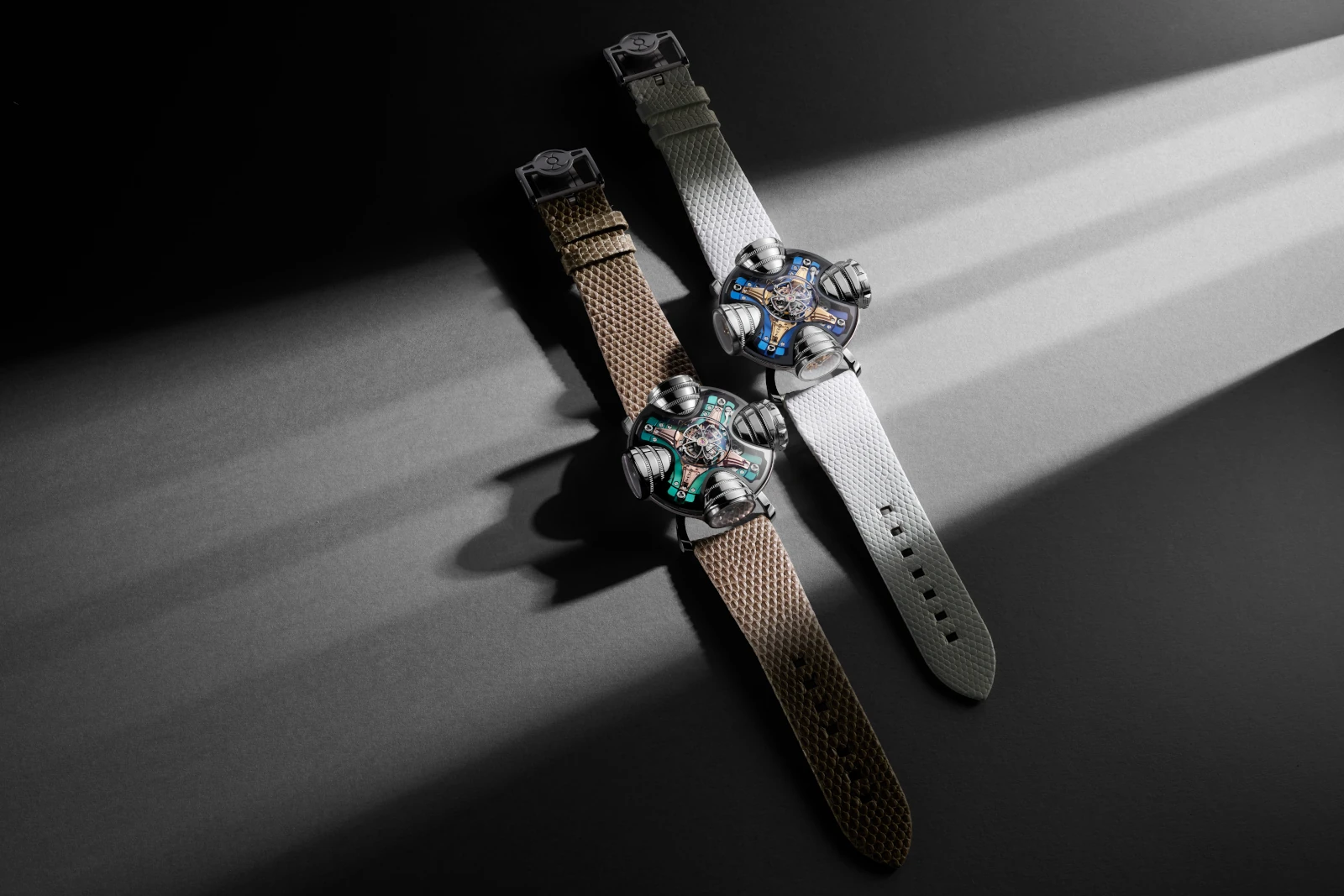
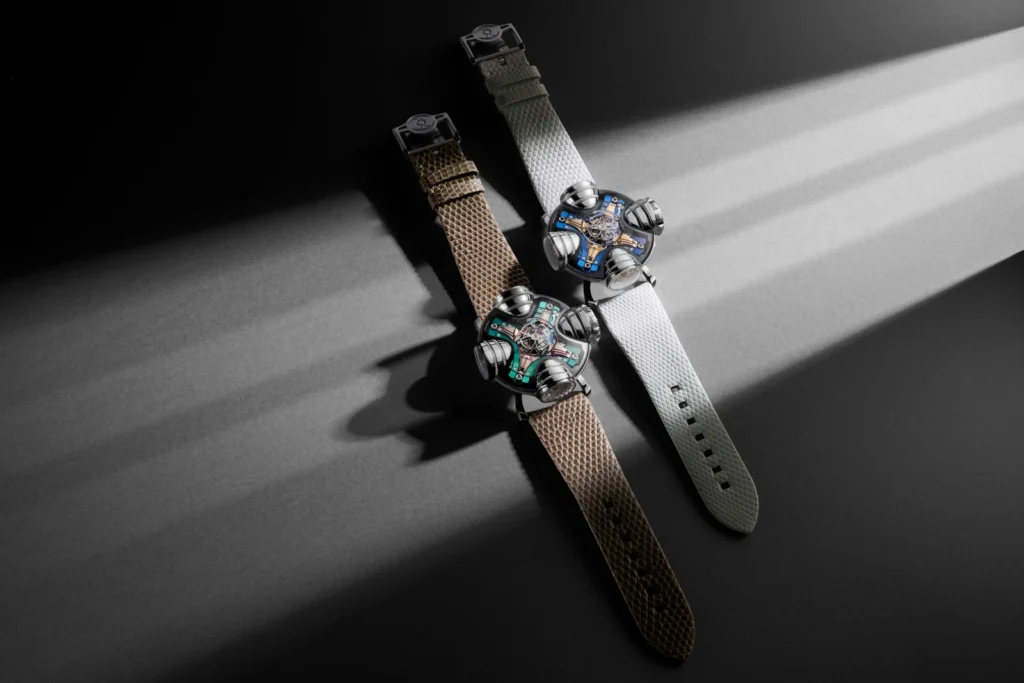
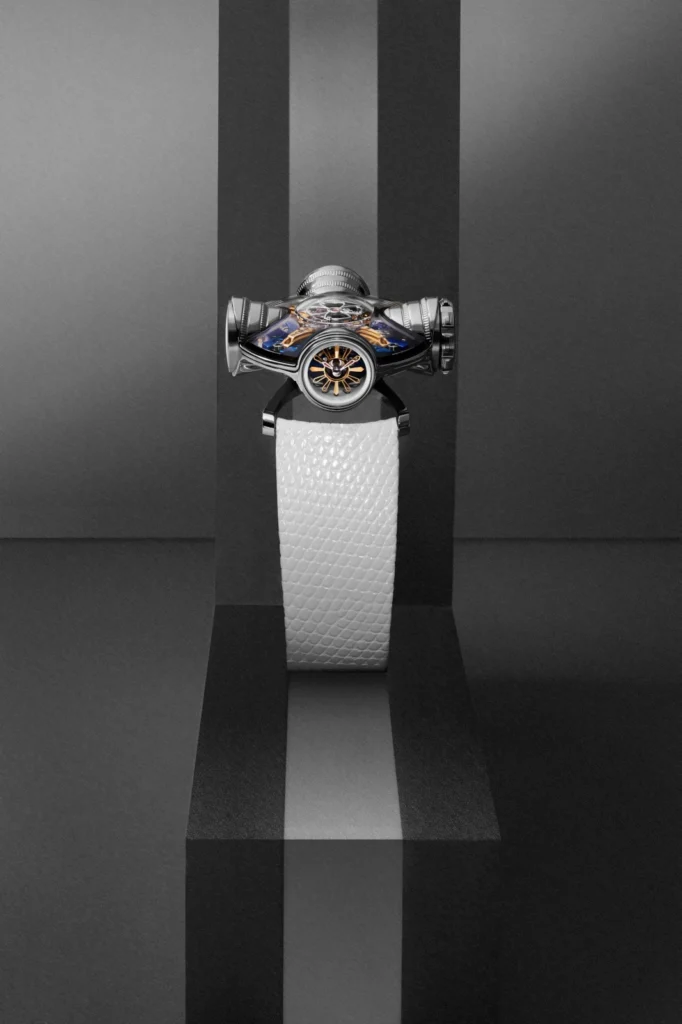
MB&F has released both Art Deco editions in grade 5 titanium, limited to ten pieces each. One pairs a blue dial plate with 3N yellow-gold-toned bridges and a white lizard strap. Another combines a green dial plate with 5N rose-gold-toned bridges and a beige lizard strap. The watch is a timely tribute to 100 years of Art Deco being celebrated this year.
MB&F has regularly returned to an existing Horological Machine platform for aesthetic reinterpretation. HM4 Thunderbolt, originally launched in 2010 with aviation-inspired design, received multiple subsequent versions including Final Edition in 2015. HM6 Space Pirate followed a similar trajectory between 2014 and 2018 with releases like Alien Nation and Final Edition. This suggests that MB&F views its Horological Machines as design platforms capable of supporting multiple visual languages without fundamental mechanical changes.
Maximilian Büsser founded MB&F in 2005 after leaving his position as managing director of Harry Winston Rare Timepieces. His stated goal involved creating a collaborative environment where external designers and watchmakers could contribute to radical timepiece concepts. Every Horological Machine since HM1 in 2007 has credited specific designers alongside Büsser, distinguishing MB&F’s approach from traditional manufacture structures where design work often remains anonymous or attributed to in-house studios.

Comparing the Architect and Art Deco editions side by side reveals how period-specific design vocabulary reshapes an object without altering its fundamental character. Soft concrete curves from 1970s experimental architecture give way to regulated rhythms of urban planning and vertical ambition. Both approaches transform the case into something beyond a movement container, validating MB&F’s original premise that a watch can function as wearable architecture.