
Resonant Histories: India and the Arab World opened this past November at the Jehangir Nicholson Art Foundation (JNAF) in Mumbai. The exhibition is the outcome of a long period of joint research between JNAF, the Barjeel Art Foundation in Sharjah and the CSMVS Museum. It looks closely at how artists from India and the Arab world came into contact with one another—sometimes directly, sometimes through shared surroundings or parallel political conditions—and how these encounters shaped the way modern art developed across both regions.
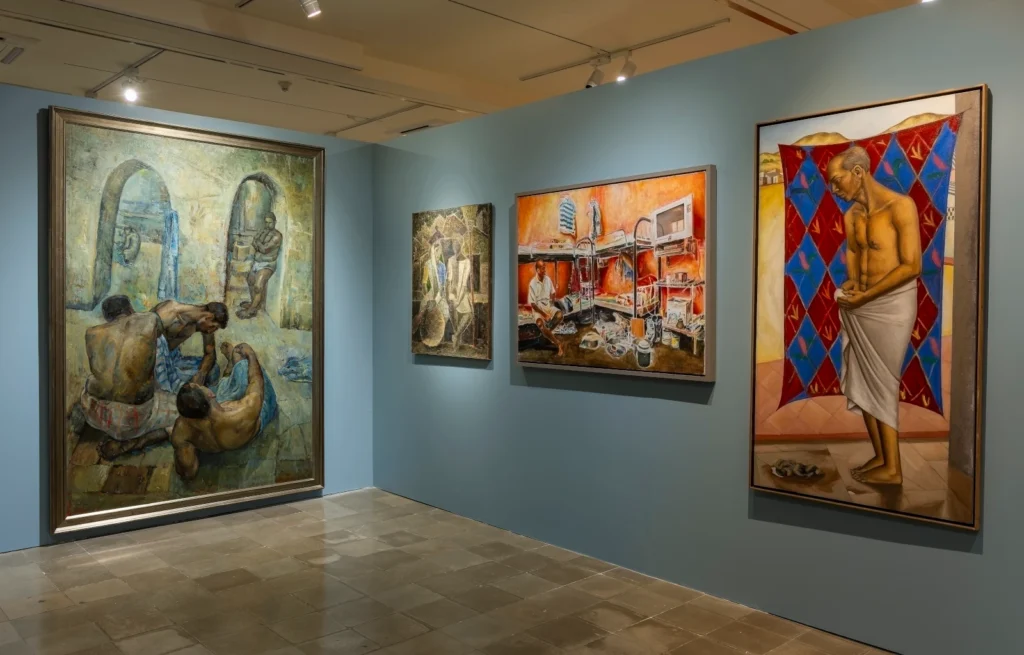
Rather than propose a single narrative, the curators have assembled a set of connections: personal relationships, historical coincidences, institutional links and moments where artists responded to similar problems in different places. The emphasis is on the variety of pathways along which ideas and images travelled. Many of these links have been mentioned in passing in existing scholarship, though rarely explored as a larger field of exchange. The exhibition begins to pull these threads together.
How the selection took shape
The starting point was the Nicholson Collection. Curators Puja Vaish and Suheyla Takesh sifted through the works with an eye for relationships—visual, historical or biographical—that tied Indian artists to those working across the Arab world. Vaish explains, “We approached the selection with an eye toward artistic dialogue between India and the Arab world, tracing shared modernist histories shaped by education, travel, and postcolonial exchange.ˮ
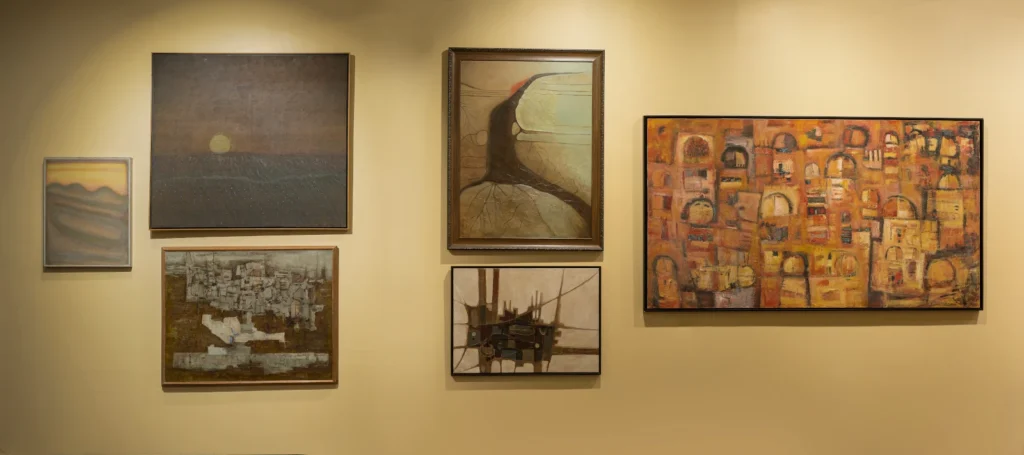
This was paired with a review of the Barjeel collection, which holds a wide range of modern Arab art. The research extended outward from the works themselves to archival catalogues of the Triennale-India, where many Arab artists exhibited from 1968 onwards. Letters, artist interviews, recollections from families and shared experiences of political transition also fed into the curatorsʼ thinking. Gradually, a set of recurring themes emerged: education abroad, long-term mobility, the legacy of empire and the building of new cultural institutions.
Journeys, landscapes and artistic language
Several artists in the exhibition moved between India and the Gulf, leaving visible traces of their journeys in their work. Nasreen Mohamedi, for instance, spent long periods visiting Bahrain and Kuwait, where her father ran a photography equipment business. These trips offered her extended time in desert and coastal landscapes that were quite different from the environments she knew in India. The exhibition presents her drawings from the 1970s, where lines are held in fine balance, at once sparse and highly structured. Her use of drafting tools, grids, measured rhythms and acute spatial attention sits comfortably beside works by Arab artists who were also working through questions of geometry, pattern and abstraction.
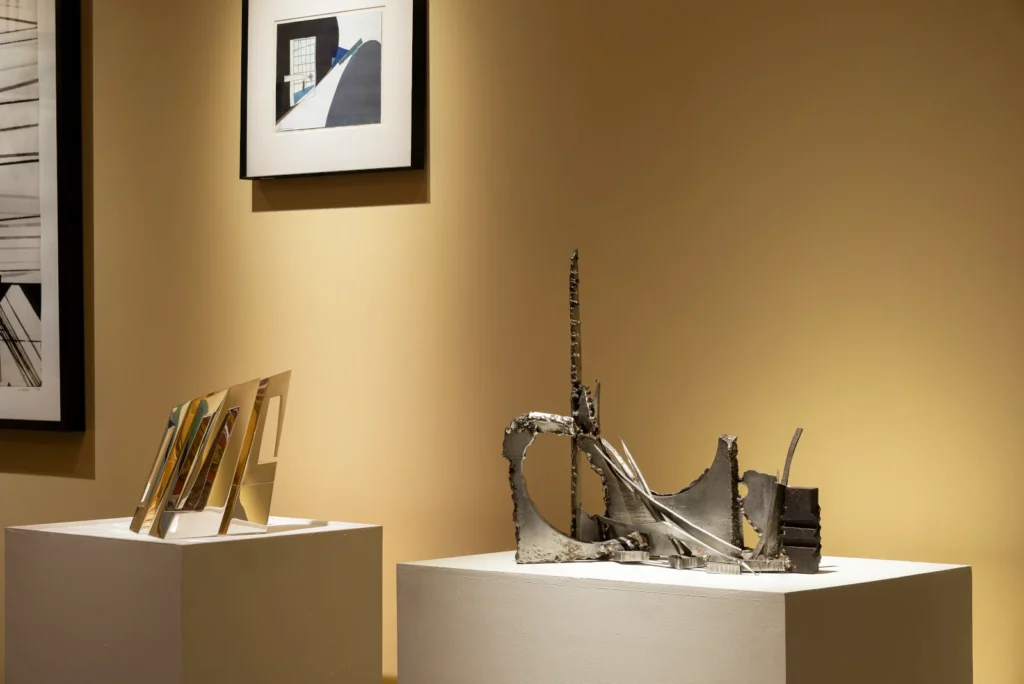
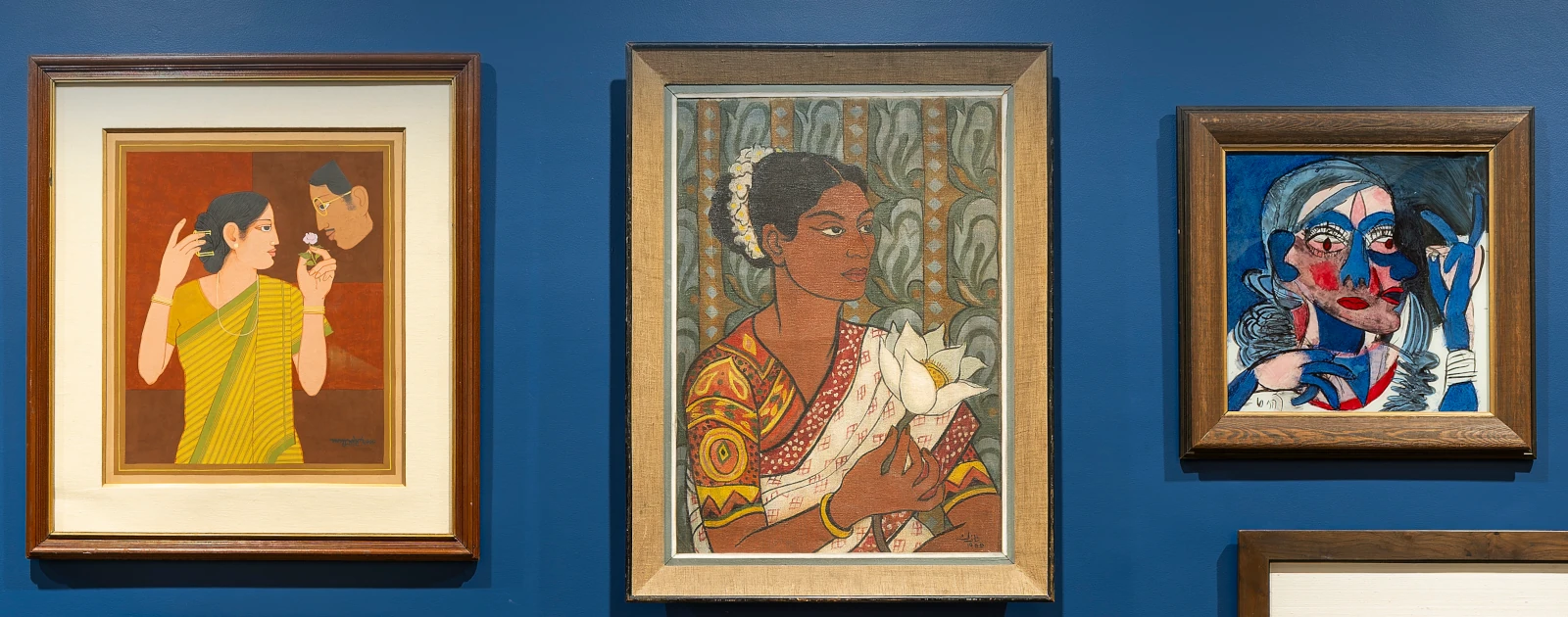
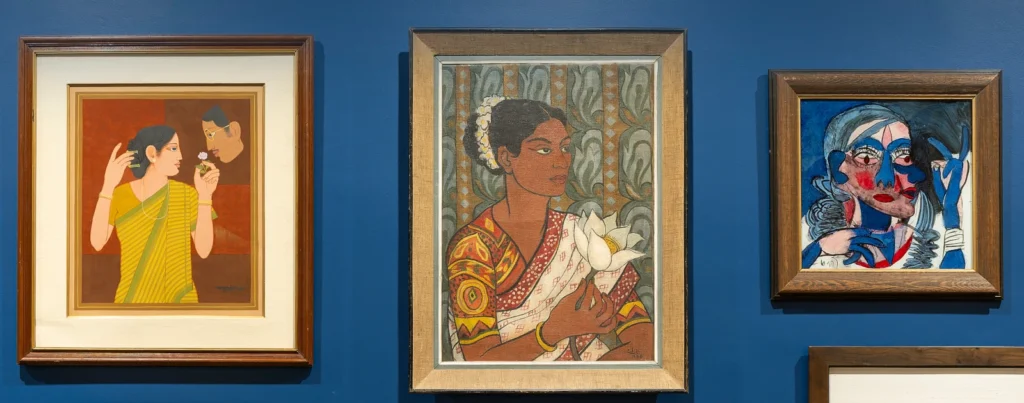
Another figure whose cross-regional travels strongly shaped her work is the Egyptian painter Nazek Hamdi. She studied at Tagoreʼs university and later in Rajasthan on a government scholarship in 1955. Her painting The Lotus Flower (The Lotus Girl) shows a woman in a sari holding a lotus, placing two visual traditions—Egyptian and Indian—in quiet proximity. The exhibition pairs Hamdiʼs work with artists from the Bengal School, which played a formative role in the revival of Asian artistic idioms during the early and mid-twentieth century. The juxtaposition makes it clear how artistic training in India allowed Hamdi to engage with stylistic currents that were circulating widely at the time.
Reading politics across regions
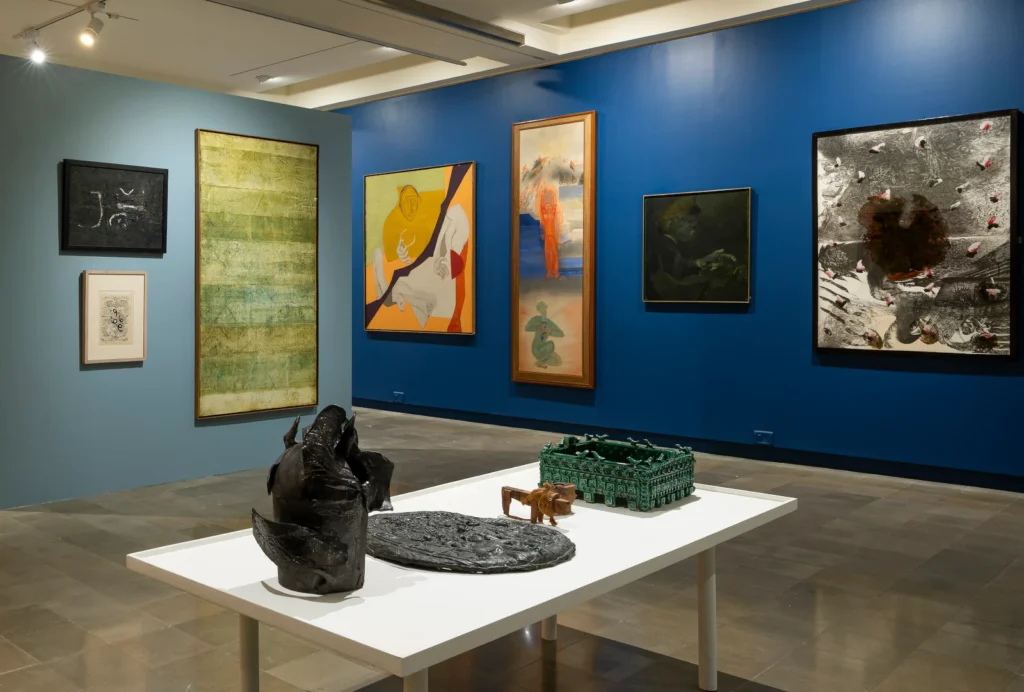
The exhibition brings together works that respond to specific political moments, some distant in time yet still felt in the present. Vivan Sundaramʼs Eclipse (1991), made with charcoal and engine oil, sits at the centre of this strand. The work grew out of the Gulf War, which unfolded on television screens across India. Sundaram did not illustrate the conflict. Instead, he turned to materials whose texture and smell recall industrial waste and burning fuel. The surface feels scorched, unsettled, slightly unstable under the eye. Nearby, works by Arab artists speak to upheavals in their own countries. Seen together, they sketch out a shared climate of anxiety, anger and political reckoning.
Questions around migration appear in a quieter register. Mohamed Kazem shows the cramped room of a South Asian worker in Dubai—a narrow bed, a shelf, a few belongings. Everything is pressed close. The space carries the weight of an entire system of labour that sustains the Gulf yet remains largely invisible. Sudhir Patwardhanʼs painting of a worker in his temporary shelter in Mumbai approaches the same subject from a different angle. His figure leans into the shadows of an improvised structure made from whatever the city has discarded. Both works keep the viewer at a respectful distance. They neither dramatise nor embellish the scene; they simply insist on being looked at, and in doing so draw attention to the movement of people across the Indian Ocean and into rapidly changing cities.
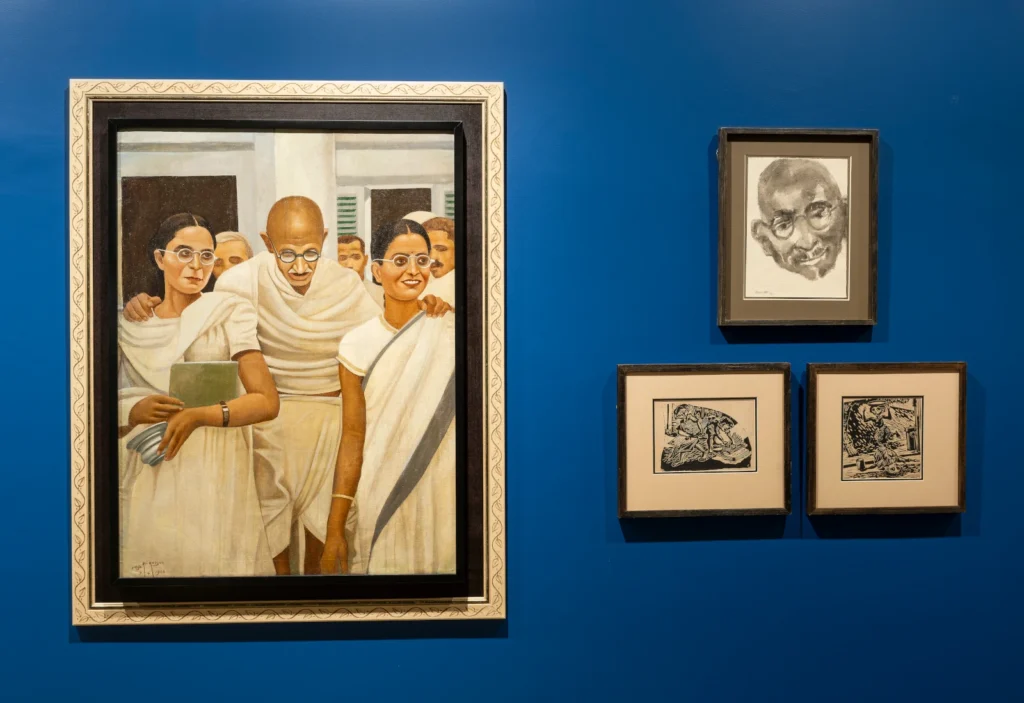
Political figures appear as well, though in varied ways. Gandhi turns up twice—once through an Egyptian artistʼs lens and once through an Indian one—showing how far his image travelled, and how frequently it was recast. A portrait of Gamal Abdel Nasser by a Syrian artist folds in references to India, Africa and Asia, echoing the aspirations of the Non-Aligned Movement. These works remind the viewer that artists across the two regions were alert to one anotherʼs political struggles and ideals.
How the collaboration unfolded
The partnership behind the exhibition began informally. In 2024, Sultan Sooud Al Qassemi of the Barjeel Art Foundation met Dr. Sabyasachi Mukherjee of the CSMVS in Arles. The conversation turned to shared histories, personal ties and the possibility of building a project around them. JNAF came on board soon after, and the curators embarked on a line of research that kept widening. It touched archives, museum stores, artistsʼ families and older catalogues of the Triennale-India, which had drawn Arab artists from its earliest editions.
As Suheyla notes, “One can say that this exhibition is an entry point – an opening into a much larger field of study that continues to unfold. There is still much to discover, analyse and document about the artistic exchanges between India and the Arab world.ˮ This sense of work in progress shapes the exhibition: it offers a view onto a growing set of connections rather than a closed argument.
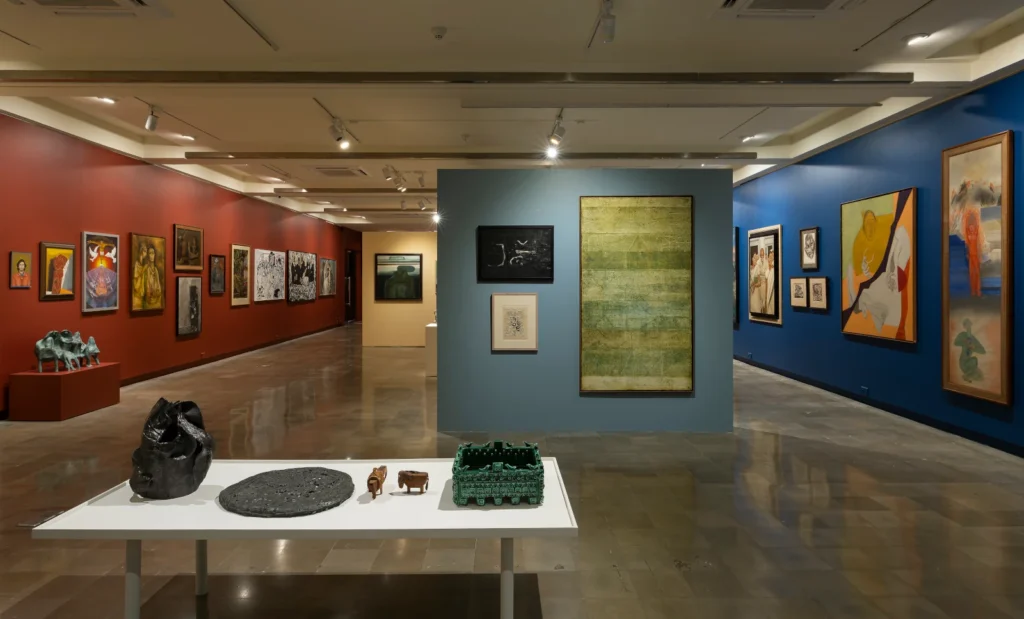
From the Barjeel collection come artists from Bahrain, Egypt, Iraq, Kuwait, Lebanon, Palestine, Syria, Tunisia and the UAE. From the Nicholson Collection come works by several generations of Indian modernists. The aim is not exhaustive coverage. The pieces have been chosen because they bring certain relationships into focus—sometimes by echo, sometimes by contrast.
Viewing modernism through another lens
Placed side by side, these works show how modernism took shape under different pressures and through different lineages. Some artists worked with abstraction that grew out of local landscapes or architectural forms. Others kept returning to the figure as a way to speak about social change. Several drew on older techniques or motifs, not to preserve them but to test what they could become in the present.
Showing these works together shifts the ground slightly. Rather than viewing modernism through its familiar Euro–American trajectory, the exhibition asks the visitor to pay attention to how artists in India and the Arab world developed their own vocabularies while staying aware of wider debates. The exhibition does not try to smooth out these differences. It allows them to sit alongside one another and lets their edges show.
A wider landscape of artistic voices
The exhibition includes well-known names and others who are less prominent in standard narratives. The range of materials is wide—painting, drawing, printmaking, mixed media—and the works vary in tone. Some are restrained and meditative; others speak plainly about political urgency or social unrest. Many reveal careful handling of materials, whether ink worked into delicate lines or industrial substances pushed into new expressive roles.
The pairings are meant to encourage looking rather than imply direct influence. The curators offer a set of vantage points from which viewers can notice overlaps—shared motifs, similar compositional decisions, or parallel subjects approached from different starting points. The intention is to keep the field open, to allow the works to complicate one another rather than collapse them into a single narrative.
Looking ahead
In bringing these works together, Resonant Histories opens a space that invites further study. It shows what is possible when collections are allowed to speak to one another across regions, and it lays the groundwork for future research into modernisms that developed outside the more frequently cited centres. The exhibition also draws attention to the artists whose practices unfolded along routes that do not neatly fit established art-historical lines.
As institutions continue to rethink how to present modern art, projects like this encourage a shift towards narratives that acknowledge movement, exchange and multiple centres of activity. The exhibition does not try to settle these histories. It simply gathers the materials that allow them to be seen more clearly.
The result is a grounded, thoughtful presentation of artistic crossings that have shaped the visual cultures of India and the Arab world—connections formed through study, migration, political engagement and the steady movement of people and ideas across the twentieth century.
Resonant Histories: India and the Arab World is on view till February 15, 2026, at the Jehangir Nicholson Art Foundation, CSMVS, Mumbai.