

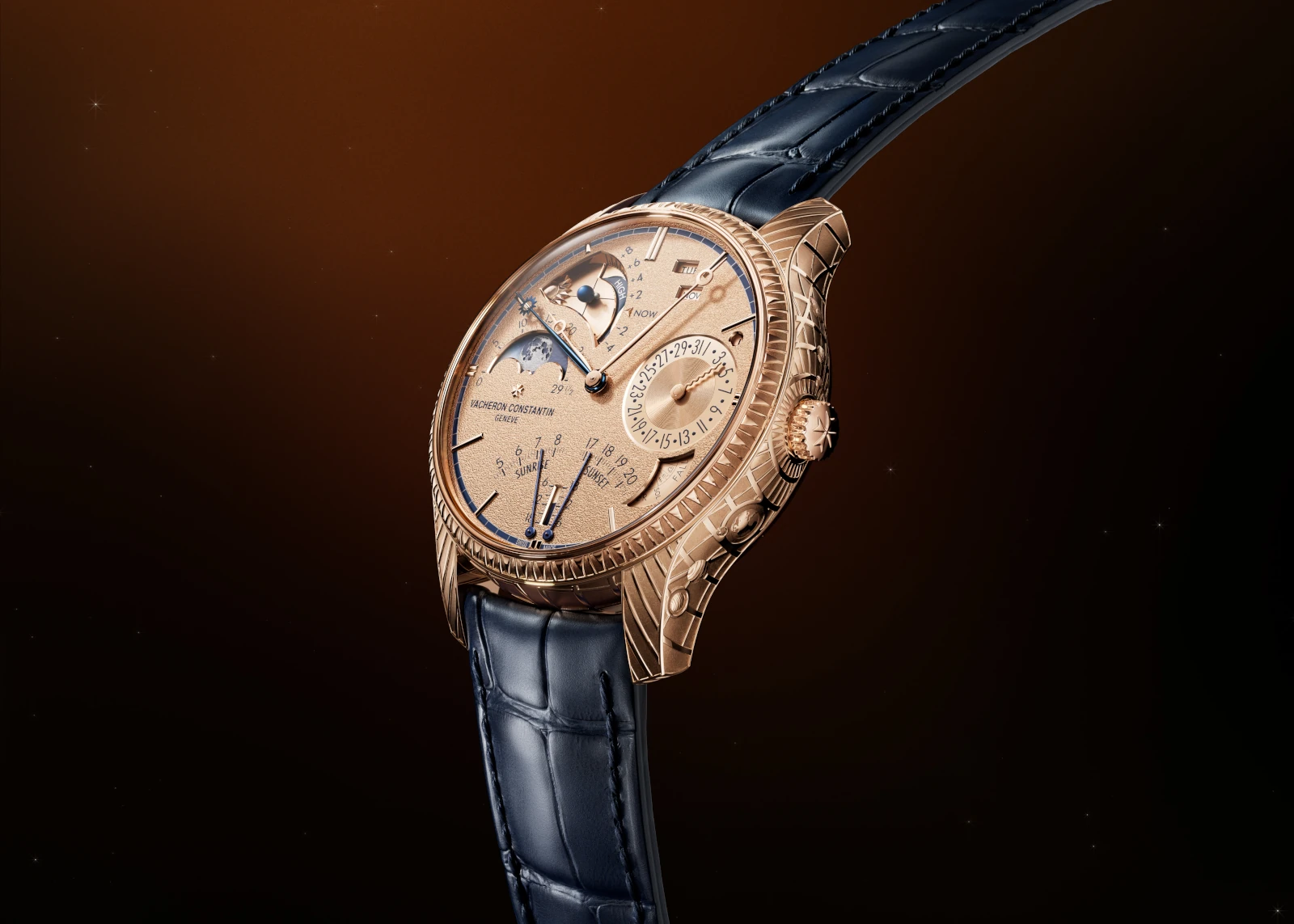
Watchmaking has always borrowed from astronomy. Both disciplines share a fundamental obsession with measuring time through celestial movement, tracking moons, suns and stars across dials that attempt to compress the cosmos into something wearable. But few manufacturers have committed to this relationship as deeply as Vacheron Constantin, and the brand’s latest creations prove that point with unusual clarity.
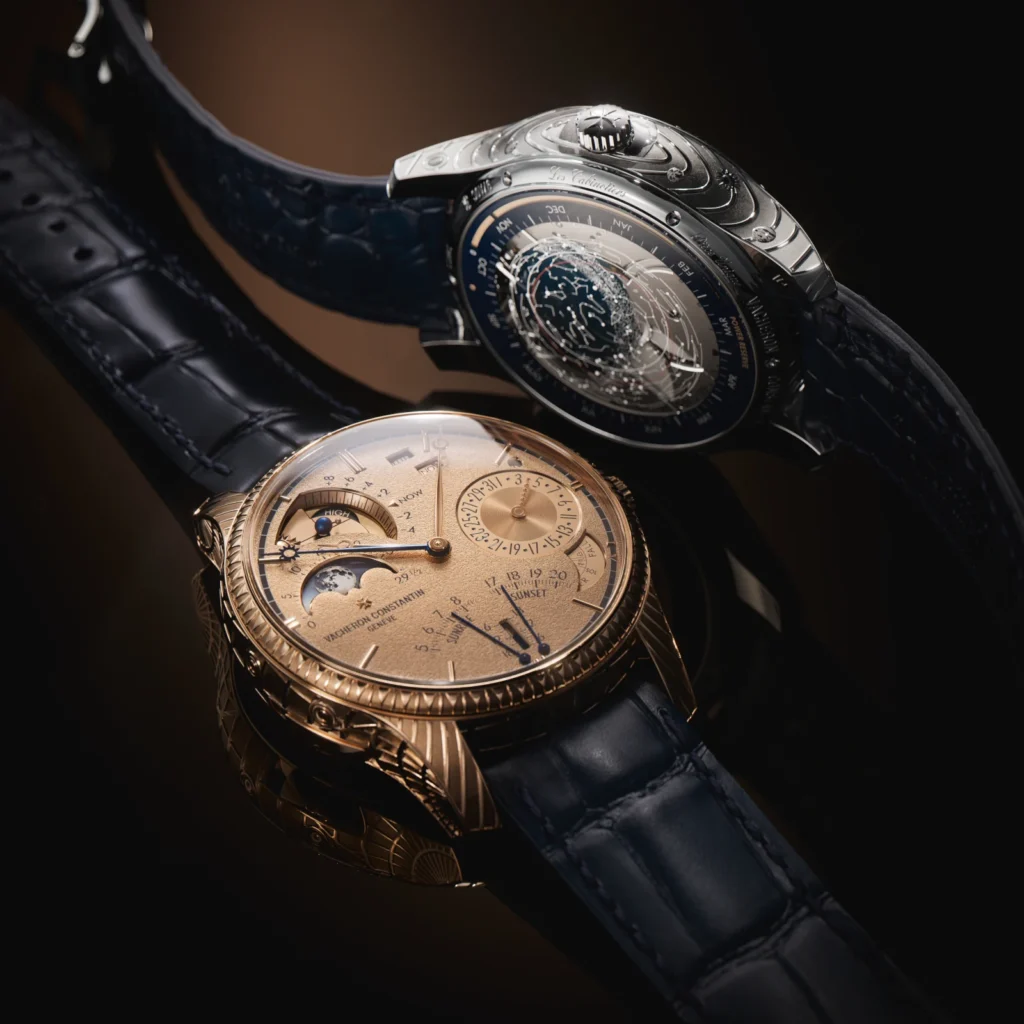
Geneva’s oldest continuously operating watchmaker has unveiled two single-piece editions of its Celestia Astronomical Grand Complication as part of its 270th anniversary celebrations. These aren’t variations on a theme. They’re philosophical opposites, each honoring a distinct model of how the universe operates.
One pays tribute to Ptolemy’s geocentric system, which placed Earth at its center. Another celebrates Copernicus’ heliocentric revolution, which dethroned our planet and positioned the Sun as the cosmic anchor point. It’s a bold choice, honoring two fundamentally incompatible worldviews on equal terms.
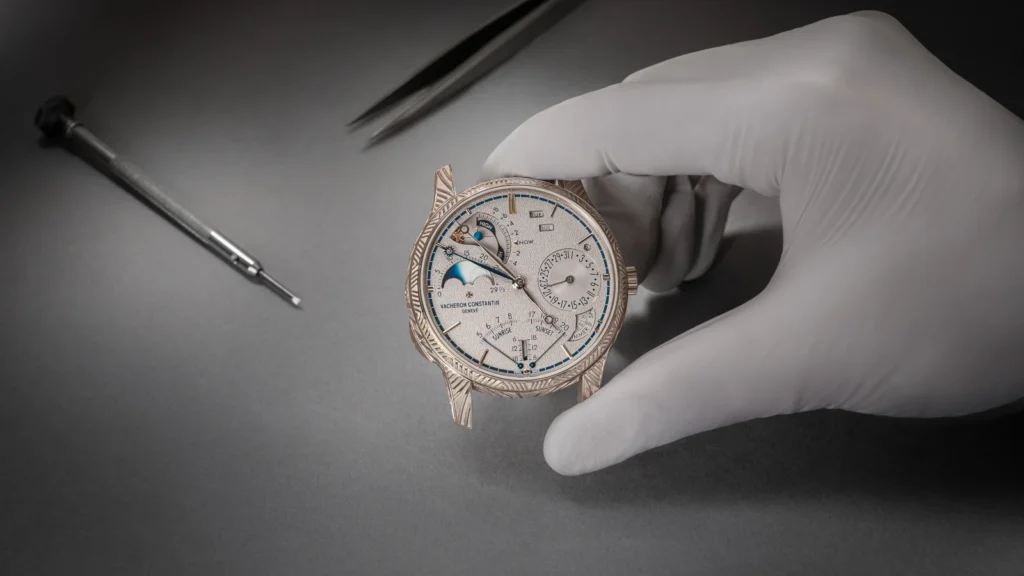
Both watches run on Calibre 3600, a double-sided movement that took five years to develop and incorporates 514 components into an 8.7mm case thickness. Each watch displays 23 astronomical complications, a number that goes beyond typical haute horlogerie bragging rights and enters genuine technical achievement territory.

Front dials handle civil time and solar time through central openworked hands, but their relationship is more complex than it appears. Earth’s elliptical orbit around the Sun and its 24-degree axial tilt mean that solar days vary slightly throughout the year.
This difference between true solar time and our standardized 24-hour day, called the equation of time, ranges from minus 16 to plus 14 minutes depending on the season. Vacheron Constantin’s calibre represents that differential as a running equation of time, with a sun-tipped minute hand moving coaxially with civil time hands, advancing or falling behind as the year progresses.
It’s worth noting that equation of time complications have appeared in high-end watchmaking before, but displaying it as a running equation, where both times are instantly readable on coaxial hands, remains relatively rare. Most manufacturers opt for simpler representations using subdials or apertures.
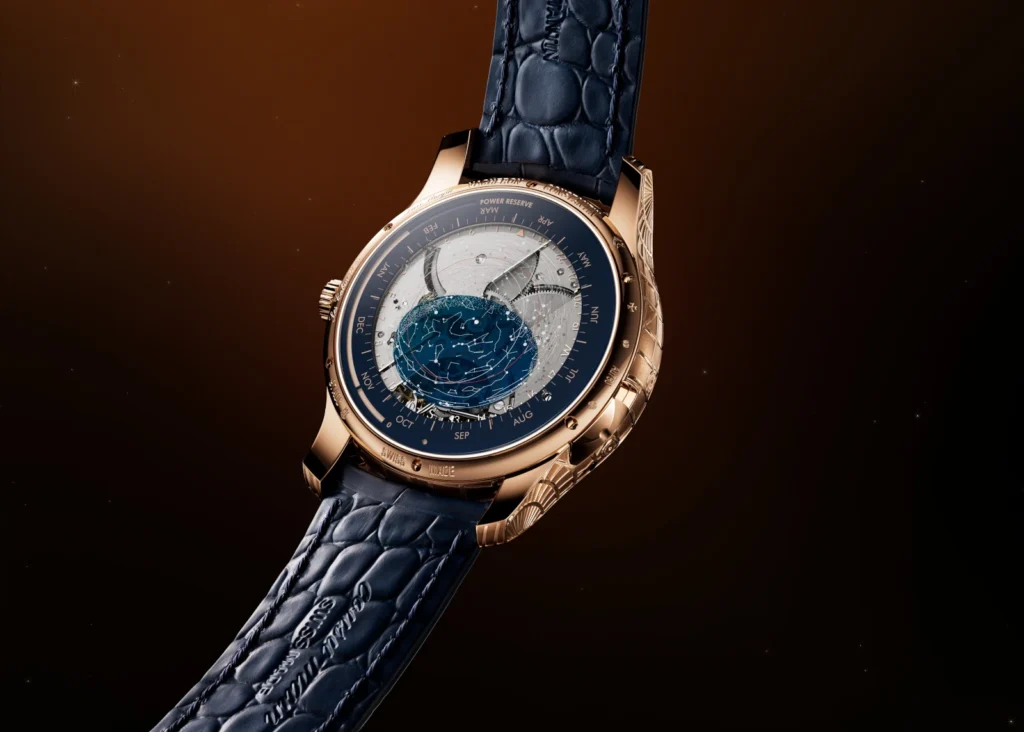
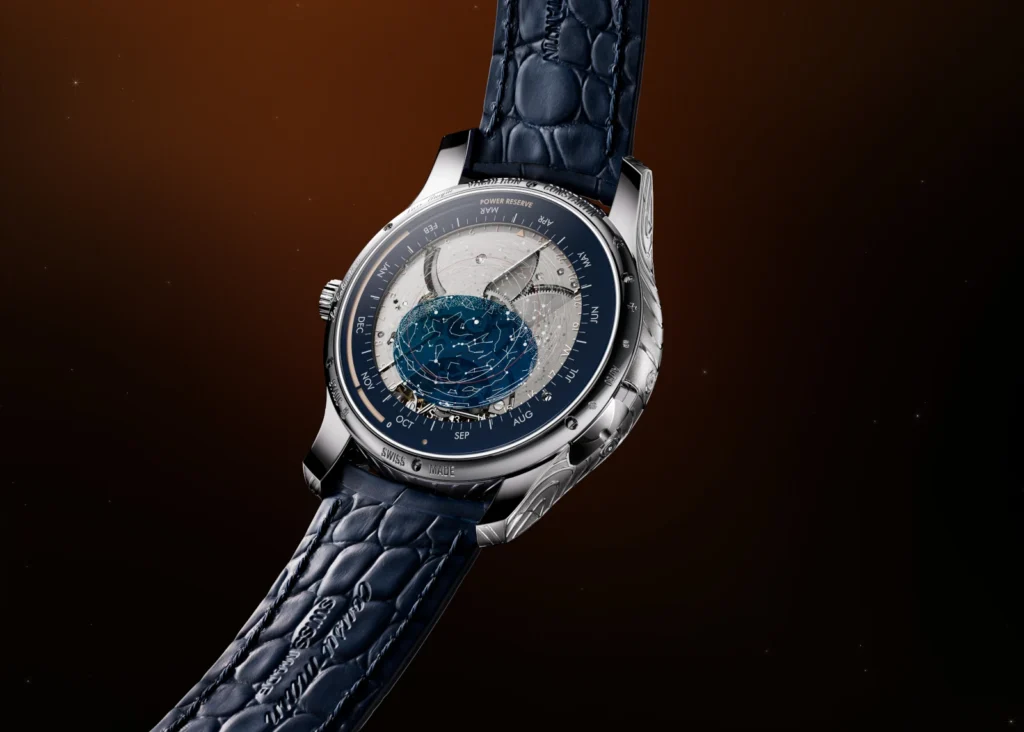
Flip either watch over and the back reveals sidereal time through a celestial map formed by two superimposed sapphire discs. A fixed upper disc marks constellations while a mobile lower disc rotates four minutes faster than civil time each day, reflecting the fact that a full 360-degree rotation relative to a distant star takes 23 hours, 56 minutes, and 4 seconds, not the 24 hours we use for daily life.
An off-center blue ellipse on the rotating disc indicates which constellations are visible from your location in real time, with white and red elliptical lines marking the celestial equator and ecliptic plane respectively. It’s a constantly changing astral map that actually works as an observational tool, not just decoration.
Front dials also display a perpetual calendar programmed until 2100, showing days and months in windows at 1 o’clock and leap years in a small circular window above a date counter at 3 o’clock. A precision moon phase indicator at 9 o’clock requires adjustment only once every 122 years.

Below this sits a display for sunrise and sunset times with graduated scales, plus a gauge showing the length of day and night. A rotating annual disc at 4 o’clock bears zodiac signs, seasons, solstices, and equinoxes. At 11 o’clock, a mareoscope combines a tidal level indicator with a three-dimensional representation of Earth-Moon-Sun alignment. Mareoscopes remain genuinely rare in watchmaking. Most brands stick to moon phases and leave the tides alone.
The backs also house a one-minute tourbillon shaped like Vacheron Constantin’s Maltese cross emblem, positioned there deliberately to preserve space for astronomical indications on the front. Six barrels mounted in series provide three weeks of power reserve, indicated by a peripheral display surrounding the celestial map.
Technical specifications only tell half the story. Cases themselves function as philosophical statements, hand-engraved to illustrate each astronomer’s cosmological model. The audacious Ptolemy’s edition features a planisphere with Earth surrounded by planetary orbits that extend from the crown across the bezel and lugs. Copernicus’ version positions the crown as the Sun, with rays radiating outward and planets moving through their heliocentric orbits.
Both pieces use champlevé engraving, where a master engraver hollows out spaces between planetary trajectories to depths of 1/10th of a millimeter on the bezel and 2/10ths on the case and lugs. Ptolemy’s piece presented challenges in maintaining symmetry across multiple case components so elliptical orbits appear continuous with no visual breaks.
Copernicus’ design offered a different problem: geometric centers of the planetary orbits fall outside the case frame on the left side, requiring a specially designed tool to draw circular arcs with a compass on the curved surface.
Planets themselves are engraved in relief, subtly domed and finely textured to reproduce their cosmic appearance. On Ptolemy’s watch, Earth features hand-polished continents in relief. Hollowed areas are finely hand-chased to create a sandblasted appearance that contrasts sharply with polished ellipses and ridges on the surface.
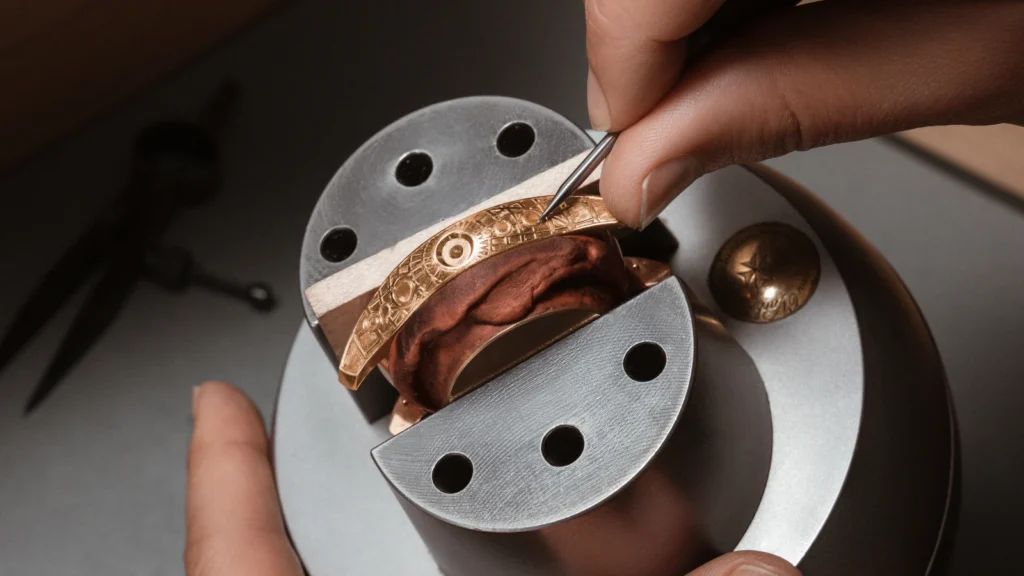
Each watch represents 240 hours of engraving work, equating to six full working weeks spent on case decoration alone. This level of case decoration aligns with Vacheron Constantin’s long-standing commitment to métiers d’art, a practice the manufacture has maintained consistently since the 18th century. And champlevé engraving, used here, is among the most technically demanding decorative techniques, requiring absolute precision since mistakes cannot be corrected on already-hollowed surfaces.
It’s also worth considering how these pieces fit into Vacheron Constantin’s broader 270th anniversary strategy. Earlier this year, the manufacturer unveiled Les Cabinotiers Minute Repeater Tourbillon, Split-Seconds Monopusher Chronograph, a piece that combined three major complications into a single movement. That watch also featured extensive hand-engraving and represented a single-piece commission.
Vacheron Constantin appears to be using its anniversary year not to launch mass-market collections but to demonstrate technical mastery through bespoke, highly complicated pieces.
These 2025 versions belong to Les Cabinotiers ‘La Quête’ series, a collection dedicated to astronomy and ancient odysseys.
Christian Selmoni, Director of Style and Patrimony, said, “The launch of the Celestia in 2017 followed two years after that of the Reference 57260, a legendary pocket watch celebrating Vacheron Constantin’s 260th anniversary. The aim was to create a wristwatch that brought together all of the Maison’s expertise in astronomical functions, not only in terms of complications but also miniaturization. It took five years of development to achieve this. In this sense, the Celestia watch, with its 23 complications integrated into the 8.7 mm-thick Calibre 3600, set a new milestone in the long story linking Vacheron Constantin to astronomy and won the award for Mechanical Exception at the Grand Prix d’Horlogerie de Genève 2017. This technical mastery, confirmed by the Geneva Hallmark, is the foundation on which the new 2025 Les Cabinotiers ‘La Quête’ series, a collection dedicated to astronomy, is based.”
Single-piece editions have become increasingly common among major manufactures as they chase collectors willing to pay for absolute uniqueness. Patek Philippe, Audemars Piguet, and Vacheron Constantin have all expanded their bespoke departments in recent years, recognizing that ultra-high-net-worth collectors want watches that literally cannot be replicated.
Ptolemy’s model dominated human thinking for 1,500 years before Copernicus revived Aristarchus of Samos’ forgotten heliocentric theory from the 3rd century BC. Both men were wrong in different ways, Ptolemy because Earth doesn’t sit motionless while everything revolves around it, Copernicus because his circular orbits didn’t account for elliptical planetary motion that Kepler would later identify. Yet both contributed foundational work toward our eventual understanding of celestial mechanics.
Creating watches that honor both perspectives without privileging one over the other suggests a willingness to engage with watchmaking history as something more than technical evolution. Vacheron Constantin has spent 270 years building its reputation on precision and craftsmanship, but these pieces suggest the brand understands that complications can carry intellectual weight beyond their mechanical function. Whether that philosophical dimension resonates with collectors or simply serves as sophisticated marketing remains to be seen, but for a manufacturer that has survived nearly three centuries, taking the long view seems appropriate.