
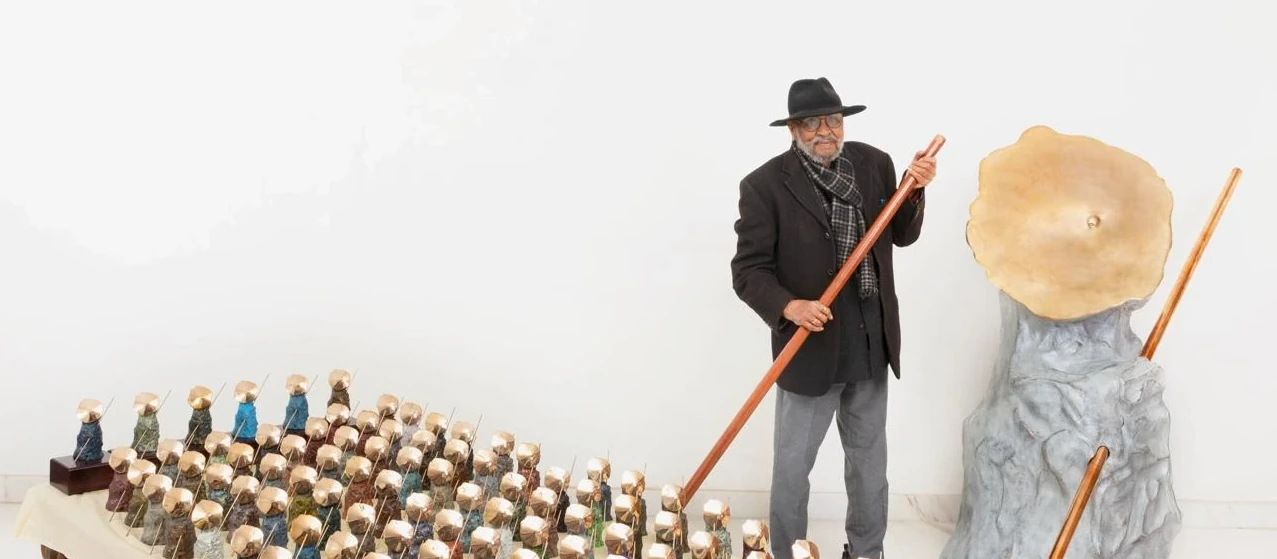
The passing of Himmat Shah in March 2025 marks the departure of an artist who defied convention and shaped the narrative of Indian modernism in his own inimitable way. To speak of Shah is to speak of a relentless explorer—one who sought to carve his own path, both literally and metaphorically, through the textures of bronze, terracotta, and burnt paper. His artistic journey was not just about creating; it was about questioning, deconstructing, and rebuilding forms that resonated with the echoes of history and the rawness of human experience.

Born in 1933 in Lothal, Gujarat—an ancient Indus Valley site—Shah carried the weight of history in his subconscious. It is no surprise that his work often felt like unearthed relics from a lost civilization, infused with a primal force that transcended time. His elongated, abstracted human heads bore silent witness to the cycles of existence, capturing the frailty and resilience of mankind in equal measure. Shah was not one to chase aesthetic perfection; instead, he sought the truth in imperfection, in the rough edges, the cracks, the unfinished forms that spoke louder than polished surfaces ever could.
His early years were marked by restless experimentation. Training at the Faculty of Fine Arts, MS University, Baroda, and later at Atelier 17 in Paris, Shah imbibed diverse influences, yet remained unwavering in his individuality. His affiliation with Group 1890, the short-lived but radical collective that sought to redefine Indian modernism, was a reflection of his defiance against artistic stagnation. Even as the group dissolved, Shah’s conviction only grew stronger—his work became more introspective, more visceral.

Shah never sought the limelight, yet recognition inevitably found him.
While his drawings, particularly his hauntingly delicate burnt paper works, revealed his sensitivity to line and space, it was in sculpture that he found his truest expression. His bronzes and terracotta heads, rugged and raw, seemed to emerge from the very earth itself—weathered, timeless, enigmatic. They were not just objects of art; they were carriers of memory, embodiments of a deeper consciousness that connected the ancient to the contemporary.
Shah never sought the limelight, yet recognition inevitably found him. His retrospectives at the Kiran Nadar Museum of Art (KNMA) and Lalit Kala Akademi cemented his legacy, offering audiences a rare glimpse into the evolution of a fiercely independent artistic mind. Awards such as the Kalidas Samman and the Lalit Kala Akademi Award followed, but for Shah, these were mere footnotes to his larger pursuit—the unending dialogue between form and void.

His passing is an irreplaceable loss, but his spirit lingers in every contour of his sculptures, in the shadows of his burnt drawings, in the silences his works command. Himmat Shah was not just an artist; he was a seeker, a provocateur, a storyteller who sculpted the intangible. His art does not just exist—it converses, it provokes, it breathes. And in that breath, his legacy endures.
*Himmat Shah passed away on March 2, at the age of 91.