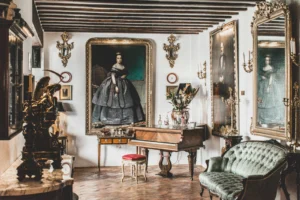

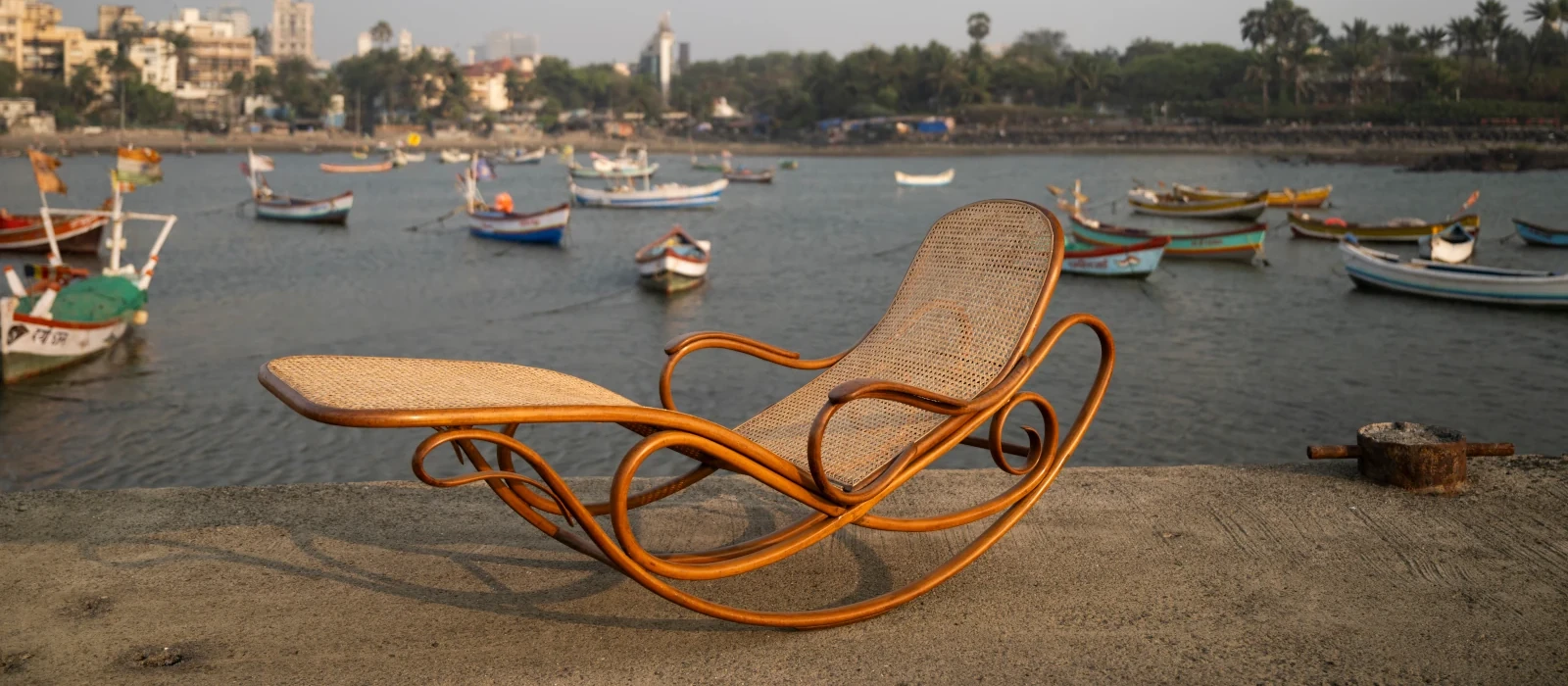
History usually arrives as a stack of paper. Letters, manifestos, land records, court rulings, speeches. The assumption is that if you want to understand the past, you read it. But objects have their own way of keeping score.
Archaeologists reconstruct entire civilisations from pottery shards and bones. Museums increasingly build exhibitions around everyday artefacts rather than famous paintings. Scholars have even argued that objects can function as historical evidence in their own right, capable of revealing connections between people, places and ideas that written archives often miss. The Harvard project behind Tangible Things explored this idea by examining how ordinary objects accumulate stories through use and movement across time. Researchers working in object-based history have made similar claims, pointing out that material culture can track shifts in trade, craftsmanship and social life with remarkable precision. A spoon, a coin, a garment, or a chair, can sometimes tell you more about a moment than a document ever could.
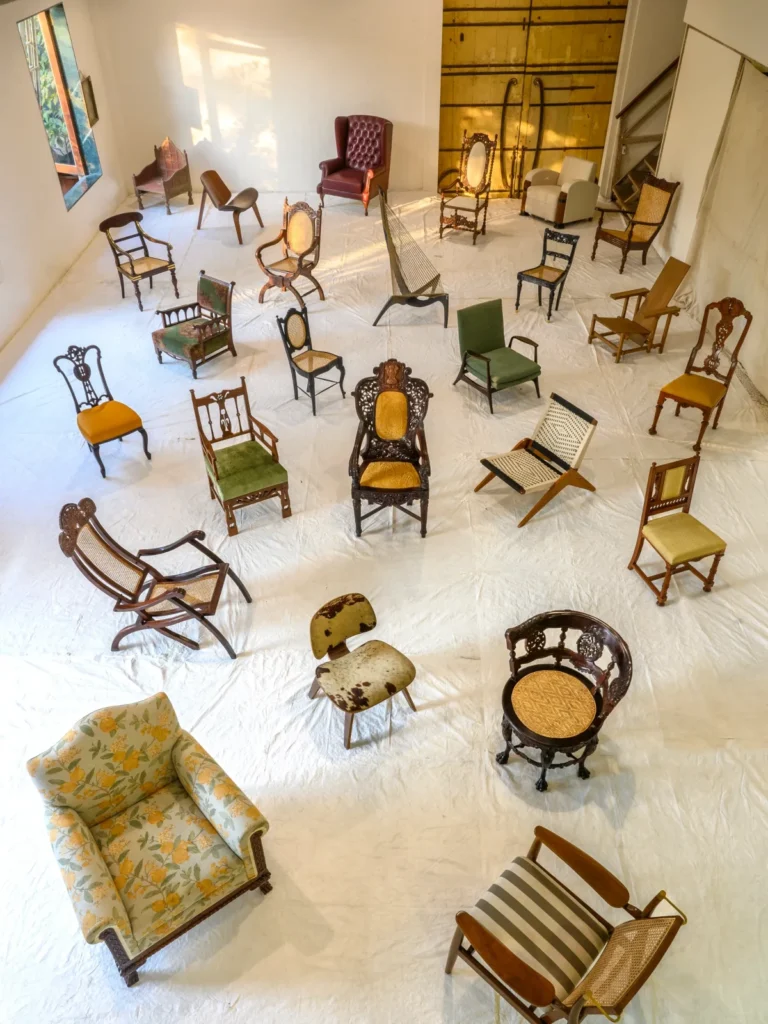
I started thinking about this while walking through the House of Mahendra Doshi in Wadala, Mumbai, which recently hosted an exhibition called “History of India Through Chairs”. The premise sounds almost mischievous at first. Chairs? As history? But after about 10 minutes inside the showroom, the idea stops feeling gimmicky and begins to feel obvious. Chairs are among the most physically intimate objects we own. They support the body, signal hierarchy, organise rooms and dictate how people interact with each other. They also travel. Designs move between continents, craftsmen reinterpret foreign styles, materials change depending on where the object is made. Follow the chair carefully enough and you begin to notice a cultural evolution unfolding in slow motion.
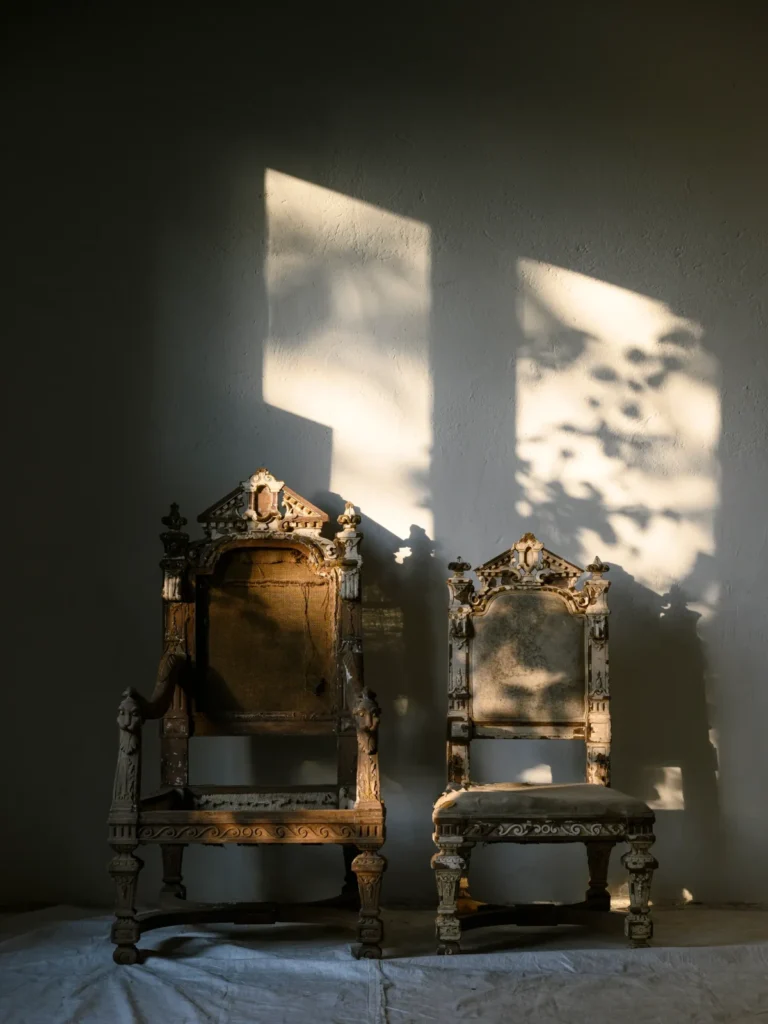
The collection itself began more than 50 years ago with the late Mahendra Doshi, a collector whose instincts ran slightly against the grain of conventional furniture collecting. He was not primarily interested in polished antiques arranged for display. He was interested in the objects that had survived real life. Anand Gandhi, Doshi’s cousin, joined him in 1994 and remembers that the project was never simply about acquiring beautiful pieces. “Whatever Mahendra collected was always more than just collecting furniture,” he says. “It was always also about preserving a piece of our heritage.”
One of the first things I noticed walking through the exhibition is how radically the idea of sitting has changed over time.
Chairs in particular fascinated Doshi because they lived such hard lives inside homes. They were dragged across floors, repaired, sat on by generations of people. “They were the most abused pieces of furniture in the house,” Gandhi tells me, laughing slightly. “Restoring them was a great challenge.” What began as a fascination with restoration slowly turned into something else: an archive of Indian social history told through seating.
One of the first things I noticed walking through the exhibition is how radically the idea of sitting has changed over time. Pre-colonial India had its own traditions of seating, many of which involved the floor. Mats, low platforms and bolsters structured domestic spaces in ways that feel very different from the dining table and chair arrangements many of us are used to today.
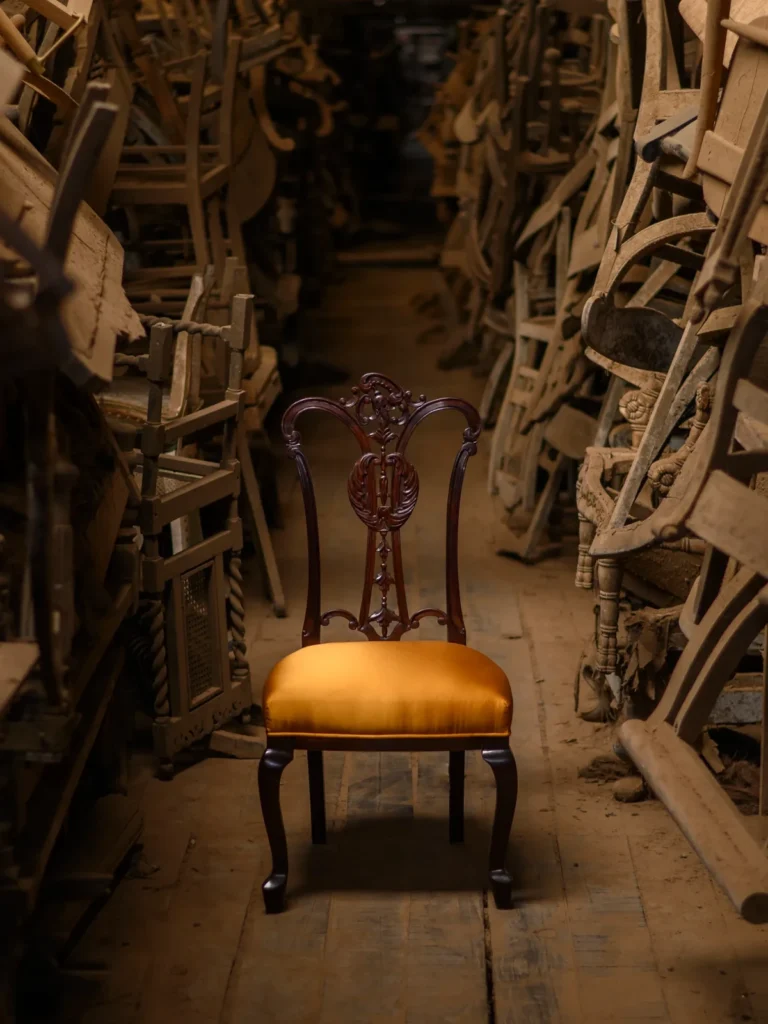
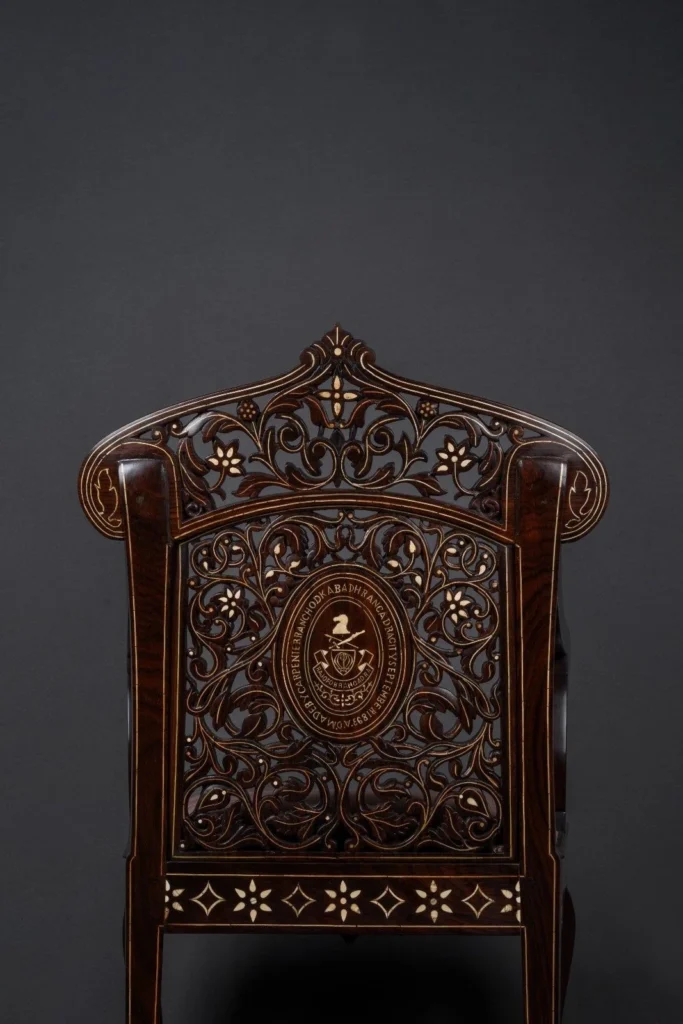
Colonial encounters shifted that arrangement quite dramatically. Gandhi points to a group of Indo-Portuguese chairs as the moment when the European concept of elevated seating began to appear more regularly in Indian interiors. “I’ve always been enamoured by the Indo Portuguese era chairs,” he says. “That was more or less the first time the concept of elevated seating with tables was introduced to our country.” One particular piece in the exhibition, a rosewood Goan bishop’s chair, makes the point immediately. The back rises high, the carving is elaborate, and the entire form feels authoritative. It is not the sort of chair you sink casually into. Gandhi describes it plainly: “The rosewood Indo Portuguese Goan Bishops chair is a good example of how chairs were used to demonstrate hierarchy, status and power.” In other words, furniture was not just about comfort. It organised social order.
Every now and then an object in the exhibition offered a little jolt of recognition, the kind that makes you realise how much history a piece of wood can carry. One chair has a headrest where a European coat of arms used to sit. The carving has been roughly removed and replaced with the Ashoka emblem. Gandhi explains that the chair likely belonged to a Portuguese or Catholic official during the colonial period before finding its way into the offices of the newly formed Indian government after independence. “We believe the original emblem was chiselled out and replaced,” he says. “This is a great example of how a chair can reflect the socio cultural transitions in our history.” Standing there, the alteration feels almost cinematic. The scar in the wood marks a political transformation more vividly than a paragraph in a textbook.
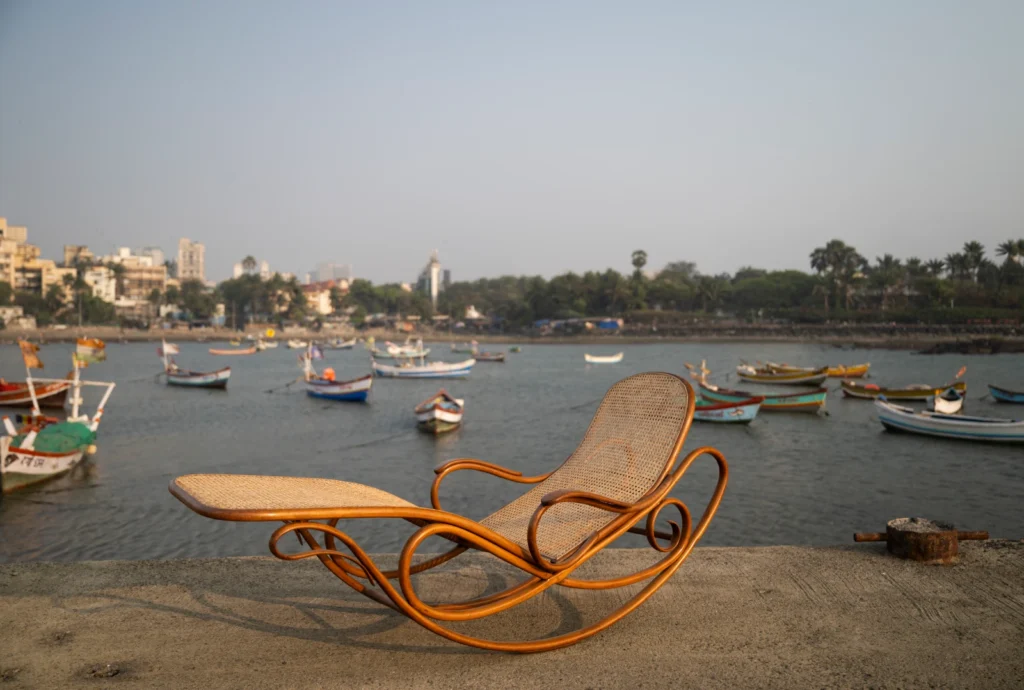
The exhibition exists today largely because the Doshi family decided to continue Mahendra Doshi’s work rather than simply preserve it. Chiki Doshi, who joined her uncle in the mid-1990s, speaks about the collection less like a set of possessions and more like a responsibility that has been passed down. “For me, thoughtful stewardship is about continuity,” she says. “We are the custodians of these treasures.” That custodianship shapes how the objects are restored and displayed. The goal is never to make a chair look new. Age matters. Wear matters. “Restoration for us is guided by restraint,” Doshi explains. “We intervene only to stabilise and protect. It is never to erase age or character.”
…furniture historically reflected trade routes, regional identities and colonial exchange alongside craftsmanship.
Anyone who has seen antique furniture sanded into glossy anonymity will understand the concern. “Over-restoring can erase history,” she says. The philosophy is something she absorbed directly from watching her uncle work. “I remember watching him study craftsmanship and speak about provenance with care. Those moments shaped how I see objects today.” Listening to her, you realise the exhibition is not just about chairs but about the transmission of knowledge across generations.
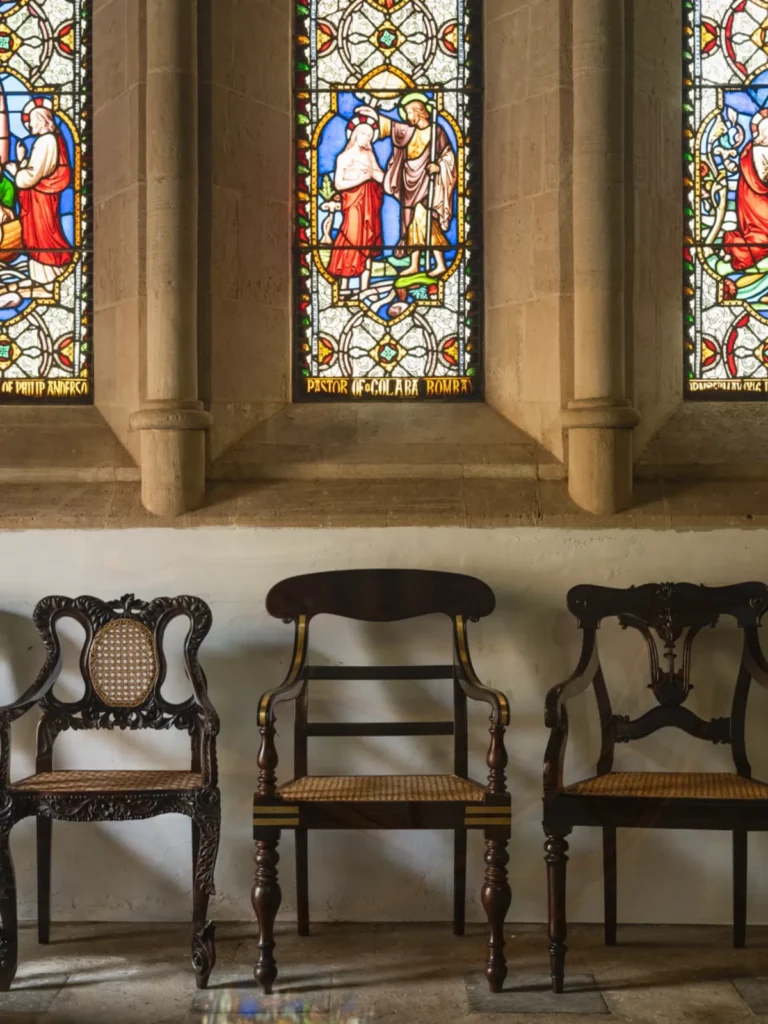
The collection is also a record of cultural exchange. Some of the most beautiful pieces emerge from moments when European design traditions collided with Indian craftsmanship and produced something entirely new. Doshi mentions the Ceylonese Dutch Burgomaster chairs as a favourite example. These pieces combine European silhouettes with local woods and carving styles, the result of Dutch colonial aesthetics meeting Indian artisanal skill. “They blend European forms with local materials and carving traditions,” she says. Look closely and you can see the conversation happening in the details: a recognisably European structure embellished with motifs that feel unmistakably Indian. Doshi believes this layered history often goes unrecognised. “India’s material culture is far more sophisticated than we often acknowledge,” she says, adding that furniture historically reflected trade routes, regional identities and colonial exchange alongside craftsmanship.
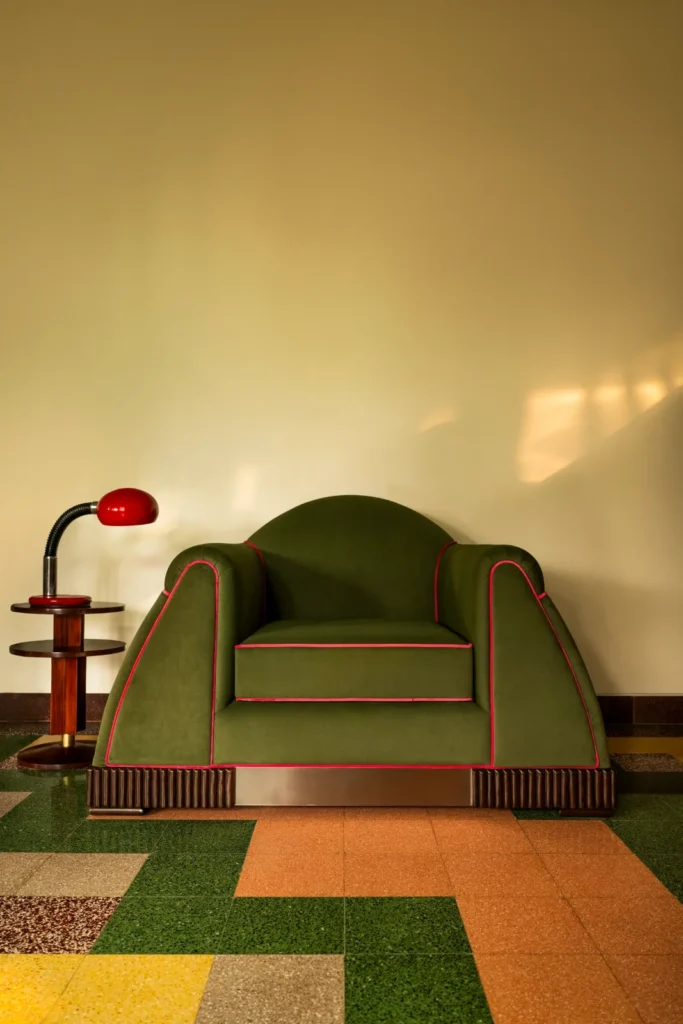
The team behind the exhibition made a conscious decision not to overwhelm the objects with elaborate staging. Vivek Gandhi, who handled the art direction, says the goal was to give the chairs enough space to speak for themselves. When he talks about them, he rattles off details that most visitors might initially miss: the curve of an armrest, the slope of a back, the angle of the legs, the type of wood, the decision to use cane rather than upholstery. “All these decisions were made in conversation with the culture of their time and place,” he explains. His approach was to situate the chairs historically and then step back. The exhibition moves chronologically through pre-colonial traditions, the Portuguese and Dutch periods, British and French influences, and eventually into twentieth-century movements like Art Deco and mid-century modernism. Gandhi describes the experience as a kind of time travel. “From the start we wanted it to feel like a museum experience,” he says, “but a soulful one.”
Architect Supriya Gandhi translated that idea into the spatial design of the exhibition. The warehouse layout at Wadala actually helped structure the narrative. Visitors begin in a double-height entrance hall devoted to pre-colonial seating traditions and then move into the larger warehouse space where colonial-era furniture unfolds period by period. The progression happens almost without you noticing it. Gandhi says the intention was to encourage visitors to slow down. Chairs appear at different heights so that carvings and joinery can be examined at eye level. Circulation routes encourage people to walk around certain pieces rather than glance and move on. “We want visitors to practise slow looking,” she says, explaining that many of the chairs reward careful attention to small handcrafted details.
One object in particular required a bit of ingenuity to display properly. The Moti chair, located in the pre-colonial section, features intricate beadwork patterns that wrap around its surface. The challenge was how to present it in a vast entrance hall without letting the scale of the room swallow it. The eventual solution involved designing a custom pedestal that allows the chair to rotate slowly. Visitors can stand at eye level and gently turn it, examining the beadwork from every angle. Gandhi says the process taught her something about exhibition design itself: how to guide curiosity without forcing it.
Walking through the show, I kept thinking about how easily objects slip past our attention in everyday life. Chairs in particular are so familiar that we rarely consider them as designed artefacts. We sit, stand, move on. Yet historians who work with objects often insist that everyday things contain extraordinary amounts of information if you are willing to look closely enough. Projects like A History of India through 75 Objects have shown how artefacts ranging from ancient tools to modern advertisements can illuminate political and cultural shifts across centuries. The same principle applies here, except the narrative unfolds through a single form repeated again and again.
By the time I reached the later sections of the exhibition, filled with Art Deco and mid-century pieces, the chairs started to feel almost like characters in a long story. Each one carried the imprint of the time that produced it: colonial ambition, artisanal adaptation, modernist optimism. None of them were originally intended as historical documents. They were simply made to be used.
And yet here they are, decades or centuries later, explaining how a society changed. The lesson is surprisingly comforting. History does not live only in libraries and archives. Sometimes it sits right in front of you, waiting patiently, asking for nothing more than a place to rest.